Meet Our Tutors
Meet Our Tutors
Reviews
UNIT
5
UNIT
5
Electromagnetic Induction
Electromagnetic Induction
Understand how changing magnetic fields generate electric fields through electromagnetic induction. This formula sheet summarizes magnetic flux, Faraday’s Law, Lenz’s Law, inductance, and LR circuits, providing the essential concepts for solving induction and electromagnetism problems.
Understand how changing magnetic fields generate electric fields through electromagnetic induction. This formula sheet summarizes magnetic flux, Faraday’s Law, Lenz’s Law, inductance, and LR circuits, providing the essential concepts for solving induction and electromagnetism problems.
Understand how changing magnetic fields generate electric fields through electromagnetic induction. This formula sheet summarizes magnetic flux, Faraday’s Law, Lenz’s Law, inductance, and LR circuits, providing the essential concepts for solving induction and electromagnetism problems.
How changing magnetic fields generate electric effects.
MAGNETIC FLUX
FARADAY’S LAW
LENZ’S LAW
INDUCTANCE & LC CIRCUITS
ΦB = ∫B→ · dA→
For uniform fields:
ΦB = BA cos θ
Loop
ℰ = −dΦBdt
An emf (and current) is induced
whenever the magnetic flux
changes due to changing B, A,
or the angle θ.
The induced
current opposes
the change in flux.
increasing
decreasing
Induced I
produces B→
downward
Induced I
produces B→
upward
ℰL = −L dIdt
(inductor emf)
UB = 12LI2
(energy in inductor)
ω = 1√LC
(angular frequency)
T = 2π√LC
(period)
UNIT
4
UNIT
4
Magnetostatics
Magnetostatics
Explore magnetic fields produced by moving charges and electric currents through the principles of magnetostatics. This guide reviews the Lorentz force, magnetic forces on current-carrying wires, Biot–Savart Law, Ampère’s Law, and the key equations needed to analyze magnetic field interactions.
Explore magnetic fields produced by moving charges and electric currents through the principles of magnetostatics. This guide reviews the Lorentz force, magnetic forces on current-carrying wires, Biot–Savart Law, Ampère’s Law, and the key equations needed to analyze magnetic field interactions.
Explore magnetic fields produced by moving charges and electric currents through the principles of magnetostatics. This guide reviews the Lorentz force, magnetic forces on current-carrying wires, Biot–Savart Law, Ampère’s Law, and the key equations needed to analyze magnetic field interactions.
Forces and magnetic fields from moving charges and currents.
LORENTZ FORCE
FORCE ON A WIRE
BIOT–SAVART LAW
AMPÈRE’S LAW
F→ = q v→ × B→
|F→| = qvB sin θ
Note: If v→ ⊥ B→, the charge
moves in a circle with
radius r = mvqB.
F→
(out of page)
F→ = I L→ × B→
|F→| = ILB sin θ
Direction from right-hand rule:
point your fingers along L→,
curl them toward B→; your thumb
points along F→.
F→
(into page)
dB→ = μ04π I dl→ × rˆr2
I = current
dl→ = current element
rˆ = unit vector from
element to field point
r = distance to field point
μ0 = 4π × 10−7 T·m/A
dB→
(into page)
∮B→ · ds→ = μ0Ienc
Quick results:
Long straight wire
B = μ0I2πr
Solenoid (long)
B ≈ μ0nI
n = N/ℓ (turns per meter)
UNIT
3
UNIT
3
Electric Circuits
Master the fundamentals of electric circuits by understanding current, voltage, resistance, and circuit analysis techniques. This summary includes Ohm’s Law, Kirchhoff’s Rules, RC circuits, transient behaviour, and network analysis methods used throughout physics and electrical engineering.
Master the fundamentals of electric circuits by understanding current, voltage, resistance, and circuit analysis techniques. This summary includes Ohm’s Law, Kirchhoff’s Rules, RC circuits, transient behaviour, and network analysis methods used throughout physics and electrical engineering.
From microscopic current flow to RC transients.
CURRENT, DRIFT & RESISTIVITY
KIRCHHOFF’S RULES
NETWORK ANALYSIS
RC CIRCUIT TRANSIENTS
I = dqdt
J = IA = nqvd
R = ρ LA
ρ = resistivity (Ω·m)
n = charge carrier density (m−3)
vd = drift velocity (m/s)
Junction Rule
∑Iin = ∑Iout
Loop Rule
∑ΔV = 0
Solve multi-loop circuits by building
linear equations from Kirchhoff’s
Junction Rule and Loop Rule.
Approach:
Assign current directions.
Apply Junction Rule at nodes.
Apply Loop Rule around independent loops.
Solve the resulting linear system.
τ = RC
Charging (switch closes at t = 0):
q(t) = Cε(1 − e−t/RC)
I(t) = εR e−t/RC
Vc(t) = ε(1 − e−t/RC)
Discharging (switch opens at t = 0):
q(t) = Q0e−t/RC, I(t) = −Q0RC e−t/RC, Vc(t) = V0e−t/RC
Charging:
approaches ε
UNIT
2
UNIT
2
Capacitance
Capacitance
Learn how capacitors store electrical energy and how they behave in different circuit configurations. This cheat sheet reviews capacitance, dielectric materials, capacitor networks, and energy storage formulas that are commonly tested in high school, AP Physics, and first-year university engineering.
Learn how capacitors store electrical energy and how they behave in different circuit configurations. This cheat sheet reviews capacitance, dielectric materials, capacitor networks, and energy storage formulas that are commonly tested in high school, AP Physics, and first-year university engineering.
Learn how capacitors store electrical energy and how they behave in different circuit configurations. This cheat sheet reviews capacitance, dielectric materials, capacitor networks, and energy storage formulas that are commonly tested in high school, AP Physics, and first-year university engineering.
Storing electric potential energy in electric fields.
CAPACITANCE BASICS
DIELECTRICS
CAPACITOR NETWORKS
ENERGY STORAGE
Q = CV
Q = charge on plates (C)
V = potential difference (V)
C = capacitance (F)
C = εAd
Parallel-plate capacitor
Other geometries: cylindrical
capacitors, spherical capacitors.
Insert a dielectric (relative permittivity κ) between plates:
E′ = Eκ
V′ = Vκ
C′ = κC
CONSTANT Q
CONSTANT V
Q unchanged
V′ = V/κ (decreases)
E′ = E/κ (decreases)
C′ = κC (increases)
V unchanged
Q′ = κQ (increases)
E′ = E (unchanged)
C′ = κC (increases)
Series:
1Ceq = ∑i1Ci
Parallel:
Ceq = ∑iCi
These rules apply to any number of capacitors.
Energy stored in a capacitor:
U = 12CV2 = Q22C = 12QV
Energy density in the electric field:
uE = 12εE2
uE = energy density (J/m3)
ε = permittivity (F/m)
E = electric field (V/m)
UNIT
1
UNIT
1
Electrostatics
Electrostatics
Build a strong understanding of electrostatics by learning how electric charges interact through electric fields and electric potential. This summary covers Coulomb’s Law, electric field vectors, Gauss’s Law, continuous charge distributions, and electric potential using the most important formulas and concepts for introductory physics and engineering courses.
Build a strong understanding of electrostatics by learning how electric charges interact through electric fields and electric potential. This summary covers Coulomb’s Law, electric field vectors, Gauss’s Law, continuous charge distributions, and electric potential using the most important formulas and concepts for introductory physics and engineering courses.
Build a strong understanding of electrostatics by learning how electric charges interact through electric fields and electric potential. This summary covers Coulomb’s Law, electric field vectors, Gauss’s Law, continuous charge distributions, and electric potential using the most important formulas and concepts for introductory physics and engineering courses.
From point-charge forces to electric fields and potential.
COULOMB’S LAW VECTORS
CONTINUOUS CHARGE DISTRIBUTIONS
GAUSS’S LAW
ELECTRIC POTENTIAL
F = k |q1q2|r2
The net electrostatic
force on q1 is the vector
sum of forces from
all other charges.
E from charged rings, finite rods, and disks using integration.
Ring (radius R,
point on axis z)
Ez = 14πε0 Qz(R2 + z2)3/2
Finite rod (length 2L,
point on axis z)
Ez = λ4πε0 (1z − L − 1z + L)
Disk (radius R,
point on axis z)
Ez = σ2ε0 (1 − z√z2 + R2)
Use integration to calculate exact E-fields.
∮SE→ · dA→ = Qenclε0
Sphere
Cylinder
Plane
Relates electric flux through a
closed surface S to enclosed charge.
E→ = k Qr2 rˆ
E→ = λ2πε0ρ ρˆ
E→ = σ2ε0 nˆ
(outside)
(outside)
(each side)
Use for spherical, cylindrical,
and planar charge configurations.
ΔV = −∫baE→ · dl→
W = −qΔV
ΔV: potential difference
between points a and b.
W: electrostatic work done
by the field moving charge q
from a to b.
Electric field E→ is a vector field;
electric potential V is a scalar
potential.
Reference: V(∞) = 0 ⇒ V(r→) = 14πε0 ∑iqiri
Here is a quick recap on all the units covered in Physics 2
Here is a quick recap on all the units covered in Physics 2

Electrostatics
Understanding electric charge, Coulomb’s law, electric force, and electric fields.
Electrostatics
Understanding electric charge, Coulomb’s law, electric force, and electric fields.

Capacitance
Exploring capacitors, stored energy, dielectric effects, and series/parallel combinations.
Capacitance
Exploring capacitors, stored energy, dielectric effects, and series/parallel combinations.

Electric Circuits
Applying Ohm’s law, Kirchhoff’s laws, and analyzing series and parallel circuits.
Electric Circuits
Applying Ohm’s law, Kirchhoff’s laws, and analyzing series and parallel circuits.
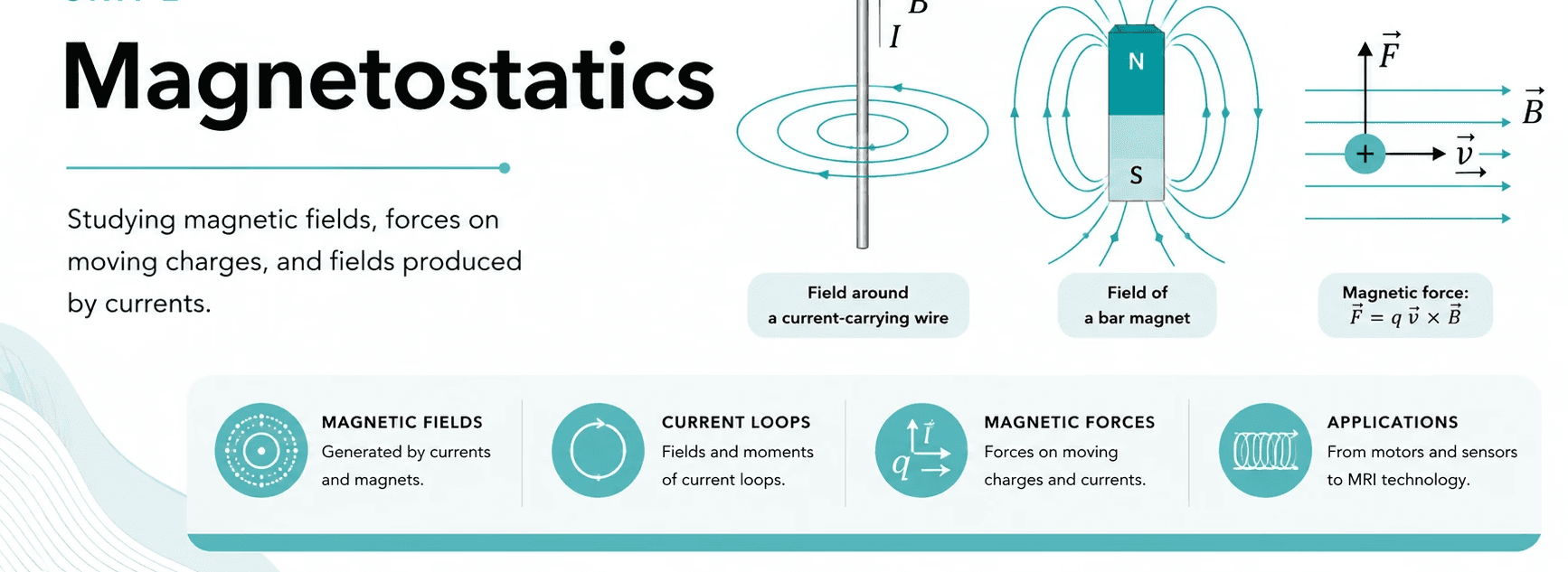
Magnetostatics
Studying magnetic fields, forces on moving charges, and fields produced by currents.
Magnetostatics
Studying magnetic fields, forces on moving charges, and fields produced by currents.

Electromagnetic Induction
Learning Faraday’s law, Lenz’s law, induced emf, and changing magnetic flux.
Electromagnetic
Induction
Learning Faraday’s law, Lenz’s law, induced emf, and changing magnetic flux.

Electromagnetic Waves
Understanding wave propagation, the electromagnetic spectrum, and the relation between electric and magnetic fields.
Electromagnetic
Waves
Understanding wave propagation, the electromagnetic spectrum, and the relation between electric and magnetic fields.
Electromagnetic
Waves
Understanding wave propagation, the electromagnetic spectrum, and the relation between electric and magnetic fields.

Wave Optics
Investigating interference, diffraction, polarization, and the wave nature of light.
Wave Optics
Investigating interference, diffraction, polarization, and the wave nature of light.

Modern Physics Intro
An introduction to relativity, quantum ideas, and the photoelectric effect.
Modern Physics
Intro
An introduction to relativity, quantum ideas, and the photoelectric effect.
What We Cover:
What We Cover:
UNIT
6
UNIT
6
Electromagnetic Waves
Electromagnetic Waves
Learn how oscillating electric and magnetic fields combine to form electromagnetic waves. This summary introduces Maxwell’s Equations, wave properties, the Poynting vector, electromagnetic energy density, and the principles that explain how light and electromagnetic radiation propagate through space.
Learn how oscillating electric and magnetic fields combine to form electromagnetic waves. This summary introduces Maxwell’s Equations, wave properties, the Poynting vector, electromagnetic energy density, and the principles that explain how light and electromagnetic radiation propagate through space.
Oscillating electric and magnetic fields propagating through space.
MAXWELL’S FRAMEWORK
WAVE PROPERTIES
POYNTING VECTOR
ENERGY DENSITY & INTENSITY
∇ · E = ρε0
∇ · B = 0
∇ × E = −∂B∂t
∇ × B = μ0J + μ0ε0 ∂E∂t
c = 1√μ0ε0
E ⊥ B ⊥
direction of
propagation
direction of
propagation
S = 1μ0 E × B
energy flow
(direction of
propagation)
u = 12ε0E2 + B22μ0
Iavg = 12cε0E02
UNIT
7
Wave Optics
Study the wave nature of light through interference, diffraction, and polarization phenomena. This guide covers reflection and refraction, Young’s Double-Slit Experiment, single-slit diffraction, wave spreading, and the formulas most frequently encountered in introductory optics and physics courses.
Interference, diffraction, and refraction as wave behavior of light.
REFLECTION & REFRACTION
YOUNG’S DOUBLE-SLIT
SINGLE-SLIT DIFFRACTION
WAVE SPREADING
Snell’s law:
n1 sin θ1 = n2 sin θ2
Phase note:
Reflection from a boundary to
a higher refractive index
introduces a phase inversion
(π rad).
Path difference:
ΔL = d sin θ
Bright fringes (maxima):
d sin θ = mλ
m = 0, ±1, ±2, …
Dark fringes (minima):
d sin θ = (m + 12)λ
m = 0, ±1, ±2, …
Minima (dark fringes):
a sin θ = mλ
m = ±1, ±2, ±3, …
m = +2
m = +1
m = 0
(central
maximum)
m = −1
m = −2
Waves acquire phase differences due to
different path lengths.
Constructive interference (in phase):
waves add → high intensity (bright).
Destructive interference (out of phase):
waves cancel → low intensity (dark).
Diffraction maxima vary in width and intensity;
the central maximum is the widest and brightest.
UNIT
8
UNIT
8
Modern Physics Intro
Discover the foundations of modern physics by exploring the quantum concepts that transformed our understanding of matter and energy. This summary reviews the photoelectric effect, wave-particle duality, the Bohr atomic model, and quantized energy states that form the basis of quantum mechanics.
Discover the foundations of modern physics by exploring the quantum concepts that transformed our understanding of matter and energy. This summary reviews the photoelectric effect, wave-particle duality, the Bohr atomic model, and quantized energy states that form the basis of quantum mechanics.
Modern Physics Intro
Discover the foundations of modern physics by exploring the quantum concepts that transformed our understanding of matter and energy. This summary reviews the photoelectric effect, wave-particle duality, the Bohr atomic model, and quantized energy states that form the basis of quantum mechanics.
Where classical ideas break down and quantum ideas begin.
PHOTOELECTRIC EFFECT
BOHR ATOM MODEL
WAVE–PARTICLE DUALITY
QUANTIZED STATES
Kmax = hf − ϕ
f0 = ϕh
f0 is the threshold
frequency.
metal surface
En = −13.6 eVn2
ΔE = hf
En = energy of level n
n = 1, 2, 3, …
ΔE = energy of photon
emitted/absorbed
λ = hp
Every particle with momentum p
has an associated de Broglie
wavelength λ.
Photons: Light is emitted or absorbed
in discrete quanta of energy.
E = hf
Atomic structure: In hydrogen-like atoms,
electrons occupy only certain allowed orbits
with quantized radius and angular momentum.
mvrn = nℏ = nh2π
n = 1, 2, 3, …

Rami Alzaytavi
B.ENG. Software Engineer

Yacoob Kathrada
Bsc. Biomedical

Maya Al Khowjeh
B.Tech. Civil Engineering

Taha Arafat
Msc. Pharmacology

Jawad Qourshah
B.ENG. Mechanical Engineering

Manish Bahat
M.ENG. Mechanical Engineering

Oubada Al Tarabishi
M.ENG. Electrical Engineering

Ahmad Dawood
MSc. Computer Science
Rami Alzaytavi
B.ENG. Software Engineer
Yacoob Kathrada
Bsc. Biomedical
Maya Al Khowjeh
B.Tech. Civil Engineering
Taha Arafat
Msc. Pharmacology
Jawad Qourshah
B.ENG. Mechanical Engineering
Manish Bahat
M.ENG. Mechanical Engineering
Oubada Al Tarabishi
M.ENG. Electrical Engineering
Ahmad Dawood
MSc. Computer Science
Contact us
Get in touch with our experts team


University Physics 2 for Engineers: Electricity, Magnetism & Optics
University Physics 2 for Engineers: Electricity, Magnetism & Optics
University Physics 2 for Engineers: Electricity, Magnetism & Optics
Navigate the abstract vectors and field calculus of classical electrodynamics. These 1-on-1 sessions translate non-visible fields, voltage loops, and electromagnetic waves into logical, mathematically step-by-step solutions for your midterms and finals.
Navigate the abstract vectors and field calculus of classical electrodynamics. These 1-on-1 sessions translate non-visible fields, voltage loops, and electromagnetic waves into logical, mathematically step-by-step solutions for your midterms and finals.
Navigate the abstract vectors and field calculus of classical electrodynamics. These 1-on-1 sessions translate non-visible fields, voltage loops, and electromagnetic waves into logical, mathematically step-by-step solutions for your midterms and finals.
100% Money-Back Guarantee on your first session.
100% Money-Back Guarantee on your first session.
100% Money-Back Guarantee on your first session.
Physics 2 is heavily conceptual and visual, testing your ability to deploy multi-variable vector integration to calculate field vectors in empty space. In these personalized sessions, you will dive into the precise problem mechanics of each core unit.
Physics 2 is heavily conceptual and visual, testing your ability to deploy multi-variable vector integration to calculate field vectors in empty space. In these personalized sessions, you will dive into the precise problem mechanics of each core unit.
Physics 2 is heavily conceptual and visual, testing your ability to deploy multi-variable vector integration to calculate field vectors in empty space. In these personalized sessions, you will dive into the precise problem mechanics of each core unit.
Where Our Students Come From
Where Our Students Come From





Coming Soon!
Physics 2 Course Notes & Exam Review
Review the major concepts taught throughout your course in one organized resource. The course review breaks challenging topics into smaller, understandable sections and provides clear examples showing how important concepts are applied.
✓ Electrostatics
✓ Capacitance
✓ Electric Circuits
✓ Magnetostatics
✓ Electromagnetic Induction
✓ Electromagnetic Waves
✓ Wave Optics
✓ Modern Physics Intro
✓ Core course topics and foundational concepts
✓ Clear explanations supported by worked examples
✓ Common mistakes and strategies for avoiding them
✓ Important skills needed for SCH4U✓ Practice questions organized by course topic

What the Course
Review Includes
Topics Covered
Coming Soon!
Physics 2 Practice Exam with Answers
Prepare for tests and final assessments with realistic, course-aligned practice exams. Each exam covers the major topics taught throughout the course, with detailed answer explanations that help students understand concepts, apply their knowledge, and learn from mistakes.
Students can use the practice exams to become familiar with different question formats, review challenging units, improve time management, and determine which concepts require additional preparation.

✓ Full-length practice exams
✓ Course-aligned and exam-style questions
✓ Questions from all major SCH4U topics
✓ Detailed step-by-step solution guides
✓ Focused review of mistakes and weaker areas
Coming Soon!

Physics 2 Formula Sheet & Equation Sheet (PDF)
Quickly access the most important formulas, equations, constants, and reference tables for your course in one organized resource. Each formula sheet is designed to simplify exam preparation by bringing together the equations, symbols, and relationships students use most often throughout the semester.
Whether you're reviewing for a quiz, preparing for a midterm, or studying for a final exam, our formula sheets provide a convenient reference for the key equations and concepts covered in your course. They help students review more efficiently while building confidence before assessments.
✓ Essential formulas organized by topic
✓ Common symbols, variables, and units
✓ Quick reference tables and diagrams
✓ Important equations used throughout the course
✓ Perfect for exam review and last-minute revision

Why Choose
Fit Minds Academy
Personalized 1-on-1 Tutoring
Every student has different strengths, learning gaps, and academic goals. Each tutoring session is tailored to the student’s course, current level, pace, and areas requiring additional support. Lessons focus on the exact concepts and problem types the student needs to understand.
Carefully Matched Tutors for Every Student
Students are matched with tutors based on their course, academic level, subject requirements, learning needs, and availability. Many of our tutors are engineers or technical professionals who understand both the course material and its practical applications.
Ontario Curriculum and Engineering-Focused Support
Our high school tutoring follows the Ontario curriculum and supports the math and science prerequisites required for engineering, science, and technology programs. We also tutor first-year and upper-year university courses, including calculus, physics, linear algebra, programming, thermodynamics, fluid mechanics, and strength of materials.
More than Homework Help
Our tutoring goes beyond completing assignments or memorizing formulas. Students receive clear explanations, structured practice, and step-by-step problem-solving support designed to strengthen understanding and prepare them for quizzes, tests, exams, university courses, and future engineering studies.
Flexible Hourly Tutoring
$95
Per Hour
Pay-As-You-Go Plan, Billed Biweekly
✓ Sessions from the comfort of your home
✓ Access to Fit Minds Discord server
✓ Personalised sessions to suit you
✓ We teach your course material
✓ Resources (course notes, practice tests, and videos)
10-hour Prepaid Plan
$900
Per 10 Hours
$90 per hour - Save $50
✓ Sessions from the comfort of your home
✓ Access to Fit Minds Discord server
✓ Personalised sessions to suit you
✓ We teach your course material
✓ Resources (course notes, practice tests, and videos)
Not Sure Which Option Is Right?
Speak with Fit Minds Academy and find the Physics 2 tutoring plan that best matches the student’s current course needs and academic goals.


Physics 2 Free Resources
Fit Minds Academy provides personalized 1-on-1 tutoring for high school students pursuing engineering programs and university students tackling challenging engineering courses. Our support covers math, physics, chemistry, calculus, statics, dynamics, thermodynamics, fluid mechanics, strength of materials, and other core engineering subjects.
Courses:

High School Courses
Support for Ontario high school students building the math and science foundation needed for future engineering programs.
Courses:

First-Year Engineering Courses
One-on-One private tutoring for core courses taken by every first years engineering student
Courses:

Advanced Engineering Courses
Course-specific tutoring for technical courses that require stronger applied problem-solving.
Pricing
All Courses We Tutor
UNIT
7
UNIT
7
Wave Optics
Wave Optics
Study the wave nature of light through interference, diffraction, and polarization phenomena. This guide covers reflection and refraction, Young’s Double-Slit Experiment, single-slit diffraction, wave spreading, and the formulas most frequently encountered in introductory optics and physics courses.
Study the wave nature of light through interference, diffraction, and polarization phenomena. This guide covers reflection and refraction, Young’s Double-Slit Experiment, single-slit diffraction, wave spreading, and the formulas most frequently encountered in introductory optics and physics courses.
Interference, diffraction, and refraction as wave behavior of light.
REFLECTION & REFRACTION
YOUNG’S DOUBLE-SLIT
SINGLE-SLIT DIFFRACTION
WAVE SPREADING
Snell’s law:
n1 sin θ1 = n2 sin θ2
Phase note:
Reflection from a boundary to
a higher refractive index
introduces a phase inversion
(π rad).
Path difference:
ΔL = d sin θ
Bright fringes (maxima):
d sin θ = mλ
m = 0, ±1, ±2, …
Dark fringes (minima):
d sin θ = (m + 12)λ
m = 0, ±1, ±2, …
Minima (dark fringes):
a sin θ = mλ
m = ±1, ±2, ±3, …
m = +2
m = +1
m = 0
(central
maximum)
m = −1
m = −2
Waves acquire phase differences due to
different path lengths.
Constructive interference (in phase):
waves add → high intensity (bright).
Destructive interference (out of phase):
waves cancel → low intensity (dark).
Diffraction maxima vary in width and intensity;
the central maximum is the widest and brightest.
Physics 2 Course Notes & Exam Review
Review the major concepts taught throughout your course in one organized resource. The course review breaks challenging topics into smaller, understandable sections and provides clear examples showing how important concepts are applied.
✓ Core course topics and foundational concepts
✓ Clear explanations supported by worked examples
✓ Common mistakes and strategies for avoiding them
✓ Important skills needed for Physics 1
✓ Practice questions organized by course topic
What the Course
Review Includes
Topics Covered
Coming Soon!
✓ Electrostatics
✓ Capacitance
✓ Electric Circuits
✓ Magnetostatics
✓ Electromagnetic Induction
✓ Electromagnetic Waves
✓ Wave Optics
✓ Modern Physics Intro
Coming Soon!
Physics 2 Practice Exam with Answers
Prepare for tests and final assessments with realistic, course-aligned practice exams. Each exam covers the major topics taught throughout the course, with detailed answer explanations that help students understand concepts, apply their knowledge, and learn from mistakes.
Students can use the practice exams to become familiar with different question formats, review challenging units, improve time management, and determine which concepts require additional preparation.
✓ Full-length practice exams
✓ Course-aligned and exam-style questions
✓ Questions from all major Physics 1 topics
✓ Detailed step-by-step solution guides
✓ Focused review of mistakes and weaker areas
Physics 2 Formula Sheet & Equation Sheet (PDF)
Coming Soon!
Quickly access the most important formulas, equations, constants, and reference tables for your course in one organized resource. Each formula sheet is designed to simplify exam preparation by bringing together the equations, symbols, and relationships students use most often throughout the semester.
Whether you're reviewing for a quiz, preparing for a midterm, or studying for a final exam, our formula sheets provide a convenient reference for the key equations and concepts covered in your course. They help students review more efficiently while building confidence before assessments.
✓ Essential formulas organized by topic
✓ Common symbols, variables, and units
✓ Quick reference tables and diagrams
✓ Important equations used throughout the course
✓ Perfect for exam review and last-minute revision
Physics 2 Free Resources
All Courses We Tutor
Fit Minds Academy provides personalized 1-on-1 tutoring for high school students pursuing engineering programs and university students tackling challenging engineering courses. Our support covers math, physics, chemistry, calculus, statics, dynamics, thermodynamics, fluid mechanics, strength of materials, and other core engineering subjects.
Courses:
High School Courses
Support for Ontario high school students building the math and science foundation needed for future engineering programs.
Courses:
First-Year Engineering Courses
One-on-One private tutoring for core courses taken by every first years engineering student
Courses:
Advanced Engineering Courses
Course-specific tutoring for technical courses that require stronger applied problem-solving.
Why Choose
Fit Minds Academy
Personalized 1-on-1 Tutoring
Every student has different strengths, learning gaps, and academic goals. Each tutoring session is tailored to the student’s course, current level, pace, and areas requiring additional support. Lessons focus on the exact concepts and problem types the student needs to understand.
Carefully Matched Tutors for Every Student
Students are matched with tutors based on their course, academic level, subject requirements, learning needs, and availability. Many of our tutors are engineers or technical professionals who understand both the course material and its practical applications.
Ontario Curriculum and Engineering-Focused Support
Our high school tutoring follows the Ontario curriculum and supports the math and science prerequisites required for engineering, science, and technology programs. We also tutor first-year and upper-year university courses, including calculus, physics, linear algebra, programming, thermodynamics, fluid mechanics, and strength of materials.
More than Homework Help
Our tutoring goes beyond completing assignments or memorizing formulas. Students receive clear explanations, structured practice, and step-by-step problem-solving support designed to strengthen understanding and prepare them for quizzes, tests, exams, university courses, and future engineering studies.
Reviews
Flexible Hourly Tutoring
$95
Per Hour
Pay-As-You-Go Plan, Billed Biweekly
✓ Sessions from the comfort of your home
✓ Access to Fit Minds Discord server
✓ Personalised sessions to suit you
✓ We teach your course material
✓ Resources (course notes, practice tests, and videos)
10-hour Prepaid Plan
$900
Per 10 Hours
$90 per hour - Save $50
✓ Sessions from the comfort of your home
✓ Access to Fit Minds Discord server
✓ Personalised sessions to suit you
✓ We teach your course material
✓ Resources (course notes, practice tests, and videos)
Not Sure Which Option Is Right?
Speak with Fit Minds Academy and find the Physics 1 tutoring plan that best matches the student’s current course needs and academic goals.
Pricing
UNIT
3
Electric Circuits
Master the fundamentals of electric circuits by understanding current, voltage, resistance, and circuit analysis techniques. This summary includes Ohm’s Law, Kirchhoff’s Rules, RC circuits, transient behaviour, and network analysis methods used throughout physics and electrical engineering.
From microscopic current flow to RC transients.
CURRENT, DRIFT & RESISTIVITY
KIRCHHOFF’S RULES
NETWORK ANALYSIS
RC CIRCUIT TRANSIENTS
I = dqdt
J = IA = nqvd
R = ρ LA
ρ = resistivity (Ω·m)
n = charge carrier density (m−3)
vd = drift velocity (m/s)
Junction Rule
∑Iin = ∑Iout
Loop Rule
∑ΔV = 0
Solve multi-loop circuits by building
linear equations from Kirchhoff’s
Junction Rule and Loop Rule.
Approach:
Assign current directions.
Apply Junction Rule at nodes.
Apply Loop Rule around independent loops.
Solve the resulting linear system.
τ = RC
Charging (switch closes at t = 0):
q(t) = Cε(1 − e−t/RC)
I(t) = εR e−t/RC
Vc(t) = ε(1 − e−t/RC)
Discharging (switch opens at t = 0):
q(t) = Q0e−t/RC, I(t) = −Q0RC e−t/RC, Vc(t) = V0e−t/RC
Charging:
approaches ε
Where Our Students Come From
Physics 2 Course Notes & Exam Review
Review the major concepts taught throughout your course in one organized resource. The course review breaks challenging topics into smaller, understandable sections and provides clear examples showing how important concepts are applied.
✓ Core course topics and foundational concepts
✓ Clear explanations supported by worked examples
✓ Common mistakes and strategies for avoiding them
✓ Important skills needed for Physics 1
✓ Practice questions organized by course topic
What the Course
Review Includes
Topics Covered
Coming Soon!
✓ Electrostatics
✓ Capacitance
✓ Electric Circuits
✓ Magnetostatics
✓ Electromagnetic Induction
✓ Electromagnetic Waves
✓ Wave Optics
✓ Modern Physics Intro
Physics 2 Practice Exam with Answers
Prepare for tests and final assessments with realistic, course-aligned practice exams. Each exam covers the major topics taught throughout the course, with detailed answer explanations that help students understand concepts, apply their knowledge, and learn from mistakes.
Students can use the practice exams to become familiar with different question formats, review challenging units, improve time management, and determine which concepts require additional preparation.
Coming Soon!
✓ Full-length practice exams
✓ Course-aligned and exam-style questions
✓ Questions from all major Physics 1 topics
✓ Detailed step-by-step solution guides
✓ Focused review of mistakes and weaker areas
Physics 2 Formula Sheet & Equation Sheet (PDF)
Coming Soon!
✓ Essential formulas organized by topic
✓ Common symbols, variables, and units
✓ Quick reference tables and diagrams
✓ Important equations used throughout the course
✓ Perfect for exam review and last-minute revision
Quickly access the most important formulas, equations, constants, and reference tables for your course in one organized resource. Each formula sheet is designed to simplify exam preparation by bringing together the equations, symbols, and relationships students use most often throughout the semester.
Whether you're reviewing for a quiz, preparing for a midterm, or studying for a final exam, our formula sheets provide a convenient reference for the key equations and concepts covered in your course. They help students review more efficiently while building confidence before assessments.
All Courses We Tutor
Fit Minds Academy provides personalized 1-on-1 tutoring for high school students pursuing engineering programs and university students tackling challenging engineering courses. Our support covers math, physics, chemistry, calculus, statics, dynamics, thermodynamics, fluid mechanics, strength of materials, and other core engineering subjects.
Physics 2 Free Resources
Courses:
High School Courses
Support for Ontario high school students building the math and science foundation needed for future engineering programs.
Courses:
First-Year Engineering Courses
One-on-One private tutoring for core courses taken by every first years engineering student
Courses:
Advanced Engineering Courses
Course-specific tutoring for technical courses that require stronger applied problem-solving.
Why Choose
Fit Minds Academy
Personalized 1-on-1 Tutoring
Every student has different strengths, learning gaps, and academic goals. Each tutoring session is tailored to the student’s course, current level, pace, and areas requiring additional support. Lessons focus on the exact concepts and problem types the student needs to understand.
Carefully Matched Tutors for Every Student
Students are matched with tutors based on their course, academic level, subject requirements, learning needs, and availability. Many of our tutors are engineers or technical professionals who understand both the course material and its practical applications.
Ontario Curriculum and Engineering-Focused Support
Our high school tutoring follows the Ontario curriculum and supports the math and science prerequisites required for engineering, science, and technology programs. We also tutor first-year and upper-year university courses, including calculus, physics, linear algebra, programming, thermodynamics, fluid mechanics, and strength of materials.
More than Homework Help
Our tutoring goes beyond completing assignments or memorizing formulas. Students receive clear explanations, structured practice, and step-by-step problem-solving support designed to strengthen understanding and prepare them for quizzes, tests, exams, university courses, and future engineering studies.
Flexible Hourly Tutoring
$95
Per Hour
Pay-As-You-Go Plan, Billed Biweekly
✓ Sessions from the comfort of your home
✓ Access to Fit Minds Discord server
✓ Personalised sessions to suit you
✓ We teach your course material
✓ Resources (course notes, practice tests, and videos)
10-hour Prepaid Plan
$900
Per 10 Hours
$90 per hour - Save $50
✓ Sessions from the comfort of your home
✓ Access to Fit Minds Discord server
✓ Personalised sessions to suit you
✓ We teach your course material
✓ Resources (course notes, practice tests, and videos)
Not Sure Which Option Is Right?
Speak with Fit Minds Academy and find the Physics 2 tutoring plan that best matches the student’s current course needs and academic goals.
Pricing
Contact us
Get in touch with our experts team
FAQ
What is Physics 2?

Is Physics 2 hard?
Why is Physics 2 so hard?
Physics 1 vs Physics 2, what's the difference?
Is Physics 2 harder than Physics 1?
Does Physics 2 build on Physics 1?
How can you pass Physics 2?
How Do I Get Started?