Here is a quick recap on all the units covered in Thermodynamics
Here is a quick recap on all the units covered in Thermodynamics

UNIT
1
UNIT
1
Properties of Pure Substances & The First Law
Properties of Pure Substances & The First Law
Properties of Pure Substances & The First Law
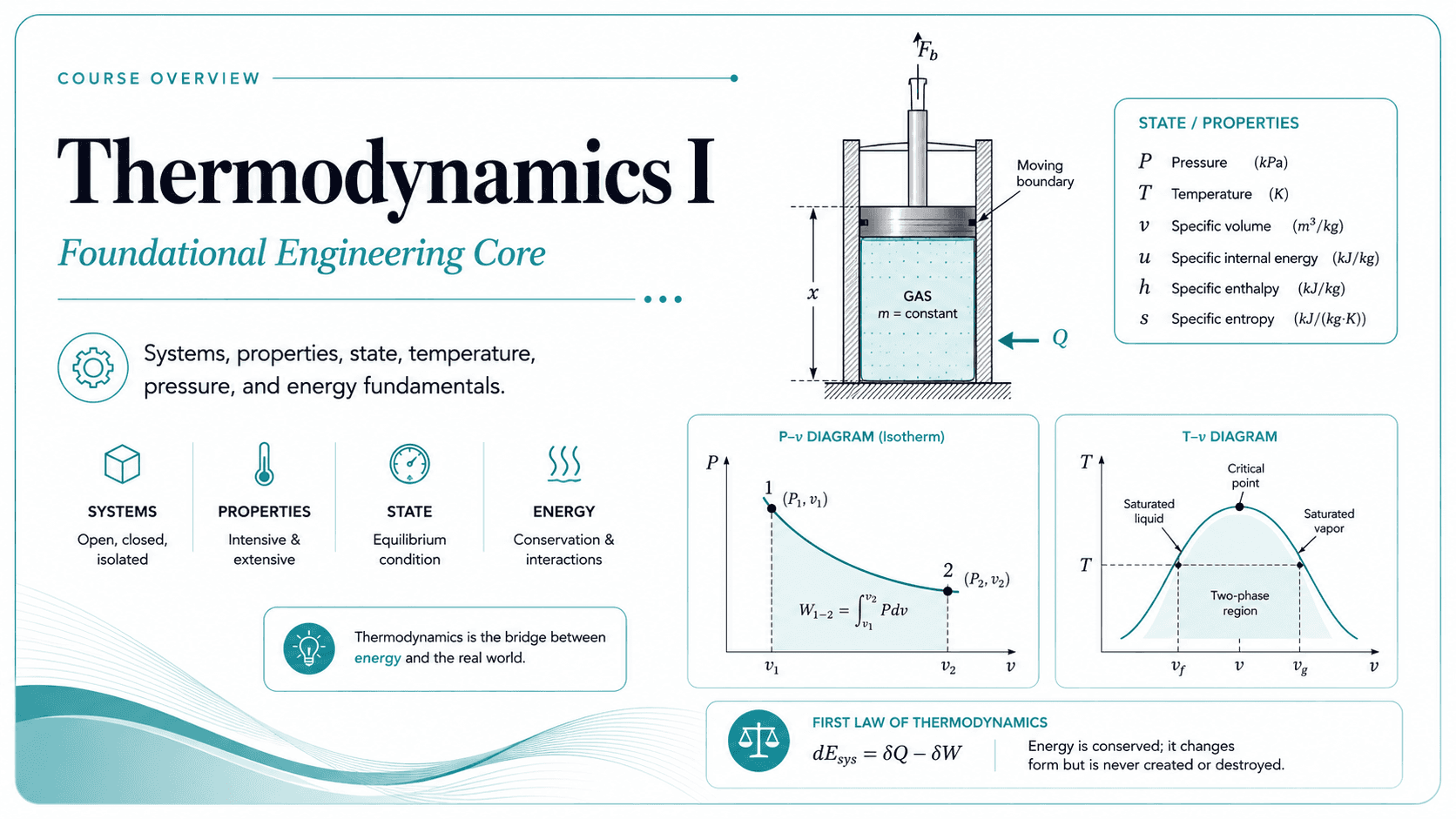
Build a strong foundation in engineering thermodynamics by understanding the properties of pure substances, energy conservation, and the First Law of Thermodynamics. You will learn to work confidently with internal energy and enthalpy — reading both from property tables, computing molar enthalpy, and knowing exactly when each one belongs in your energy balance. This summary covers state properties, steam tables, phase change, closed systems, steady-flow energy analysis, and the fundamental concepts used throughout mechanical, chemical, and aerospace engineering.
Build a strong foundation in engineering thermodynamics by understanding the properties of pure substances, energy conservation, and the First Law of Thermodynamics. You will learn to work confidently with internal energy and enthalpy — reading both from property tables, computing molar enthalpy, and knowing exactly when each one belongs in your energy balance. This summary covers state properties, steam tables, phase change, closed systems, steady-flow energy analysis, and the fundamental concepts used throughout mechanical, chemical, and aerospace engineering.
Build a strong foundation in engineering thermodynamics by understanding the properties of pure substances, energy conservation, and the First Law of Thermodynamics. You will learn to work confidently with internal energy and enthalpy — reading both from property tables, computing molar enthalpy, and knowing exactly when each one belongs in your energy balance. This summary covers state properties, steam tables, phase change, closed systems, steady-flow energy analysis, and the fundamental concepts used throughout mechanical, chemical, and aerospace engineering.
State Properties, Pure Substances, and First-Law Analysis
1State parameters & pure substances
- State defined by P, v, T, u, h, s
- Use P–v–T surfaces to identify thermodynamic state
- Recognize saturated liquid, saturated vapor, superheated vapor, and compressed liquid
- Quality in two-phase region:
x = mvapormtotal
2Steam tables & phase change
- Read properties from saturated and superheated steam tables
- In the mixture region:
v = vf + x(vg − vf)
- Similar interpolation logic for u, h, s
| SATURATED (at given P or T) | SUPERHEATED (at given P and T) | ||
|---|---|---|---|
| Saturated Liquid (f) | Saturated Vapor (g) | ||
| v | vf | vg | ⋯ |
| u | uf | ug | ⋯ |
| h | hf | hg | ⋯ |
| s | sf | sg | ⋯ |
Quality x
(0 < x < 1)
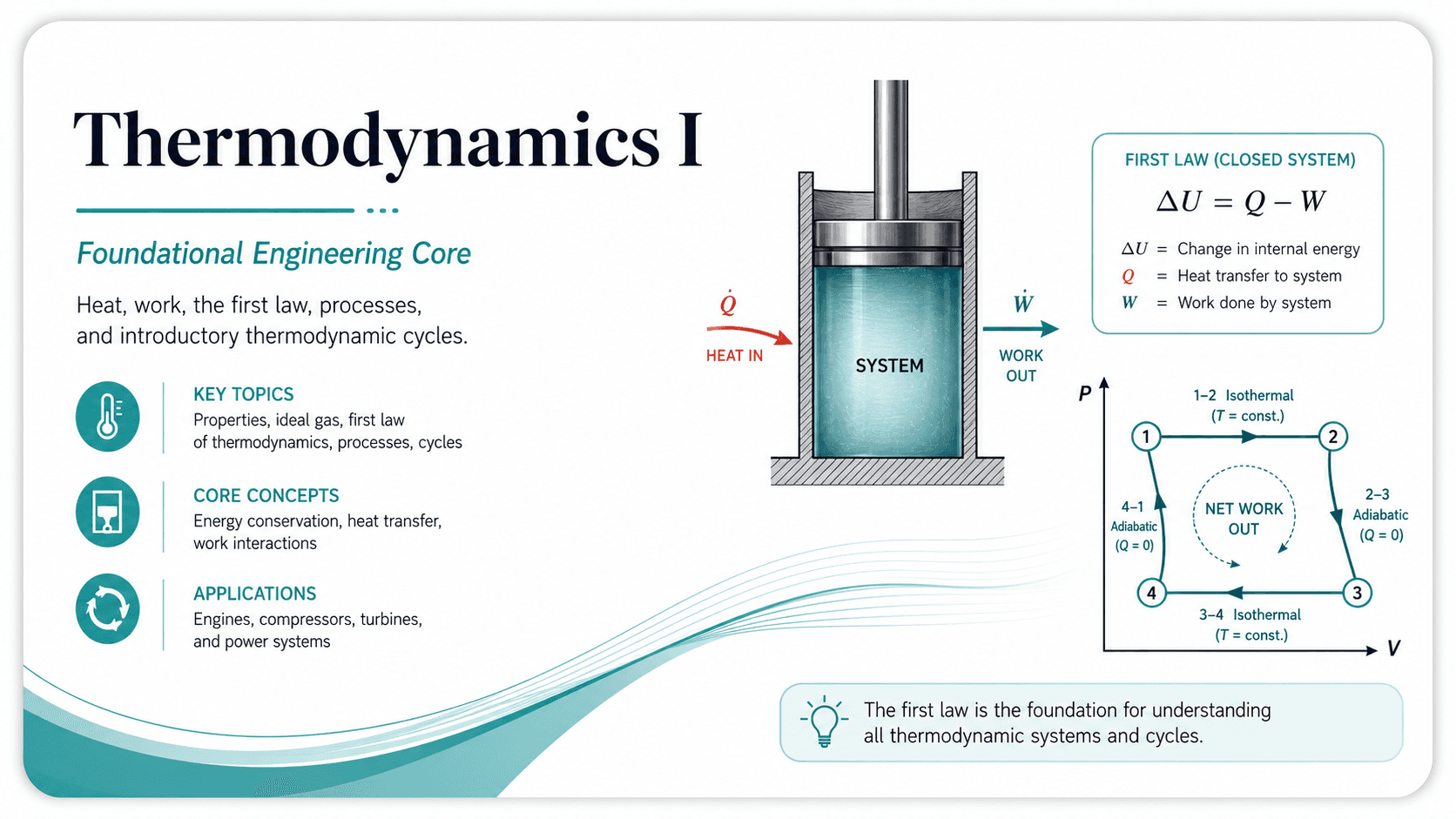
3First law for closed systems
- Apply energy conservation to piston-cylinder devices
- Evaluate boundary work along polytropic paths
- Track heat and work crossing the system boundary
First Law (closed system)
ΔU = Q − W
Boundary Work
Wb = ∫12 P dV
(positive when done by system)
Polytropic path: Pvn = C (n = 0 isobaric, n = 1 isothermal, n = k adiabatic)
4Steady-flow energy equation
q − ws = (h2 − h1) + V22 − V122 + g(z2 − z1)
- Apply to nozzles, diffusers, compressors, and turbines
- Control-volume analysis for flowing systems
- NOZZLE
- DIFFUSER
- COMPRESSOR
- TURBINE
UNIT
3
UNIT
3
Power & Refrigeration Cycles (Carnot, Rankine, Otto)
Power & Refrigeration Cycles (Carnot, Rankine, Otto)
Power & Refrigeration Cycles (Carnot, Rankine, Otto)
Apply thermodynamic principles to real engineering systems by studying power generation, refrigeration, and HVAC applications. This cheat sheet covers gas power cycles, vapor power cycles, vapor-compression refrigeration, psychrometrics, and the engineering relationships used in advanced thermodynamic analysis.
Apply thermodynamic principles to real engineering systems by studying power generation, refrigeration, and HVAC applications. This cheat sheet covers gas power cycles, vapor power cycles, vapor-compression refrigeration, psychrometrics, and the engineering relationships used in advanced thermodynamic analysis.
Apply thermodynamic principles to real engineering systems by studying power generation, refrigeration, and HVAC applications. This cheat sheet covers gas power cycles, vapor power cycles, vapor-compression refrigeration, psychrometrics, and the engineering relationships used in advanced thermodynamic analysis.
Power Cycles, Refrigeration, and Psychrometrics
1Gas power cycles
- Otto cycle (SI engine)
- Constant-volume heat addition and rejection
- Diesel cycle (CI engine)
- Constant-pressure heat addition
- Brayton cycle (Gas turbine)
- Constant-pressure heat addition
- Regeneration and intercooling improve efficiency
Regeneration (example)
Intercooling (example)
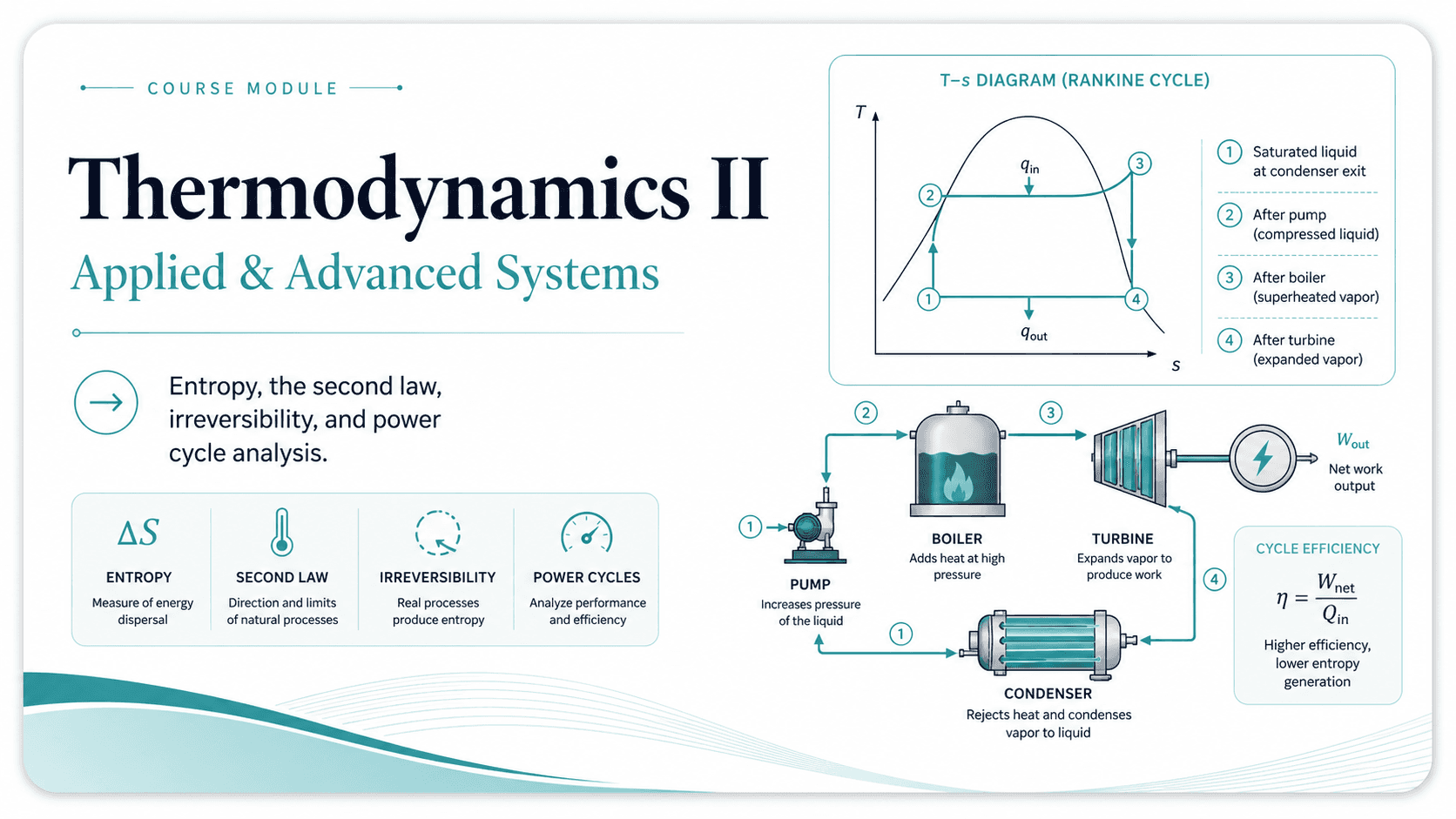
2Vapor power cycles
- Rankine cycle (steam power)
- Heat addition in boiler
- Expansion in turbine
- Heat rejection in condenser
- Pump returns liquid to boiler pressure
- Improvements
- Reheat between turbine stages
- Regeneration (feedwater heating)
Reheat: 3 → 3′ (additional heat in boiler) Regeneration: Feedwater heaters before boiler
3Vapor-compression refrigeration
- Four main components
- Evaporator absorbs heat
- Compressor raises pressure
- Condenser rejects heat
- Expansion valve throttles
- Cooling effect
Q̇L = ṁ(h1 − h4) (at evaporator)
- Coefficient of performance (COP)
COPR = Q̇LẆin = h1 − h4h2 − h1
4Psychrometrics & HVAC
- Relative humidity
φ = PvPsat(Tdb) (0 < φ ≤ 1)
- Dew point Tdp: temperature where φ = 1 at constant humidity ratio ω
- Wet-bulb temperature Twb: adiabatic saturation temperature
- Adiabatic saturation: air approaches saturation by evaporative cooling
- Moist air processes
- Sensible heating/cooling (ω = const)
- Humidification/dehumidification
- Mixing of air streams
UNIT
4
UNIT
4
Property Relations & Combustion
Property Relations & Combustion
Property Relations & Combustion
Complete your thermodynamics studies by learning advanced topics used in energy systems and combustion analysis. Along the way you will become fast and accurate with steam tables, thermodynamic property tables, and the ideal gas law — the daily tools of every thermodynamics problem. This summary reviews thermodynamic property relations, exergy analysis, combustion processes, chemical equilibrium, and flame temperature calculations that are essential in mechanical, energy, and chemical engineering.
Complete your thermodynamics studies by learning advanced topics used in energy systems and combustion analysis. Along the way you will become fast and accurate with steam tables, thermodynamic property tables, and the ideal gas law — the daily tools of every thermodynamics problem. This summary reviews thermodynamic property relations, exergy analysis, combustion processes, chemical equilibrium, and flame temperature calculations that are essential in mechanical, energy, and chemical engineering.
Complete your thermodynamics studies by learning advanced topics used in energy systems and combustion analysis. Along the way you will become fast and accurate with steam tables, thermodynamic property tables, and the ideal gas law — the daily tools of every thermodynamics problem. This summary reviews thermodynamic property relations, exergy analysis, combustion processes, chemical equilibrium, and flame temperature calculations that are essential in mechanical, energy, and chemical engineering.
Thermodynamic Relations, Exergy, and Combustion
1Thermodynamic relations
- Maxwell relations are derived from fundamental thermodynamic potentials.
(∂T∂v)s = −(∂p∂s)v
(∂v∂T)p = −(∂s∂p)T
(∂T∂p)s = (∂v∂s)p
(∂p∂T)v = (∂s∂v)T
- Clapeyron equation for phase equilibrium:
dpsatdT = hfgT (vg − vf )
- Use measurable properties and relations to determine changes in internal energy, enthalpy, and entropy.
- Apply appropriate property relations (e.g., equations of state, property tables) to evaluate changes.
2Exergy (availability) analysis
- Exergy is the maximum useful work potential relative to the environment (T0, p0).
- Exergy balance for a control volume (steady flow):
Ėinx − Ėoutx − Ẇuseful = Ėdestx
- Exergy destroyed is due to irreversibility (heat transfer across finite ΔT, friction, mixing, chemical reaction, etc.).
Exergy destroyed = T0 Sgen (≥0)
Environment: T0, p0
3Combustion analysis
- Balanced fuel–air reaction for a hydrocarbon fuel CxHy (complete combustion):
CxHy + a(O2 + 3.76 N2) → x CO2 + y2 H2O + 3.76 a N2
- Theoretical air (stoichiometric): minimum air for complete combustion.
- Excess air: % EA = (A − Ast) / Ast × 100%
- Air–fuel ratio: A/F = ṁairṁfuel
- Enthalpy of formation (h°f): reference enthalpy at 25°C and 1 atm.
Energy balance (steady, adiabatic):
∑ ṁin hin + Q̇ − Ẇ = ∑ ṁout hout
- For adiabatic combustor: Q̇ ≈ 0
- Use h°f and sensible enthalpies to compute heat release and Tad.
4Chemical equilibrium & flame temperature
- At high temperatures, products dissociate. Equilibrium composition minimizes Gibbs free energy.
- Equilibrium constant (in terms of partial pressures):
Kp(T) = ∏i(pip°)νi = exp(−ΔG°(T)RT)
- Adiabatic flame temperature (Tad): temperature of products at equilibrium with reactants when Q̇ = 0 and Ẇ = 0 (adiabatic, no shaft work).
- Solve simultaneously: element balances + equilibrium relations + energy balance.
Meet Our Thermodynamics Tutors
Meet Our Thermodynamics Tutors
Meet Our Thermodynamics Tutors
Reviews
Reviews

University Thermodynamics for Engineers
University Thermodynamics for Engineers
University Thermodynamics for Engineers
Master the foundational laws of energy conversion, entropy generation, and chemical combustion. These 1-on-1 sessions equip you with the property table strategies, cycle tracking methods, and exergy balance tools required to solve complex energy systems on your midterms and finals.
Master the foundational laws of energy conversion, entropy generation, and chemical combustion. These 1-on-1 sessions equip you with the property table strategies, cycle tracking methods, and exergy balance tools required to solve complex energy systems on your midterms and finals.
Master the foundational laws of energy conversion, entropy generation, and chemical combustion. These 1-on-1 sessions equip you with the property table strategies, cycle tracking methods, and exergy balance tools required to solve complex energy systems on your midterms and finals.
100% Money-Back Guarantee on your first session.
100% Money-Back Guarantee on your first session.
100% Money-Back Guarantee on your first session.
What We Cover:
What We Cover:
Thermodynamics requires absolute precision when tracking system definitions, phase boundaries, and state parameters. In these personalized sessions, you will step away from basic assumptions to evaluate true real-world power generation and refrigeration loops.
Thermodynamics requires absolute precision when tracking system definitions, phase boundaries, and state parameters. In these personalized sessions, you will step away from basic assumptions to evaluate true real-world power generation and refrigeration loops.
Thermodynamics requires absolute precision when tracking system definitions, phase boundaries, and state parameters. In these personalized sessions, you will step away from basic assumptions to evaluate true real-world power generation and refrigeration loops.
UNIT
2
UNIT
2
Entropy & The Second Law of Thermodynamics
Entropy & The Second Law of Thermodynamics
Entropy & The Second Law of Thermodynamics
Expand your understanding of thermodynamic systems by exploring entropy, energy quality, and the limitations imposed by the Second Law of Thermodynamics. You will master the relationship between enthalpy and entropy, understand reversible and irreversible processes, and learn which thermodynamic quantities are state functions — the concept behind almost every trick question on thermo exams. This guide reviews Carnot cycles, entropy generation, isentropic processes, and thermodynamic efficiency, providing the principles needed to analyze real engineering systems.
Expand your understanding of thermodynamic systems by exploring entropy, energy quality, and the limitations imposed by the Second Law of Thermodynamics. This guide reviews Carnot cycles, entropy generation, isentropic processes, and thermodynamic efficiency, providing the principles needed to analyze real engineering systems.
Expand your understanding of thermodynamic systems by exploring entropy, energy quality, and the limitations imposed by the Second Law of Thermodynamics. You will master the relationship between enthalpy and entropy, understand reversible and irreversible processes, and learn which thermodynamic quantities are state functions — the concept behind almost every trick question on thermo exams. This guide reviews Carnot cycles, entropy generation, isentropic processes, and thermodynamic efficiency, providing the principles needed to analyze real engineering systems.
Expand your understanding of thermodynamic systems by exploring entropy, energy quality, and the limitations imposed by the Second Law of Thermodynamics. You will master the relationship between enthalpy and entropy, understand reversible and irreversible processes, and learn which thermodynamic quantities are state functions — the concept behind almost every trick question on thermo exams. This guide reviews Carnot cycles, entropy generation, isentropic processes, and thermodynamic efficiency, providing the principles needed to analyze real engineering systems.
Second Law, Carnot Limits, and Entropy Dynamics
1Second law foundations
- Processes have a direction; not all processes are possible.
- Kelvin–Planck statement: It is impossible to construct a device that operates in a cycle and produces net work while interacting with a single heat reservoir.
- Clausius statement: It is impossible to construct a device that operates in a cycle whose only effect is the transfer of heat from a colder body to a hotter body.
- Irreversibility: Real processes generate entropy; useful work is always less than the ideal (reversible) limit.
Energy balance (cycle): QH = Wout + QL
2Carnot cycle & ideal limits
Carnot cycle is the most efficient engine between two reservoirs (TH > TL).
Thermal efficiency (engine):
ηth = 1 − TLTH
Refrigerator COP:
COPR = TLTH − TL
Heat pump COP:
COPHP = THTH − TL
No engine operating between TH and TL can have ηth greater than Carnot.
3Entropy change
- Entropy is a property that measures energy dispersal or unavailability.
- Clausius inequality (any process):
Δs = ∫12 δqT + sgen ≥ ∫12 δqT
where sgen ≥ 0 (entropy generation)
- For a reversible process: sgen = 0
- For an irreversible process: sgen > 0
- Isolated system: ΔSsystem ≥ 0
Reversible process (equality holds):
ds = δqrevT
Key implications
- sgen = 0→Reversible (ideal)
- sgen > 0→Irreversible (real)
- Greater sgen→Greater irreversibility and lower performance
4Isentropic efficiency
Turbine (steady-flow)
Turbine isentropic efficiency (most important):
ηt = waws = h1 − h2h1 − h2s ≤ 1
where ws = h1 − h2s (ideal isentropic work)
Compressor (steady-flow)
Compressor isentropic efficiency:
ηc = wswa = h2s − h1h2 − h1 ≤ 1
where ws = h2s − h1 (ideal isentropic work in)

Rami Alzaytavi
B.ENG. Software Engineer

Yacoob Kathrada
Bsc. Biomedical

Maya Al Khowjeh
B.Tech. Civil Engineering

Taha Arafat
Msc. Pharmacology

Jawad Qourshah
B.ENG. Mechanical Engineering

Manish Bahat
M.ENG. Mechanical Engineering

Oubada Al Tarabishi
M.ENG. Electrical Engineering

Ahmad Dawood
MSc. Computer Science
Rami Alzaytavi
B.ENG. Software Engineer
Yacoob Kathrada
Bsc. Biomedical
Maya Al Khowjeh
B.Tech. Civil Engineering
Taha Arafat
Msc. Pharmacology
Jawad Qourshah
B.ENG. Mechanical Engineering
Manish Bahat
M.ENG. Mechanical Engineering
Oubada Al Tarabishi
M.ENG. Electrical Engineering
Ahmad Dawood
MSc. Computer Science
Contact us
Get in touch with our experts team

Contact us
Get in touch with our experts team
Where Our Students Come From
Where Our Students Come From





Coming Soon!
Thermodynamics Course Notes & Exam Review
Review the major concepts taught throughout your course in one organized resource. The course review breaks challenging topics into smaller, understandable sections and provides clear examples showing how important concepts are applied.
✓ Thermodynamic Systems & Properties
✓ Pure Substances & State Postulates
✓ Work & Heat Transfer
✓ The First Law of Thermodynamics (Energy Conservation)
✓ Control Volume Analysis (Open and Closed Systems)
✓ The Second Law of Thermodynamics
✓ Entropy Generation
✓ Basic Power & Refrigeration Cycles (Carnot, Rankine, Otto)
✓ Core course topics and foundational concepts
✓ Clear explanations supported by worked examples
✓ Common mistakes and strategies for avoiding them
✓ Important skills needed for Thermodynamics
✓ Practice questions organized by course topic

What the Course
Review Includes
Topics Covered
Coming Soon!
Thermodynamics Practice Problems with Solutions
Prepare for tests and final assessments with realistic, course-aligned practice exams. Each exam covers the major topics taught throughout the course, with detailed answer explanations that help students understand concepts, apply their knowledge, and learn from mistakes.
Students can use the practice exams to become familiar with different question formats, review challenging units, improve time management, and determine which concepts require additional preparation.

✓ Full-length practice exams
✓ Course-aligned and exam-style questions
✓ Questions from all major Thermodynamics topics
✓ Detailed step-by-step solution guides
✓ Focused review of mistakes and weaker areas
Coming Soon!

Thermodynamics Equation Sheet & Cheat Sheet (PDF)
Quickly access the most important formulas, equations, constants, and reference tables for your course in one organized resource. Each formula sheet is designed to simplify exam preparation by bringing together the equations, symbols, and relationships students use most often throughout the semester.
Whether you're reviewing for a quiz, preparing for a midterm, or studying for a final exam, our formula sheets provide a convenient reference for the key equations and concepts covered in your course. They help students review more efficiently while building confidence before assessments.
✓ Essential formulas organized by topic
✓ Common symbols, variables, and units
✓ Quick reference tables and diagrams
✓ Important equations used throughout the course
✓ Perfect for exam review and last-minute revision
Thermodynamics Free Resources
Fit Minds Academy provides personalized 1-on-1 tutoring for high school students pursuing engineering programs and university students tackling challenging engineering courses. Our support covers math, physics, chemistry, calculus, statics, dynamics, thermodynamics, fluid mechanics, strength of materials, and other core engineering subjects.
Courses:

High School Courses
Support for Ontario high school students building the math and science foundation needed for future engineering programs.
Courses:

First-Year Engineering Courses
One-on-One private tutoring for core courses taken by every first years engineering student
Courses:

Advanced Engineering Courses
Course-specific tutoring for technical courses that require stronger applied problem-solving.
All Courses We Tutor

Why Choose
Fit Minds Academy
Personalized 1-on-1 Tutoring
Every student has different strengths, learning gaps, and academic goals. Each tutoring session is tailored to the student’s course, current level, pace, and areas requiring additional support. Lessons focus on the exact concepts and problem types the student needs to understand.
Carefully Matched Tutors for Every Student
Students are matched with tutors based on their course, academic level, subject requirements, learning needs, and availability. Many of our tutors are engineers or technical professionals who understand both the course material and its practical applications.
Ontario Curriculum and Engineering-Focused Support
Our high school tutoring follows the Ontario curriculum and supports the math and science prerequisites required for engineering, science, and technology programs. We also tutor first-year and upper-year university courses, including calculus, physics, linear algebra, programming, thermodynamics, fluid mechanics, and strength of materials.
More than Homework Help
Our tutoring goes beyond completing assignments or memorizing formulas. Students receive clear explanations, structured practice, and step-by-step problem-solving support designed to strengthen understanding and prepare them for quizzes, tests, exams, university courses, and future engineering studies.
Flexible Hourly Tutoring
$125
Per Hour
Pay-As-You-Go Plan, Billed Biweekly
✓ Sessions from the comfort of your home
✓ Access to Fit Minds Discord server
✓ Personalised sessions to suit you
✓ We teach your course material
✓ Resources (course notes, practice tests, and videos)
10-hour Prepaid Plan
$1100
Per 10 Hours
$110 per hour - Save $150
✓ Sessions from the comfort of your home
✓ Access to Fit Minds Discord server
✓ Personalised sessions to suit you
✓ We teach your course material
✓ Resources (course notes, practice tests, and videos)
Not Sure Which Option Is Right?
Speak with Fit Minds Academy and find the Thermodynamics tutoring plan that best matches the student’s current course needs and academic goals.


Pricing
Thermodynamics Course Notes & Exam Review
Review the major concepts taught throughout your course in one organized resource. The course review breaks challenging topics into smaller, understandable sections and provides clear examples showing how important concepts are applied.
✓ Core course topics and foundational concepts
✓ Clear explanations supported by worked examples
✓ Common mistakes and strategies for avoiding them
✓ Important skills needed for Thermodynamics
✓ Practice questions organized by course topic
What the Course
Review Includes
Topics Covered
Coming Soon!
✓ Thermodynamic Systems & Properties
✓ Pure Substances & State Postulates
✓ Work & Heat Transfer
✓ The First Law of Thermodynamics (Energy Conservation)
✓ Control Volume Analysis (Open and Closed Systems)
✓ The Second Law of Thermodynamics
✓ Entropy Generation
✓ Basic Power & Refrigeration Cycles (Carnot, Rankine, Otto)
Coming Soon!
Thermodynamics Practice Problems with Solutions
Prepare for tests and final assessments with realistic, course-aligned practice exams. Each exam covers the major topics taught throughout the course, with detailed answer explanations that help students understand concepts, apply their knowledge, and learn from mistakes.
Students can use the practice exams to become familiar with different question formats, review challenging units, improve time management, and determine which concepts require additional preparation.
✓ Full-length practice exams
✓ Course-aligned and exam-style questions
✓ Questions from all major Thermodynamics topics
✓ Detailed step-by-step solution guides
✓ Focused review of mistakes and weaker areas
Thermodynamics Equation Sheet & Cheat Sheet (PDF)
Coming Soon!
✓ Essential formulas organized by topic
✓ Common symbols, variables, and units
✓ Quick reference tables and diagrams
✓ Important equations used throughout the course
✓ Perfect for exam review and last-minute revision
Quickly access the most important formulas, equations, constants, and reference tables for your course in one organized resource. Each formula sheet is designed to simplify exam preparation by bringing together the equations, symbols, and relationships students use most often throughout the semester.
Whether you're reviewing for a quiz, preparing for a midterm, or studying for a final exam, our formula sheets provide a convenient reference for the key equations and concepts covered in your course. They help students review more efficiently while building confidence before assessments.
Courses:
High School Courses
Support for Ontario high school students building the math and science foundation needed for future engineering programs.
Courses:
First-Year Engineering Courses
One-on-One private tutoring for core courses taken by every first years engineering student
Courses:
Advanced Engineering Courses
Course-specific tutoring for technical courses that require stronger applied problem-solving.
Fit Minds Academy provides personalized 1-on-1 tutoring for high school students pursuing engineering programs and university students tackling challenging engineering courses. Our support covers math, physics, chemistry, calculus, statics, dynamics, thermodynamics, fluid mechanics, strength of materials, and other core engineering subjects.
All Courses We Tutor
Thermodynamics Free Resources
Why Choose
Fit Minds Academy
Personalized 1-on-1 Tutoring
Every student has different strengths, learning gaps, and academic goals. Each tutoring session is tailored to the student’s course, current level, pace, and areas requiring additional support. Lessons focus on the exact concepts and problem types the student needs to understand.
Carefully Matched Tutors for Every Student
Students are matched with tutors based on their course, academic level, subject requirements, learning needs, and availability. Many of our tutors are engineers or technical professionals who understand both the course material and its practical applications.
Ontario Curriculum and Engineering-Focused Support
Our high school tutoring follows the Ontario curriculum and supports the math and science prerequisites required for engineering, science, and technology programs. We also tutor first-year and upper-year university courses, including calculus, physics, linear algebra, programming, thermodynamics, fluid mechanics, and strength of materials.
More than Homework Help
Our tutoring goes beyond completing assignments or memorizing formulas. Students receive clear explanations, structured practice, and step-by-step problem-solving support designed to strengthen understanding and prepare them for quizzes, tests, exams, university courses, and future engineering studies.
Flexible Hourly Tutoring
$125
Per Hour
Pay-As-You-Go Plan, Billed Biweekly
✓ Sessions from the comfort of your home
✓ Access to Fit Minds Discord server
✓ Personalised sessions to suit you
✓ We teach your course material
✓ Resources (course notes, practice tests, and videos)
10-hour Prepaid Plan
$1100
Per 10 Hours
$110 per hour - Save $150
✓ Sessions from the comfort of your home
✓ Access to Fit Minds Discord server
✓ Personalised sessions to suit you
✓ We teach your course material
✓ Resources (course notes, practice tests, and videos)
Not Sure Which Option Is Right?
Speak with Fit Minds Academy and find the Thermodynamics tutoring plan that best matches the student’s current course needs and academic goals.
Pricing
Where Our Students Come From
Thermodynamics Course Notes & Exam Review
Review the major concepts taught throughout your course in one organized resource. The course review breaks challenging topics into smaller, understandable sections and provides clear examples showing how important concepts are applied.
✓ Core course topics and foundational concepts
✓ Clear explanations supported by worked examples
✓ Common mistakes and strategies for avoiding them
✓ Important skills needed for Thermodynamics
✓ Practice questions organized by course topic
What the Course
Review Includes
Topics Covered
Coming Soon!
Thermodynamics Practice Problems with Solutions
Prepare for tests and final assessments with realistic, course-aligned practice exams. Each exam covers the major topics taught throughout the course, with detailed answer explanations that help students understand concepts, apply their knowledge, and learn from mistakes.
Students can use the practice exams to become familiar with different question formats, review challenging units, improve time management, and determine which concepts require additional preparation.
Coming Soon!
✓ Full-length practice exams
✓ Course-aligned and exam-style questions
✓ Questions from all major Thermodynamics topics
✓ Detailed step-by-step solution guides
✓ Focused review of mistakes and weaker areas
Thermodynamics Equation Sheet & Cheat Sheet (PDF)
Coming Soon!
✓ Essential formulas organized by topic
✓ Common symbols, variables, and units
✓ Quick reference tables and diagrams
✓ Important equations used throughout the course
✓ Perfect for exam review and last-minute revision
Quickly access the most important formulas, equations, constants, and reference tables for your course in one organized resource. Each formula sheet is designed to simplify exam preparation by bringing together the equations, symbols, and relationships students use most often throughout the semester.
Whether you're reviewing for a quiz, preparing for a midterm, or studying for a final exam, our formula sheets provide a convenient reference for the key equations and concepts covered in your course. They help students review more efficiently while building confidence before assessments.
All Courses We Tutor
Thermodynamics Free Resources
Fit Minds Academy provides personalized 1-on-1 tutoring for high school students pursuing engineering programs and university students tackling challenging engineering courses. Our support covers math, physics, chemistry, calculus, statics, dynamics, thermodynamics, fluid mechanics, strength of materials, and other core engineering subjects.
Courses:
High School Courses
Support for Ontario high school students building the math and science foundation needed for future engineering programs.
Courses:
First-Year Engineering Courses
One-on-One private tutoring for core courses taken by every first years engineering student
Courses:
Advanced Engineering Courses
Course-specific tutoring for technical courses that require stronger applied problem-solving.
Why Choose
Fit Minds Academy
Personalized 1-on-1 Tutoring
Every student has different strengths, learning gaps, and academic goals. Each tutoring session is tailored to the student’s course, current level, pace, and areas requiring additional support. Lessons focus on the exact concepts and problem types the student needs to understand.
Carefully Matched Tutors for Every Student
Students are matched with tutors based on their course, academic level, subject requirements, learning needs, and availability. Many of our tutors are engineers or technical professionals who understand both the course material and its practical applications.
Ontario Curriculum and Engineering-Focused Support
Our high school tutoring follows the Ontario curriculum and supports the math and science prerequisites required for engineering, science, and technology programs. We also tutor first-year and upper-year university courses, including calculus, physics, linear algebra, programming, thermodynamics, fluid mechanics, and strength of materials.
More than Homework Help
Our tutoring goes beyond completing assignments or memorizing formulas. Students receive clear explanations, structured practice, and step-by-step problem-solving support designed to strengthen understanding and prepare them for quizzes, tests, exams, university courses, and future engineering studies.
Contact us
Get in touch with our experts team
✓ Thermodynamic Systems & Properties
✓ Pure Substances & State Postulates
✓ Work & Heat Transfer
✓ The First Law of Thermodynamics (Energy Conservation)
✓ Control Volume Analysis (Open and Closed Systems)
✓ The Second Law of Thermodynamics
✓ Entropy Generation
✓ Basic Power & Refrigeration Cycles (Carnot, Rankine, Otto)
Flexible Hourly Tutoring
$125
Per Hour
Pay-As-You-Go Plan, Billed Biweekly
✓ Sessions from the comfort of your home
✓ Access to Fit Minds Discord server
✓ Personalised sessions to suit you
✓ We teach your course material
✓ Resources (course notes, practice tests, and videos)
10-hour Prepaid Plan
$1100
Per 10 Hours
$110 per hour - Save $150
✓ Sessions from the comfort of your home
✓ Access to Fit Minds Discord server
✓ Personalised sessions to suit you
✓ We teach your course material
✓ Resources (course notes, practice tests, and videos)
Not Sure Which Option Is Right?
Speak with Fit Minds Academy and find the Thermodynamics tutoring plan that best matches the student’s current course needs and academic goals.
Pricing
FAQ
What is Thermodynamics?

Is Thermodynamics Hard?
Is Thermodynamics harder than Fluid Mechanics?
Do you need Physics to understand Thermodynamics?
What is the difference between work and heat in thermodynamics?
What is the difference between enthalpy and entropy?
How do I pass Thermodynamics?
Do you offer Thermodynamics tutoring online?