Linear Algebra Tutors for University & Engineering Students
Linear Algebra Tutors for University & Engineering Students
Linear Algebra Tutors for University & Engineering Students
Reviews
UNIT
5
UNIT
5
Linear Transformations
Understand how linear transformations describe mappings between vector spaces while preserving mathematical structure. This guide introduces linearity tests, kernels, ranges, matrix representations, and transformation properties that are widely applied in engineering, robotics, graphics, and applied mathematics.
Understand how linear transformations describe mappings between vector spaces while preserving mathematical structure. This guide introduces linearity tests, kernels, ranges, matrix representations, and transformation properties that are widely applied in engineering, robotics, graphics, and applied mathematics.
1Verifying linearity
A function T: V → W is linear if for all vectors u, v ∈ V and all scalars c,
T(u + v) = T(u) + T(v)
T(cu) = cT(u)
Mapping diagram
2Kernel and range
The kernel of T is the set of all vectors mapped to the zero vector:
ker(T) = {v ∈ V | T(v) = 0W}
The range (or image) of T is the set of all possible outputs:
Range(T) = {T(v) | v ∈ V} ⊆ W
3Standard matrix representation
- Let {e1, e2, …, en} be the standard basis of V.
- The columns of the matrix [T] are T(e1), T(e2), …, T(en) expressed in the standard basis of W.
- These matrices can represent geometric transformations such as rotations, reflections, and shears.
[T] = [T(e1) T(e2) ⋯ T(en)]
Rotations
Reflections
Shears
UNIT
4
Vector Spaces
Explore vector spaces and the mathematical structures that form the basis of linear algebra. This summary covers subspaces, linear independence, span, basis, dimension, and rank-nullity concepts that are fundamental to advanced mathematics, engineering, computer science, and data analysis.
Explore vector spaces and the mathematical structures that form the basis of linear algebra. This summary covers subspaces, linear independence, span, basis, dimension, and rank-nullity concepts that are fundamental to advanced mathematics, engineering, computer science, and data analysis.
1Subspace Verification
A nonempty subset W of a vector space V is a subspace if it satisfies:
Zero vector: 0 ∈ W.
Closure under addition: If u, v ∈ W, then u + v ∈ W.
Closure under scalar multiplication: If u ∈ W and c ∈ 𝔽, then cu ∈ W.
2Span & Linear Independence
The span of vectors v1, v2, …, vk is
span{v1, v2, …, vk} = { c1v1 + c2v2 + ⋯ + ckvk | ci ∈ 𝔽 }.
A set {v1, v2, …, vk} is linearly independent if
c1v1 + c2v2 + ⋯ + ckvk = 0
implies c1 = c2 = ⋯ = ck = 0 (only trivial solution). Otherwise, the set is linearly dependent (there exists a non-trivial solution).
3Basis & Dimension
A basis of a vector space V is a minimal linearly independent set that spans V.
Every vector in V can be written uniquely as a linear combination of basis vectors.
Rank–Nullity Theorem: For a matrix A with n columns,
rank(A) + nullity(A) = n.
- Rank(A) = dimension of the column space Col(A) ≤ 𝔽m.
- Nullity(A) = dimension of the kernel Null(A) ≤ 𝔽n.
Dimension of V: The number of vectors in any basis of V (all bases have the same size).
Key Idea: Understand structure through independence, span, and dimension.
UNIT
3
UNIT
3
Determinants
Master determinants and understand their role in solving systems of equations, finding matrix inverses, and analyzing linear transformations. This formula sheet reviews cofactor expansion, determinant properties, and the mathematical significance of determinants in linear algebra and engineering applications. You will master 2x2 and 3x3 determinants first, then extend to larger matrices using cofactor expansion.
Master determinants and understand their role in solving systems of equations, finding matrix inverses, and analyzing linear transformations. This formula sheet reviews cofactor expansion, determinant properties, and the mathematical significance of determinants in linear algebra and engineering applications. You will master 2x2 and 3x3 determinants first, then extend to larger matrices using cofactor expansion.
1Cofactor Expansion
Determinant expansion along the first row using signed minors (cofactors):
det(A) = a11C11 + a12C12 + a13C13
where
C1j = (−1)1+jM1j
M1j = minor of a1j
(determinant of the 2 × 2 submatrix obtained by deleting row 1 and column j)
2Operational Properties
Swapping any two rows (or columns) changes the sign of the determinant.
det(A) → −det(A)
- k ·
Multiplying any row (or column) by a scalar k multiplies the determinant by k.
det(A) → k det(A)
- Ri ←
Ri+kRjAdding a multiple of one row (or column) to another row (or column) does not change the determinant.
det(A) → det(A)
If A is upper triangular, then the determinant equals the product of the diagonal entries.
det(A) = a11a22 ⋯ ann
3Why Determinants
Matter
Determinants reveal whether a matrix is invertible or collapses dimensions.
- det(A) ≠ 0→A is invertible; no collapse of dimensions.
- det(A) = 0→A is singular; it collapses dimensions.
UNIT
2
UNIT
2
Matrix Operations
Develop a solid understanding of matrix algebra by learning how to perform essential matrix operations. This guide covers matrix multiplication, transposition, inverses, matrix properties, and common computational techniques that are frequently used in engineering, physics, computer graphics, and machine learning.
Develop a solid understanding of matrix algebra by learning how to perform essential matrix operations. This guide covers matrix multiplication, transposition, inverses, matrix properties, and common computational techniques that are frequently used in engineering, physics, computer graphics, and machine learning.
1Matrix Multiplication & Transposition
Multiplication is non‑commutative.
In general,
AB ≠ BA
Transposition Rule:
(AB)T = BTAT
The transpose of a product reverses the order.
2Matrix Inversion
The inverse of a matrix (if it exists) can be found using row reduction on the augmented matrix [A | I].
[AI] ~ [IA−1]
Method:
- Form [A | I].
- Apply elementary row operations.
- Obtain [I | A−1].
Important Notes
- Inverse matrices exist only for invertible (nonsingular) matrices.
- Matrix arithmetic requires careful dimension checking.
UNIT
1
UNIT
1
Systems of Linear Equations
Learn the foundation of linear algebra by solving systems of linear equations using algebraic and matrix-based methods. This summary introduces Gaussian elimination, matrix representation, solution classifications, and consistency conditions that are essential for engineering, computer science, data science, and higher mathematics courses. Gaussian elimination works by reducing the augmented matrix to row echelon form (REF), and then to reduced row echelon form (RREF) to read off the solution directly.
Learn the foundation of linear algebra by solving systems of linear equations using algebraic and matrix-based methods. This summary introduces Gaussian elimination, matrix representation, solution classifications, and consistency conditions that are essential for engineering, computer science, data science, and higher mathematics courses. Gaussian elimination works by reducing the augmented matrix to row echelon form (REF), and then to reduced row echelon form (RREF) to read off the solution directly.
1Gaussian elimination
Use Elementary Row Operations (EROs) to transform the augmented matrix to REF, then RREF.
Elementary Row Operations
- 1Ri ↔ Rj(swap rows)
- 2Ri → kRi(k ≠ 0) (scale a row)
- 3Ri → Ri + kRj(add multiple of one row to another)
Augmented Matrix
12−1−82−1314−112−2Row Echelon Form (REF)
12−1−80−55300012Reduced Row Echelon Form (RREF)
1002010−40012Apply EROs systematically to reach REF, then RREF. The RREF reveals the solution structure clearly.
2Solution classification
(a) Unique solution
Every variable is a pivot variable (no free variables).
Example RREF:
One solution.
(b) Infinite solutions
At least one free variable (fewer pivots than variables).
Example RREF:
Let x3 = s, x4 = t be free.
Parametric vector solution:
x = x1x2x3x4 = 1400 + s −2110 + t 0−301 s, t ∈ ℝ
(c) No solution (inconsistent)
A row of the form [ 0 0 ⋯ 0 | b ] with b ≠ 0 appears in RREF.
Example RREF:
No solution (inconsistent).
KEY TAKEAWAY: The row-reduced echelon form (RREF) of the augmented matrix tells whether a system has one solution, infinitely many solutions, or no solution.
Here is a quick recap on all the units covered in
Linear Algebra
Here is a quick recap on all the units covered in
Linear Algebra
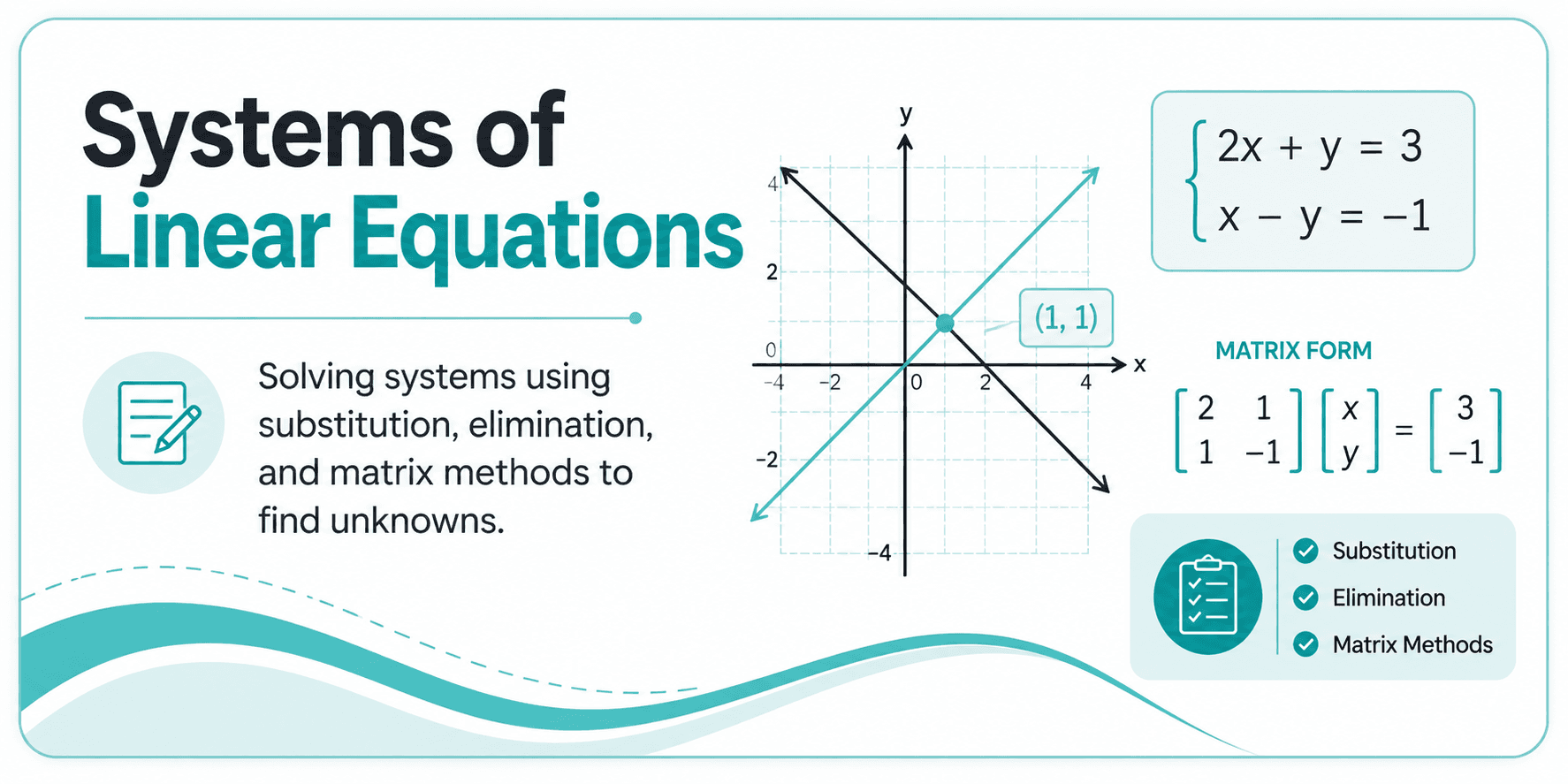
Systems of Linear Equations
Solving systems using substitution, elimination, and matrix methods to find unknowns.
Systems of Linear Equations
Solving systems using substitution, elimination, and matrix methods to find unknowns.

Matrix Operations
Adding, multiplying, row reducing, and inverting matrices to solve structured problems.
Matrix Operations
Adding, multiplying, row reducing, and inverting matrices to solve structured problems.
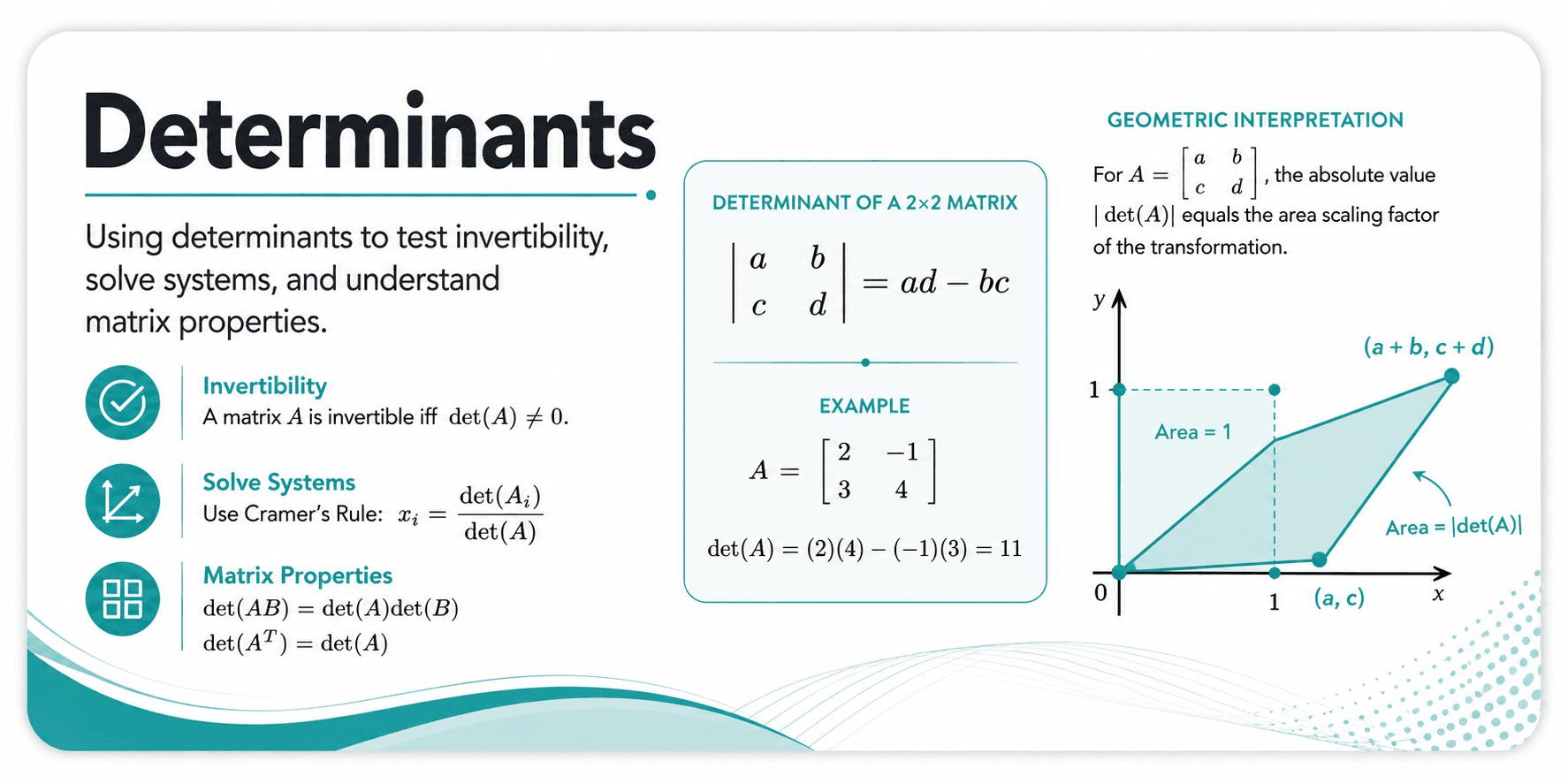
Determinants
Using determinants to test invertibility, solve systems, and understand matrix properties.
Determinants
Using determinants to test invertibility, solve systems, and understand matrix properties.
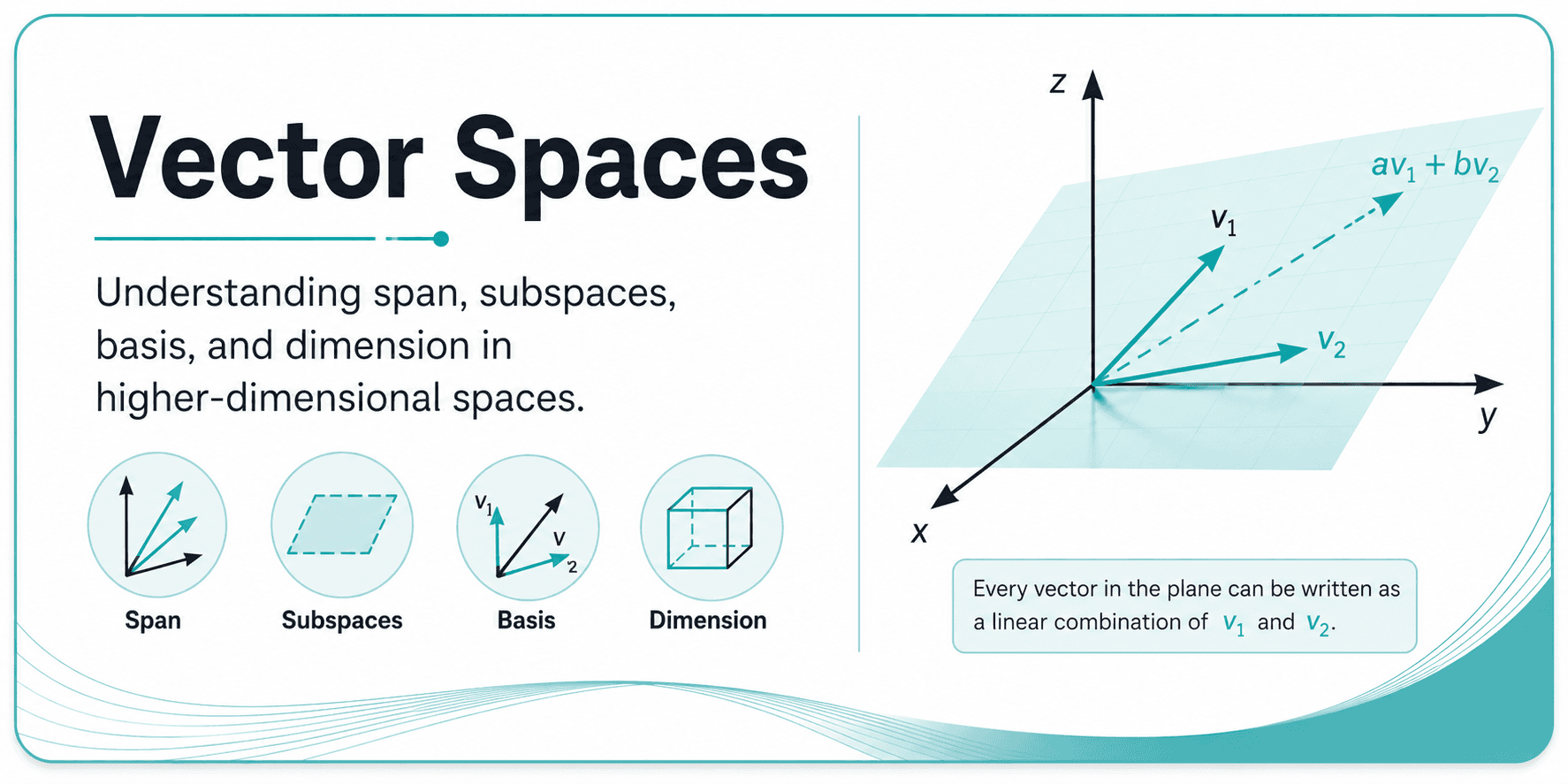
Vector Spaces
Understanding span, subspaces, basis, and dimension in higher-dimensional spaces.
Vector Spaces
Understanding span, subspaces, basis, and dimension in higher-dimensional spaces.

Linear Transformations
Mapping vectors between spaces through rotations, reflections, scalings, and shears.
Linear Transformations
Mapping vectors between spaces through rotations, reflections, scalings, and shears.
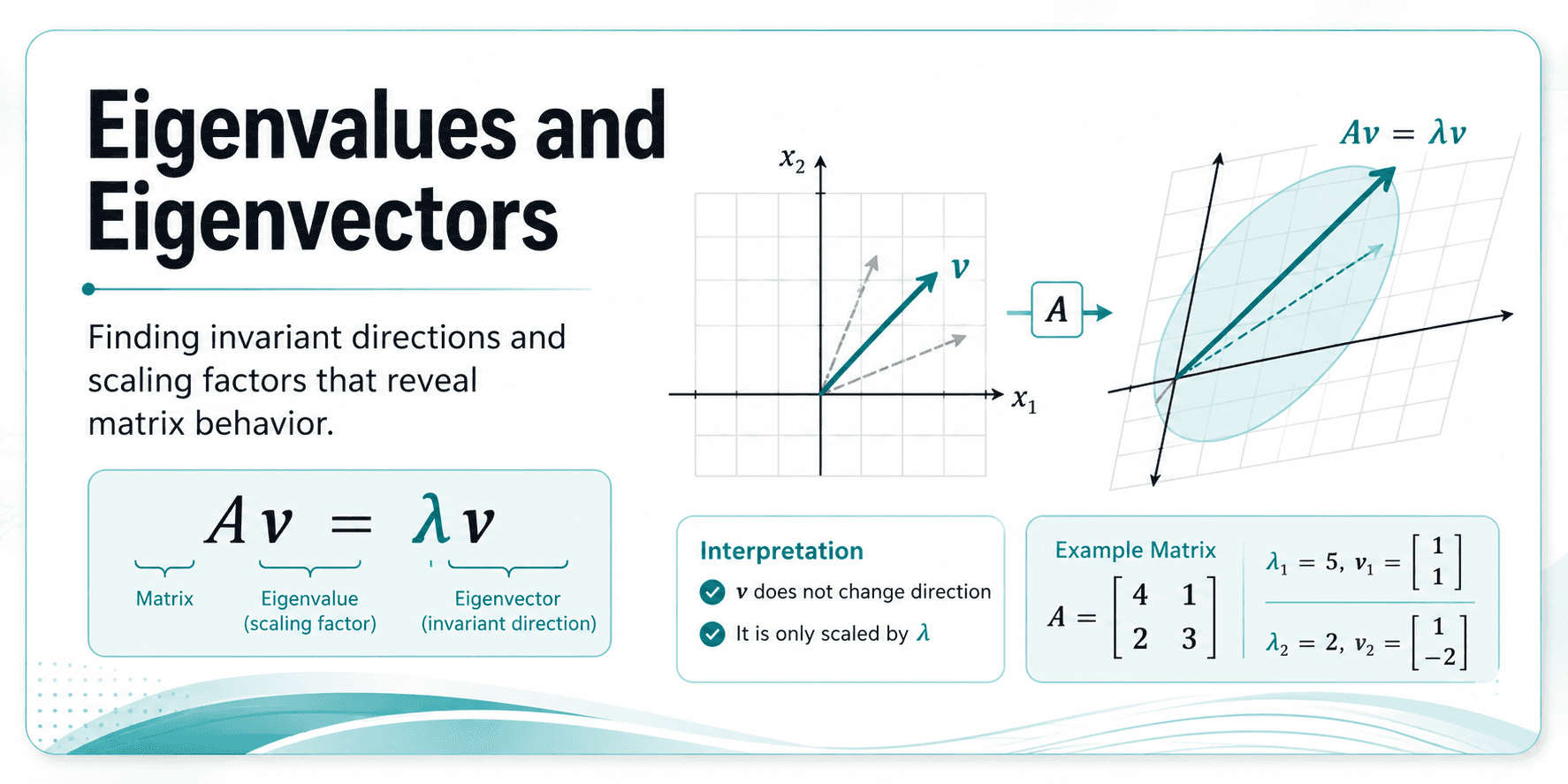
Eigenvalues and Eigenvectors
Finding invariant directions and scaling factors that reveal matrix behavior.
Eigenvalues and Eigenvectors
Finding invariant directions and scaling factors that reveal matrix behavior.
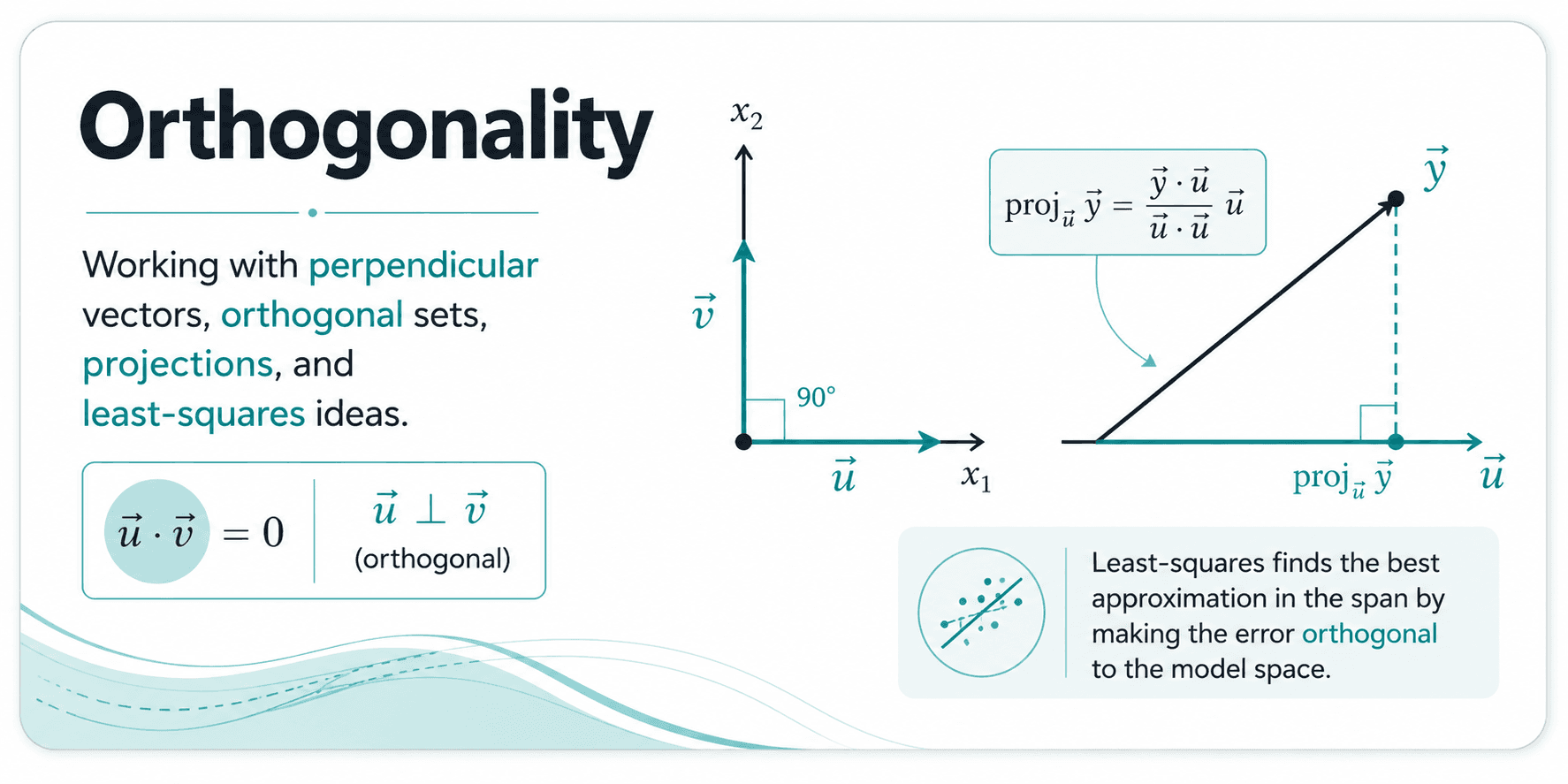
Orthogonality
Working with perpendicular vectors, orthogonal sets, projections, and least-squares ideas.
Orthogonality
Working with perpendicular vectors, orthogonal sets, projections, and least-squares ideas.
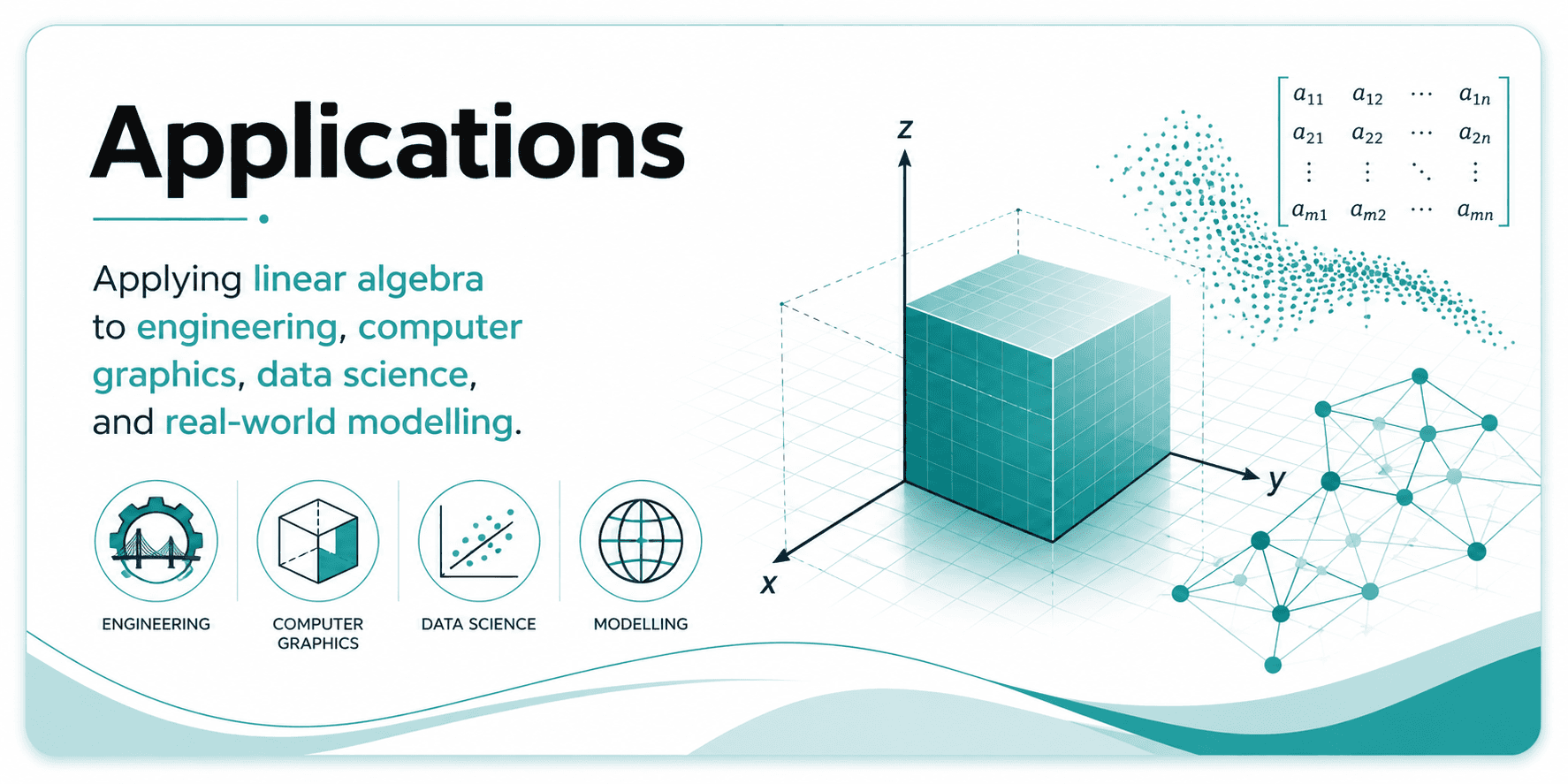
Applications
Applying linear algebra to engineering, computer graphics, data science, and real-world modelling.
What We Cover:
What We Cover:

University Linear Algebra for Engineers: Matrices, Vector Spaces & Eigenvalues
University Linear Algebra for Engineers: Matrices, Vector Spaces & Eigenvalues
University Linear Algebra for Engineers: Matrices, Vector Spaces & Eigenvalues
Transition from basic matrix computation to visualizing and mastering multi-dimensional vector spaces and linear transformations. These 1-on-1 sessions focus on building both the computational accuracy and the abstract logic required for advanced engineering algorithms. We tutor linear algebra at every Ontario university — whether your course is MAT223 or MAT188 (UofT), MATH 136 (Waterloo), MATH 1B03 (McMaster), or MTH 141 (TMU).
Transition from basic matrix computation to visualizing and mastering multi-dimensional vector spaces and linear transformations. These 1-on-1 sessions focus on building both the computational accuracy and the abstract logic required for advanced engineering algorithms. We tutor linear algebra at every Ontario university — whether your course is MAT223 or MAT188 (UofT), MATH 136 (Waterloo), MATH 1B03 (McMaster), or MTH 141 (TMU).
Transition from basic matrix computation to visualizing and mastering multi-dimensional vector spaces and linear transformations. These 1-on-1 sessions focus on building both the computational accuracy and the abstract logic required for advanced engineering algorithms. We tutor linear algebra at every Ontario university — whether your course is MAT223 or MAT188 (UofT), MATH 136 (Waterloo), MATH 1B03 (McMaster), or MTH 141 (TMU).
100% Money-Back Guarantee on your first session.
100% Money-Back Guarantee on your first session.
UNIT
6
UNIT
6
Eigenvalues and Eigenvectors
Discover how eigenvalues and eigenvectors reveal important characteristics of linear systems and matrices. This summary explains characteristic equations, eigenspaces, matrix diagonalization, and their applications in differential equations, machine learning, computer vision, quantum mechanics, and engineering.
Discover how eigenvalues and eigenvectors reveal important characteristics of linear systems and matrices. This summary explains characteristic equations, eigenspaces, matrix diagonalization, and their applications in differential equations, machine learning, computer vision, quantum mechanics, and engineering.
Characteristic Equation
det(A − λI) = 0
Solve this equation to find the eigenvalues λ of matrix A.
Eigenspace Extraction
(A − λI)x = 0
For each eigenvalue λ, solve the homogeneous system to find eigenvectors x in the null space (kernel) of A − λI.
Matrix Diagonalization
A = PDP−1
If A is diagonalizable, P contains eigenvectors of A (as columns) and D is a diagonal matrix of eigenvalues.
Diagonalization makes large matrix powers Ak easy to compute: Ak = PDkP−1.
Visual hint
Eigenvectors are directions that are scaled but not rotated.
- Direction stays the same.
- Only the length changes by λ.
Ax = λxNo rotation, only scaling.
Linear algebra functions as a core operational language for engineering data, structural systems, and graphics processing. In these personalized sessions, you will learn to navigate the proofs, algorithms, and matrix mechanics tested on university exams.
Linear algebra functions as a core operational language for engineering data, structural systems, and graphics processing. In these personalized sessions, you will learn to navigate the proofs, algorithms, and matrix mechanics tested on university exams.
Linear algebra functions as a core operational language for engineering data, structural systems, and graphics processing. In these personalized sessions, you will learn to navigate the proofs, algorithms, and matrix mechanics tested on university exams.
UNIT
7
UNIT
7
Orthogonality
Learn the principles of orthogonality and how perpendicular vectors simplify mathematical computations. This cheat sheet reviews inner products, projections, orthogonal sets, Gram–Schmidt orthogonalization, and least squares methods used extensively in optimization, signal processing, statistics, and engineering.
Learn the principles of orthogonality and how perpendicular vectors simplify mathematical computations. This cheat sheet reviews inner products, projections, orthogonal sets, Gram–Schmidt orthogonalization, and least squares methods used extensively in optimization, signal processing, statistics, and engineering.
1Inner Products & Projections
- The dot product (inner product) helps us verify orthogonality.
u ⊥ v if and only if u · v = 0
- The projection of u onto v is
projv(u) = u · vv · v v
2Orthogonal and Orthonormal Sets
Two vectors u and v are orthogonal if
u · v = 0.
- A set of vectors {v1, v2, …, vk} is orthogonal if vi · vj = 0 for all i ≠ j.
- A set is orthonormal if the vectors are orthogonal and each has unit length: ‖vi‖ = 1 for all i.
Key Idea
Orthonormal vectors are mutually perpendicular and have length 1.
3Gram–Schmidt Process
Gram–Schmidt
Process
The Gram–Schmidt process converts any linearly independent set (a skewed basis) into an orthogonal set.
With normalization, it produces an orthonormal set.
Why It Matters
Orthogonal/orthonormal bases simplify computations, least squares solutions, and understanding of vector spaces.
UNIT
8
UNIT
8
Applications
See how linear algebra is applied to real-world engineering and scientific problems. This summary introduces least squares approximation, Markov chains, systems of differential equations, and practical applications that demonstrate the importance of matrices and vector spaces across multiple disciplines.
See how linear algebra is applied to real-world engineering and scientific problems. This summary introduces least squares approximation, Markov chains, systems of differential equations, and practical applications that demonstrate the importance of matrices and vector spaces across multiple disciplines.
1Least Squares
Given an overdetermined system Ax ≈ b,
the least squares solution minimizes ‖Ax − b‖2.
Normal equation:
ATAx̂ = ATb
2Markov Chains
A Markov chain models transitions between states using a transition matrix P.
It describes the evolution of probabilities and predicts steady-state behavior.
Steady State
A probability vector π such that πTP = πT. As k → ∞, Pk converges to a matrix with rows equal to πT.
3Systems of Differential Equations
Coupled first-order linear systems
x′(t) = Ax(t)
can be decoupled using diagonalization. If A = PDP−1, then with y = P−1x, we get y′(t) = Dy(t), a system of independent equations.
Coupled System
x′(t) = Ax(t)
(variables influence each other)
P−1
change of variables
Decoupled System
y′(t) = Dy(t)
(independent equations)
P
transform back
Back to Original
x(t) = Py(t)
Note: Linear algebra provides the tools to solve real-world problems in engineering optimization, data fitting, and dynamic systems. It turns models into solutions.

Rami Alzaytavi
B.ENG. Software Engineer

Yacoob Kathrada
Bsc. Biomedical

Maya Al Khowjeh
B.Tech. Civil Engineering

Taha Arafat
Msc. Pharmacology

Jawad Qourshah
B.ENG. Mechanical Engineering

Manish Bahat
M.ENG. Mechanical Engineering

Oubada Al Tarabishi
M.ENG. Electrical Engineering

Ahmad Dawood
MSc. Computer Science
Rami Alzaytavi
B.ENG. Software Engineer
Yacoob Kathrada
Bsc. Biomedical
Maya Al Khowjeh
B.Tech. Civil Engineering
Taha Arafat
Msc. Pharmacology
Jawad Qourshah
B.ENG. Mechanical Engineering
Manish Bahat
M.ENG. Mechanical Engineering
Oubada Al Tarabishi
M.ENG. Electrical Engineering
Ahmad Dawood
MSc. Computer Science
Contact us
Get in touch with our experts team

Contact us
Get in touch with our experts team
Where Our Students Come From





Coming Soon!
Linear Algebra Course Notes & Exam Review
Review the major concepts taught throughout your course in one organized resource. The course review breaks challenging topics into smaller, understandable sections and provides clear examples showing how important concepts are applied.
✓ Systems of Linear Equations
✓ Matrix Operations
✓ Determinants
✓ Vector Spaces
✓ Linear Transformations
✓ Eigenvalues and Eigenvectors
✓ Orthogonality
✓ Application
✓ Core course topics and foundational concepts
✓ Clear explanations supported by worked examples
✓ Common mistakes and strategies for avoiding them
✓ Important skills needed for SCH4U✓ Practice questions organized by course topic

What the Course
Review Includes
Topics Covered
Coming Soon!
Linear Algebra Practice Exam with Answers
Prepare for tests and final assessments with realistic, course-aligned practice exams. Each exam covers the major topics taught throughout the course, with detailed answer explanations that help students understand concepts, apply their knowledge, and learn from mistakes.
Students can use the practice exams to become familiar with different question formats, review challenging units, improve time management, and determine which concepts require additional preparation.

✓ Full-length practice exams
✓ Course-aligned and exam-style questions
✓ Questions from all major SCH4U topics
✓ Detailed step-by-step solution guides
✓ Focused review of mistakes and weaker areas
Coming Soon!

Linear Algebra Cheat Sheet & Formula Sheet (PDF)
Quickly access the most important formulas, equations, constants, and reference tables for your course in one organized resource. Each formula sheet is designed to simplify exam preparation by bringing together the equations, symbols, and relationships students use most often throughout the semester.
Whether you're reviewing for a quiz, preparing for a midterm, or studying for a final exam, our formula sheets provide a convenient reference for the key equations and concepts covered in your course. They help students review more efficiently while building confidence before assessments.
✓ Essential formulas organized by topic
✓ Common symbols, variables, and units
✓ Quick reference tables and diagrams
✓ Important equations used throughout the course
✓ Perfect for exam review and last-minute revision
Linear Algebra Free Resources
Fit Minds Academy provides personalized 1-on-1 tutoring for high school students pursuing engineering programs and university students tackling challenging engineering courses. Our support covers math, physics, chemistry, calculus, statics, dynamics, thermodynamics, fluid mechanics, strength of materials, and other core engineering subjects.
Courses:

High School Courses
Support for Ontario high school students building the math and science foundation needed for future engineering programs.
Courses:

First-Year Engineering Courses
One-on-One private tutoring for core courses taken by every first years engineering student
Courses:

Advanced Engineering Courses
Course-specific tutoring for technical courses that require stronger applied problem-solving.
All Courses We Tutor

Why Choose
Fit Minds Academy
Personalized 1-on-1 Tutoring
Every student has different strengths, learning gaps, and academic goals. Each tutoring session is tailored to the student’s course, current level, pace, and areas requiring additional support. Lessons focus on the exact concepts and problem types the student needs to understand.
Carefully Matched Tutors for Every Student
Students are matched with tutors based on their course, academic level, subject requirements, learning needs, and availability. Many of our tutors are engineers or technical professionals who understand both the course material and its practical applications.
Ontario Curriculum and Engineering-Focused Support
Our high school tutoring follows the Ontario curriculum and supports the math and science prerequisites required for engineering, science, and technology programs. We also tutor first-year and upper-year university courses, including calculus, physics, linear algebra, programming, thermodynamics, fluid mechanics, and strength of materials.
More than Homework Help
Our tutoring goes beyond completing assignments or memorizing formulas. Students receive clear explanations, structured practice, and step-by-step problem-solving support designed to strengthen understanding and prepare them for quizzes, tests, exams, university courses, and future engineering studies.
Flexible Hourly Tutoring
$95
Per Hour
Pay-As-You-Go Plan, Billed Biweekly
✓ Sessions from the comfort of your home
✓ Access to Fit Minds Discord server
✓ Personalised sessions to suit you
✓ We teach your course material
✓ Resources (course notes, practice tests, and videos)
10-hour Prepaid Plan
$900
Per 10 Hours
$90 per hour - Save $50
✓ Sessions from the comfort of your home
✓ Access to Fit Minds Discord server
✓ Personalised sessions to suit you
✓ We teach your course material
✓ Resources (course notes, practice tests, and videos)
Not Sure Which Option Is Right?
Speak with Fit Minds Academy and find the Linear Algebra tutoring plan that best matches the student’s current course needs and academic goals.


Pricing
Linear Algebra Course Notes & Exam Review
Review the major concepts taught throughout your course in one organized resource. The course review breaks challenging topics into smaller, understandable sections and provides clear examples showing how important concepts are applied.
✓ Core course topics and foundational concepts
✓ Clear explanations supported by worked examples
✓ Common mistakes and strategies for avoiding them
✓ Important skills needed for Physics 1
✓ Practice questions organized by course topic
What the Course
Review Includes
Topics Covered
Coming Soon!
✓ Systems of Linear Equations
✓ Matrix Operations
✓ Determinants
✓ Vector Spaces
✓ Linear Transformations
✓ Eigenvalues and Eigenvectors
✓ Orthogonality
✓ Application
Coming Soon!
Linear Algebra Practice Exam with Answers
Prepare for tests and final assessments with realistic, course-aligned practice exams. Each exam covers the major topics taught throughout the course, with detailed answer explanations that help students understand concepts, apply their knowledge, and learn from mistakes.
Students can use the practice exams to become familiar with different question formats, review challenging units, improve time management, and determine which concepts require additional preparation.
✓ Full-length practice exams
✓ Course-aligned and exam-style questions
✓ Questions from all major Physics 1 topics
✓ Detailed step-by-step solution guides
✓ Focused review of mistakes and weaker areas
Linear Algebra Cheat Sheet & Formula Sheet (PDF)
Coming Soon!
Quickly access the most important formulas, equations, constants, and reference tables for your course in one organized resource. Each formula sheet is designed to simplify exam preparation by bringing together the equations, symbols, and relationships students use most often throughout the semester.
Whether you're reviewing for a quiz, preparing for a midterm, or studying for a final exam, our formula sheets provide a convenient reference for the key equations and concepts covered in your course. They help students review more efficiently while building confidence before assessments.
✓ Essential formulas organized by topic
✓ Common symbols, variables, and units
✓ Quick reference tables and diagrams
✓ Important equations used throughout the course
✓ Perfect for exam review and last-minute revision
Linear Algebra Free Resources
All Courses We Tutor
Fit Minds Academy provides personalized 1-on-1 tutoring for high school students pursuing engineering programs and university students tackling challenging engineering courses. Our support covers math, physics, chemistry, calculus, statics, dynamics, thermodynamics, fluid mechanics, strength of materials, and other core engineering subjects.
Courses:
High School Courses
Support for Ontario high school students building the math and science foundation needed for future engineering programs.
Courses:
First-Year Engineering Courses
One-on-One private tutoring for core courses taken by every first years engineering student
Courses:
Advanced Engineering Courses
Course-specific tutoring for technical courses that require stronger applied problem-solving.
Why Choose
Fit Minds Academy
Personalized 1-on-1 Tutoring
Every student has different strengths, learning gaps, and academic goals. Each tutoring session is tailored to the student’s course, current level, pace, and areas requiring additional support. Lessons focus on the exact concepts and problem types the student needs to understand.
Carefully Matched Tutors for Every Student
Students are matched with tutors based on their course, academic level, subject requirements, learning needs, and availability. Many of our tutors are engineers or technical professionals who understand both the course material and its practical applications.
Ontario Curriculum and Engineering-Focused Support
Our high school tutoring follows the Ontario curriculum and supports the math and science prerequisites required for engineering, science, and technology programs. We also tutor first-year and upper-year university courses, including calculus, physics, linear algebra, programming, thermodynamics, fluid mechanics, and strength of materials.
More than Homework Help
Our tutoring goes beyond completing assignments or memorizing formulas. Students receive clear explanations, structured practice, and step-by-step problem-solving support designed to strengthen understanding and prepare them for quizzes, tests, exams, university courses, and future engineering studies.
Flexible Hourly Tutoring
$95
Per Hour
Pay-As-You-Go Plan, Billed Biweekly
✓ Sessions from the comfort of your home
✓ Access to Fit Minds Discord server
✓ Personalised sessions to suit you
✓ We teach your course material
✓ Resources (course notes, practice tests, and videos)
10-hour Prepaid Plan
$900
Per 10 Hours
$90 per hour - Save $50
✓ Sessions from the comfort of your home
✓ Access to Fit Minds Discord server
✓ Personalised sessions to suit you
✓ We teach your course material
✓ Resources (course notes, practice tests, and videos)
Not Sure Which Option Is Right?
Speak with Fit Minds Academy and find the Linear Algebra tutoring plan that best matches the student’s current course needs and academic goals.
Pricing
Where Our Students Come From
Here is a quick recap on all the units covered in
Linear Algebra
UNIT
5
Linear Transformations
Understand how linear transformations describe mappings between vector spaces while preserving mathematical structure. This guide introduces linearity tests, kernels, ranges, matrix representations, and transformation properties that are widely applied in engineering, robotics, graphics, and applied mathematics.
1Verifying linearity
A function T: V → W is linear if for all vectors u, v ∈ V and all scalars c,
T(u + v) = T(u) + T(v)
T(cu) = cT(u)
Mapping diagram
2Kernel and range
The kernel of T is the set of all vectors mapped to the zero vector:
ker(T) = {v ∈ V | T(v) = 0W}
The range (or image) of T is the set of all possible outputs:
Range(T) = {T(v) | v ∈ V} ⊆ W
3Standard matrix representation
- Let {e1, e2, …, en} be the standard basis of V.
- The columns of the matrix [T] are T(e1), T(e2), …, T(en) expressed in the standard basis of W.
- These matrices can represent geometric transformations such as rotations, reflections, and shears.
[T] = [T(e1) T(e2) ⋯ T(en)]
Rotations
Reflections
Shears
UNIT
4
Vector Spaces
Explore vector spaces and the mathematical structures that form the basis of linear algebra. This summary covers subspaces, linear independence, span, basis, dimension, and rank-nullity concepts that are fundamental to advanced mathematics, engineering, computer science, and data analysis.
1Subspace Verification
A nonempty subset W of a vector space V is a subspace if it satisfies:
Zero vector: 0 ∈ W.
Closure under addition: If u, v ∈ W, then u + v ∈ W.
Closure under scalar multiplication: If u ∈ W and c ∈ 𝔽, then cu ∈ W.
2Span & Linear Independence
The span of vectors v1, v2, …, vk is
span{v1, v2, …, vk} = { c1v1 + c2v2 + ⋯ + ckvk | ci ∈ 𝔽 }.
A set {v1, v2, …, vk} is linearly independent if
c1v1 + c2v2 + ⋯ + ckvk = 0
implies c1 = c2 = ⋯ = ck = 0 (only trivial solution). Otherwise, the set is linearly dependent (there exists a non-trivial solution).
3Basis & Dimension
A basis of a vector space V is a minimal linearly independent set that spans V.
Every vector in V can be written uniquely as a linear combination of basis vectors.
Rank–Nullity Theorem: For a matrix A with n columns,
rank(A) + nullity(A) = n.
- Rank(A) = dimension of the column space Col(A) ≤ 𝔽m.
- Nullity(A) = dimension of the kernel Null(A) ≤ 𝔽n.
Dimension of V: The number of vectors in any basis of V (all bases have the same size).
Key Idea: Understand structure through independence, span, and dimension.
UNIT
3
Determinants
Master determinants and understand their role in solving systems of equations, finding matrix inverses, and analyzing linear transformations. This formula sheet reviews cofactor expansion, determinant properties, and the mathematical significance of determinants in linear algebra and engineering applications. You will master 2x2 and 3x3 determinants first, then extend to larger matrices using cofactor expansion.
1Cofactor Expansion
Determinant expansion along the first row using signed minors (cofactors):
det(A) = a11C11 + a12C12 + a13C13
where
C1j = (−1)1+jM1j
M1j = minor of a1j
(determinant of the 2 × 2 submatrix obtained by deleting row 1 and column j)
2Operational Properties
Swapping any two rows (or columns) changes the sign of the determinant.
det(A) → −det(A)
- k ·
Multiplying any row (or column) by a scalar k multiplies the determinant by k.
det(A) → k det(A)
- Ri ←
Ri+kRjAdding a multiple of one row (or column) to another row (or column) does not change the determinant.
det(A) → det(A)
If A is upper triangular, then the determinant equals the product of the diagonal entries.
det(A) = a11a22 ⋯ ann
3Why Determinants
Matter
Determinants reveal whether a matrix is invertible or collapses dimensions.
- det(A) ≠ 0→A is invertible; no collapse of dimensions.
- det(A) = 0→A is singular; it collapses dimensions.
UNIT
2
Matrix Operations
Develop a solid understanding of matrix algebra by learning how to perform essential matrix operations. This guide covers matrix multiplication, transposition, inverses, matrix properties, and common computational techniques that are frequently used in engineering, physics, computer graphics, and machine learning.
1Matrix Multiplication & Transposition
Multiplication is non‑commutative.
In general,
AB ≠ BA
Transposition Rule:
(AB)T = BTAT
The transpose of a product reverses the order.
2Matrix Inversion
The inverse of a matrix (if it exists) can be found using row reduction on the augmented matrix [A | I].
[AI] ~ [IA−1]
Method:
- Form [A | I].
- Apply elementary row operations.
- Obtain [I | A−1].
Important Notes
- Inverse matrices exist only for invertible (nonsingular) matrices.
- Matrix arithmetic requires careful dimension checking.
UNIT
1
Systems of Linear Equations
Learn the foundation of linear algebra by solving systems of linear equations using algebraic and matrix-based methods. This summary introduces Gaussian elimination, matrix representation, solution classifications, and consistency conditions that are essential for engineering, computer science, data science, and higher mathematics courses. Gaussian elimination works by reducing the augmented matrix to row echelon form (REF), and then to reduced row echelon form (RREF) to read off the solution directly.
1Gaussian elimination
Use Elementary Row Operations (EROs) to transform the augmented matrix to REF, then RREF.
Elementary Row Operations
- 1Ri ↔ Rj(swap rows)
- 2Ri → kRi(k ≠ 0) (scale a row)
- 3Ri → Ri + kRj(add multiple of one row to another)
Augmented Matrix
12−1−82−1314−112−2Row Echelon Form (REF)
12−1−80−55300012Reduced Row Echelon Form (RREF)
1002010−40012Apply EROs systematically to reach REF, then RREF. The RREF reveals the solution structure clearly.
2Solution classification
(a) Unique solution
Every variable is a pivot variable (no free variables).
Example RREF:
One solution.
(b) Infinite solutions
At least one free variable (fewer pivots than variables).
Example RREF:
Let x3 = s, x4 = t be free.
Parametric vector solution:
x = x1x2x3x4 = 1400 + s −2110 + t 0−301 s, t ∈ ℝ
(c) No solution (inconsistent)
A row of the form [ 0 0 ⋯ 0 | b ] with b ≠ 0 appears in RREF.
Example RREF:
No solution (inconsistent).
KEY TAKEAWAY: The row-reduced echelon form (RREF) of the augmented matrix tells whether a system has one solution, infinitely many solutions, or no solution.
UNIT
6
Eigenvalues and Eigenvectors
Discover how eigenvalues and eigenvectors reveal important characteristics of linear systems and matrices. This summary explains characteristic equations, eigenspaces, matrix diagonalization, and their applications in differential equations, machine learning, computer vision, quantum mechanics, and engineering.
Characteristic Equation
det(A − λI) = 0
Solve this equation to find the eigenvalues λ of matrix A.
Eigenspace Extraction
(A − λI)x = 0
For each eigenvalue λ, solve the homogeneous system to find eigenvectors x in the null space (kernel) of A − λI.
Matrix Diagonalization
A = PDP−1
If A is diagonalizable, P contains eigenvectors of A (as columns) and D is a diagonal matrix of eigenvalues.
Diagonalization makes large matrix powers Ak easy to compute: Ak = PDkP−1.
Visual hint
Eigenvectors are directions that are scaled but not rotated.
- Direction stays the same.
- Only the length changes by λ.
Ax = λxNo rotation, only scaling.
UNIT
7
Orthogonality
Learn the principles of orthogonality and how perpendicular vectors simplify mathematical computations. This cheat sheet reviews inner products, projections, orthogonal sets, Gram–Schmidt orthogonalization, and least squares methods used extensively in optimization, signal processing, statistics, and engineering.
1Inner Products & Projections
- The dot product (inner product) helps us verify orthogonality.
u ⊥ v if and only if u · v = 0
- The projection of u onto v is
projv(u) = u · vv · v v
2Orthogonal and Orthonormal Sets
Two vectors u and v are orthogonal if
u · v = 0.
- A set of vectors {v1, v2, …, vk} is orthogonal if vi · vj = 0 for all i ≠ j.
- A set is orthonormal if the vectors are orthogonal and each has unit length: ‖vi‖ = 1 for all i.
Key Idea
Orthonormal vectors are mutually perpendicular and have length 1.
3Gram–Schmidt Process
Gram–Schmidt
Process
The Gram–Schmidt process converts any linearly independent set (a skewed basis) into an orthogonal set.
With normalization, it produces an orthonormal set.
Why It Matters
Orthogonal/orthonormal bases simplify computations, least squares solutions, and understanding of vector spaces.
UNIT
8
Applications
See how linear algebra is applied to real-world engineering and scientific problems. This summary introduces least squares approximation, Markov chains, systems of differential equations, and practical applications that demonstrate the importance of matrices and vector spaces across multiple disciplines.
1Least Squares
Given an overdetermined system Ax ≈ b,
the least squares solution minimizes ‖Ax − b‖2.
Normal equation:
ATAx̂ = ATb
2Markov Chains
A Markov chain models transitions between states using a transition matrix P.
It describes the evolution of probabilities and predicts steady-state behavior.
Steady State
A probability vector π such that πTP = πT. As k → ∞, Pk converges to a matrix with rows equal to πT.
3Systems of Differential Equations
Coupled first-order linear systems
x′(t) = Ax(t)
can be decoupled using diagonalization. If A = PDP−1, then with y = P−1x, we get y′(t) = Dy(t), a system of independent equations.
Coupled System
x′(t) = Ax(t)
(variables influence each other)
P−1
change of variables
Decoupled System
y′(t) = Dy(t)
(independent equations)
P
transform back
Back to Original
x(t) = Py(t)
Note: Linear algebra provides the tools to solve real-world problems in engineering optimization, data fitting, and dynamic systems. It turns models into solutions.
Linear Algebra Course Notes & Exam Review
Review the major concepts taught throughout your course in one organized resource. The course review breaks challenging topics into smaller, understandable sections and provides clear examples showing how important concepts are applied.
✓ Core course topics and foundational concepts
✓ Clear explanations supported by worked examples
✓ Common mistakes and strategies for avoiding them
✓ Important skills needed for Physics 1
✓ Practice questions organized by course topic
What the Course
Review Includes
Topics Covered
Coming Soon!
✓ Systems of Linear Equations
✓ Matrix Operations
✓ Determinants
✓ Vector Spaces
✓ Linear Transformations
✓ Eigenvalues and Eigenvectors
✓ Orthogonality
✓ Application
Linear Algebra Practice Exam with Answers
Prepare for tests and final assessments with realistic, course-aligned practice exams. Each exam covers the major topics taught throughout the course, with detailed answer explanations that help students understand concepts, apply their knowledge, and learn from mistakes.
Students can use the practice exams to become familiar with different question formats, review challenging units, improve time management, and determine which concepts require additional preparation.
Coming Soon!
✓ Full-length practice exams
✓ Course-aligned and exam-style questions
✓ Questions from all major Physics 1 topics
✓ Detailed step-by-step solution guides
✓ Focused review of mistakes and weaker areas
Linear Algebra Cheat Sheet & Formula Sheet (PDF)
Coming Soon!
✓ Essential formulas organized by topic
✓ Common symbols, variables, and units
✓ Quick reference tables and diagrams
✓ Important equations used throughout the course
✓ Perfect for exam review and last-minute revision
Quickly access the most important formulas, equations, constants, and reference tables for your course in one organized resource. Each formula sheet is designed to simplify exam preparation by bringing together the equations, symbols, and relationships students use most often throughout the semester.
Whether you're reviewing for a quiz, preparing for a midterm, or studying for a final exam, our formula sheets provide a convenient reference for the key equations and concepts covered in your course. They help students review more efficiently while building confidence before assessments.
All Courses We Tutor
Fit Minds Academy provides personalized 1-on-1 tutoring for high school students pursuing engineering programs and university students tackling challenging engineering courses. Our support covers math, physics, chemistry, calculus, statics, dynamics, thermodynamics, fluid mechanics, strength of materials, and other core engineering subjects.
Linear Algebra Free Resources
Courses:
High School Courses
Support for Ontario high school students building the math and science foundation needed for future engineering programs.
Courses:
First-Year Engineering Courses
One-on-One private tutoring for core courses taken by every first years engineering student
Courses:
Advanced Engineering Courses
Course-specific tutoring for technical courses that require stronger applied problem-solving.
Why Choose
Fit Minds Academy
Personalized 1-on-1 Tutoring
Every student has different strengths, learning gaps, and academic goals. Each tutoring session is tailored to the student’s course, current level, pace, and areas requiring additional support. Lessons focus on the exact concepts and problem types the student needs to understand.
Carefully Matched Tutors for Every Student
Students are matched with tutors based on their course, academic level, subject requirements, learning needs, and availability. Many of our tutors are engineers or technical professionals who understand both the course material and its practical applications.
Ontario Curriculum and Engineering-Focused Support
Our high school tutoring follows the Ontario curriculum and supports the math and science prerequisites required for engineering, science, and technology programs. We also tutor first-year and upper-year university courses, including calculus, physics, linear algebra, programming, thermodynamics, fluid mechanics, and strength of materials.
More than Homework Help
Our tutoring goes beyond completing assignments or memorizing formulas. Students receive clear explanations, structured practice, and step-by-step problem-solving support designed to strengthen understanding and prepare them for quizzes, tests, exams, university courses, and future engineering studies.
Flexible Hourly Tutoring
$95
Per Hour
Pay-As-You-Go Plan, Billed Biweekly
✓ Sessions from the comfort of your home
✓ Access to Fit Minds Discord server
✓ Personalised sessions to suit you
✓ We teach your course material
✓ Resources (course notes, practice tests, and videos)
10-hour Prepaid Plan
$900
Per 10 Hours
$90 per hour - Save $50
✓ Sessions from the comfort of your home
✓ Access to Fit Minds Discord server
✓ Personalised sessions to suit you
✓ We teach your course material
✓ Resources (course notes, practice tests, and videos)
Not Sure Which Option Is Right?
Speak with Fit Minds Academy and find the Linear Algebra tutoring plan that best matches the student’s current course needs and academic goals.
Pricing
Contact us
Get in touch with our experts team
FAQ
What Is Linear Algebra?

Do You Need Calculus for Linear Algebra?
Why Is Linear Algebra So Hard?
What Universities Teach Linear Algebra?
Is Linear Algebra Hard?
Is Linear Algebra Easier Than Calculus?
What Is Linear Algebra Good For?
Do You Offer Linear Algebra Tutoring Online?