Reviews
Reviews
UNIT
5
UNIT
5
Internal Flows (Pipe Networks)
Internal Flows (Pipe Networks)
Internal Flows (Pipe Networks)

Study internal fluid flow through pipes and duct systems by learning the principles governing pressure losses and flow resistance. You will learn to distinguish laminar from turbulent flow using the Reynolds number, and calculate head losses in real pipe systems. This summary covers flow regimes, head loss calculations, Darcy–Weisbach analysis, Moody diagrams, friction factors, and minor losses commonly encountered in engineering fluid systems.
Study internal fluid flow through pipes and duct systems by learning the principles governing pressure losses and flow resistance. You will learn to distinguish laminar from turbulent flow using the Reynolds number, and calculate head losses in real pipe systems. This summary covers flow regimes, head loss calculations, Darcy–Weisbach analysis, Moody diagrams, friction factors, and minor losses commonly encountered in engineering fluid systems.
Study internal fluid flow through pipes and duct systems by learning the principles governing pressure losses and flow resistance. You will learn to distinguish laminar from turbulent flow using the Reynolds number, and calculate head losses in real pipe systems. This summary covers flow regimes, head loss calculations, Darcy–Weisbach analysis, Moody diagrams, friction factors, and minor losses commonly encountered in engineering fluid systems.
Internal flow analysis plays a critical role in designing efficient piping systems, water distribution networks, HVAC systems, and industrial process equipment. Mastering these concepts helps engineers minimize energy losses while improving system performance and reliability.
Internal flow analysis plays a critical role in designing efficient piping systems, water distribution networks, HVAC systems, and industrial process equipment. Mastering these concepts helps engineers minimize energy losses while improving system performance and reliability.
Internal flow analysis plays a critical role in designing efficient piping systems, water distribution networks, HVAC systems, and industrial process equipment. Mastering these concepts helps engineers minimize energy losses while improving system performance and reliability.
UNIT
4
UNIT
4
Dimensional Analysis & Similitude
Dimensional Analysis & Similitude
Dimensional Analysis & Similitude

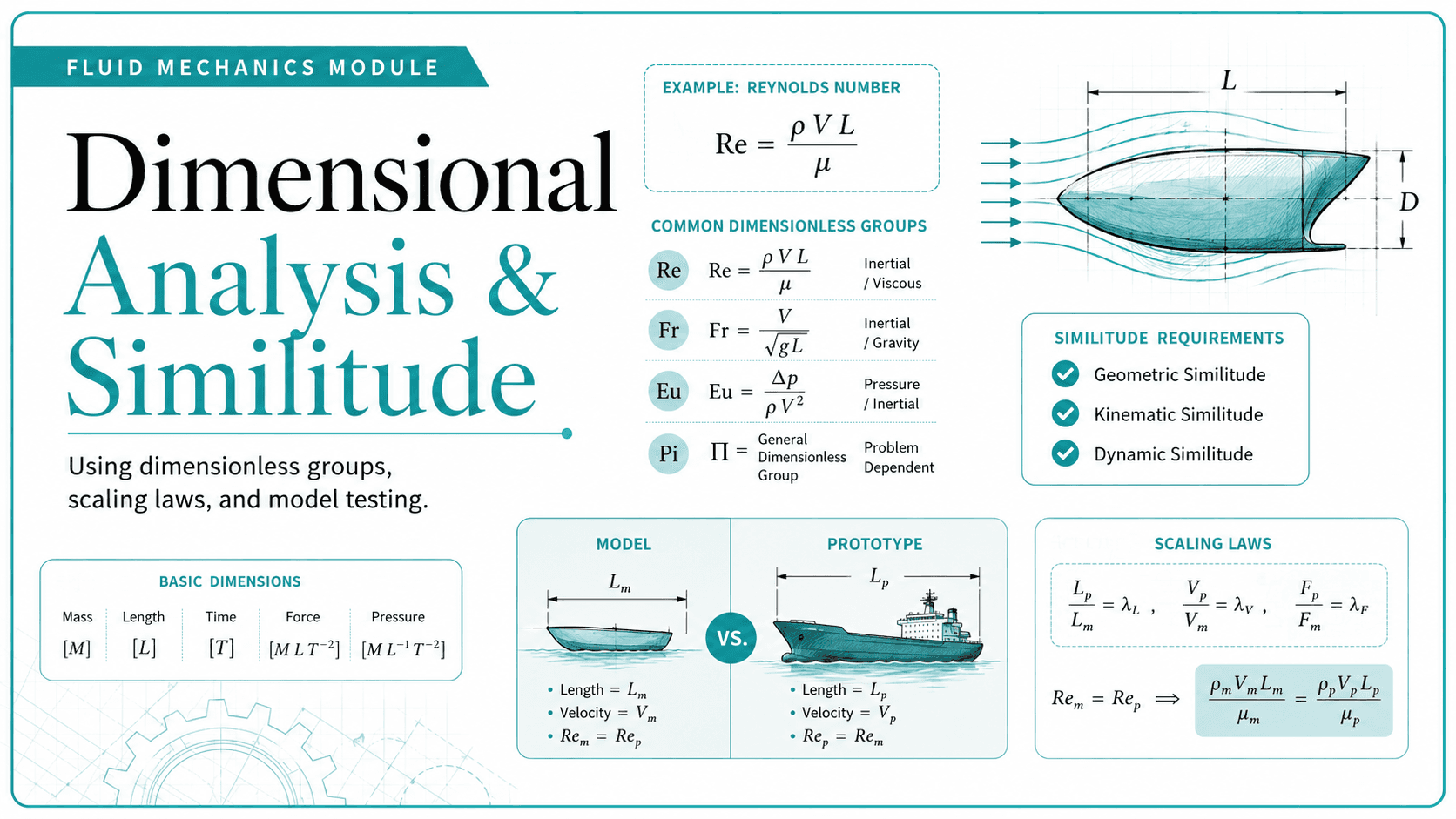
Understand how dimensional analysis simplifies complex engineering problems by identifying the relationships between important physical variables. This guide reviews Buckingham Pi Theory, dimensionless numbers, similitude principles, and model testing techniques that are widely used in experimental fluid mechanics and engineering design.
Understand how dimensional analysis simplifies complex engineering problems by identifying the relationships between important physical variables. This guide reviews Buckingham Pi Theory, dimensionless numbers, similitude principles, and model testing techniques that are widely used in experimental fluid mechanics and engineering design.
Understand how dimensional analysis simplifies complex engineering problems by identifying the relationships between important physical variables. This guide reviews Buckingham Pi Theory, dimensionless numbers, similitude principles, and model testing techniques that are widely used in experimental fluid mechanics and engineering design.
Dimensional analysis allows engineers to predict the behaviour of full-scale systems using laboratory models while reducing experimental costs and development time. These techniques are fundamental to research, product development, and performance testing across many engineering disciplines.
Dimensional analysis allows engineers to predict the behaviour of full-scale systems using laboratory models while reducing experimental costs and development time. These techniques are fundamental to research, product development, and performance testing across many engineering disciplines.
Dimensional analysis allows engineers to predict the behaviour of full-scale systems using laboratory models while reducing experimental costs and development time. These techniques are fundamental to research, product development, and performance testing across many engineering disciplines.
UNIT
3
UNIT
3
Control Volume Analysis
Control Volume Analysis
Control Volume Analysis
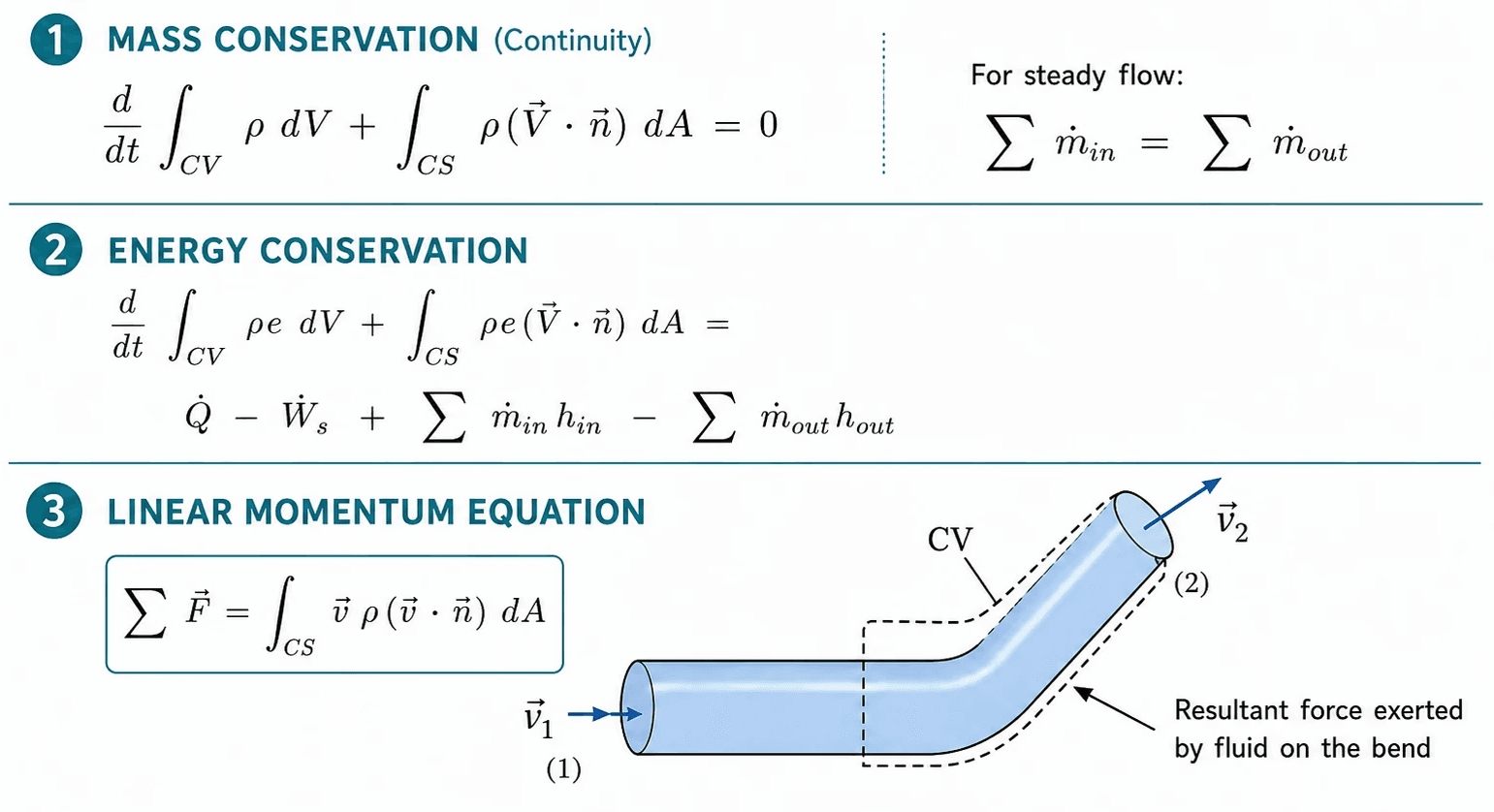
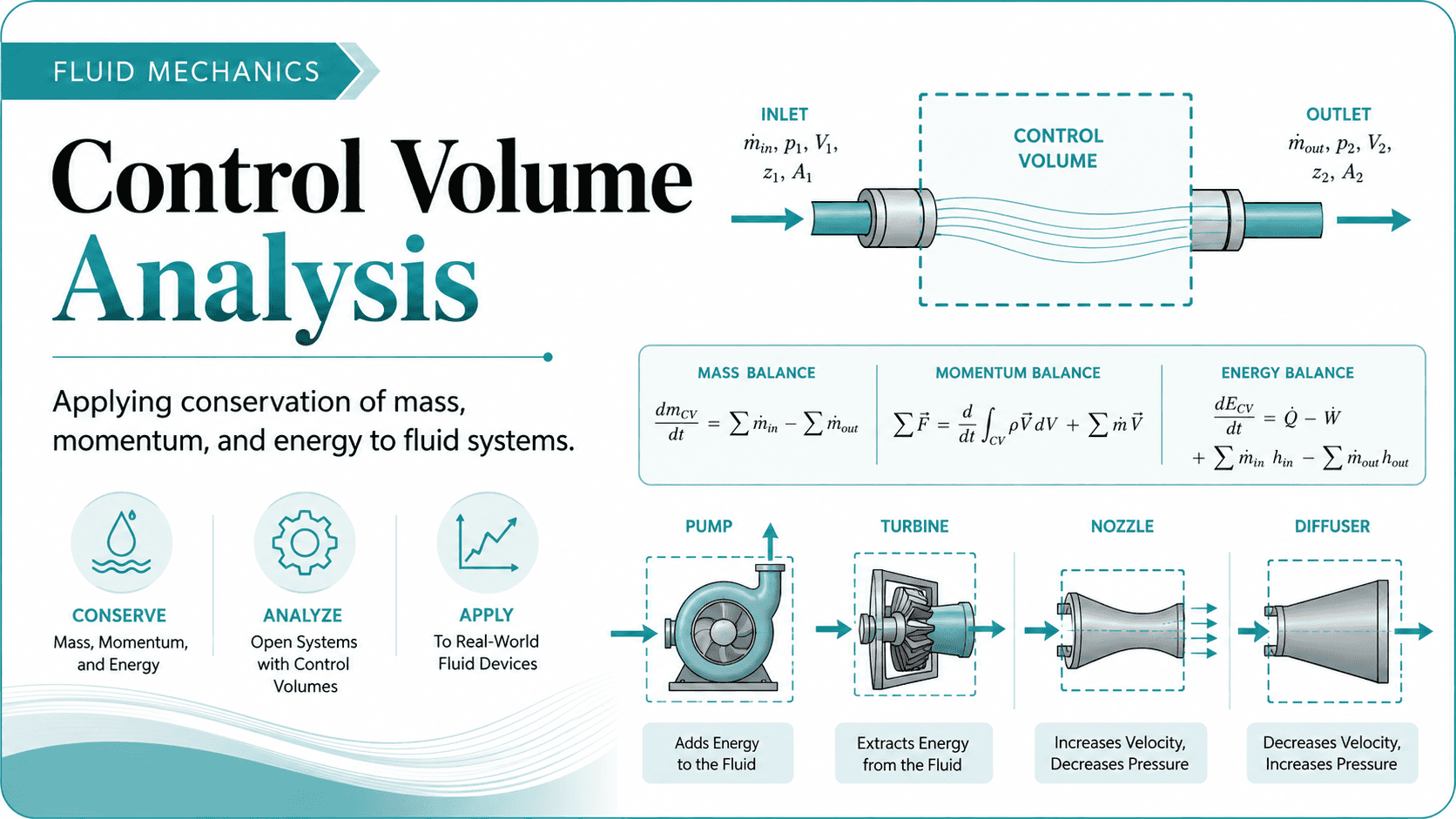
Apply the conservation laws of mass, momentum, and energy using the control volume approach to analyze engineering systems. This summary covers the continuity equation, conservation of energy, linear momentum equations, and practical control volume analysis techniques used throughout mechanical and fluid engineering.
Apply the conservation laws of mass, momentum, and energy using the control volume approach to analyze engineering systems. This summary covers the continuity equation, conservation of energy, linear momentum equations, and practical control volume analysis techniques used throughout mechanical and fluid engineering.
Apply the conservation laws of mass, momentum, and energy using the control volume approach to analyze engineering systems. This summary covers the continuity equation, conservation of energy, linear momentum equations, and practical control volume analysis techniques used throughout mechanical and fluid engineering.
Control volume analysis connects theoretical fluid mechanics with practical engineering design by simplifying the analysis of real systems. These conservation principles are widely applied to nozzles, diffusers, turbines, pumps, compressors, and many industrial fluid systems.
Control volume analysis connects theoretical fluid mechanics with practical engineering design by simplifying the analysis of real systems. These conservation principles are widely applied to nozzles, diffusers, turbines, pumps, compressors, and many industrial fluid systems.
UNIT
2
UNIT
2
Fluid Kinematics & Dynamics
Fluid Kinematics & Dynamics
Fluid Kinematics & Dynamics
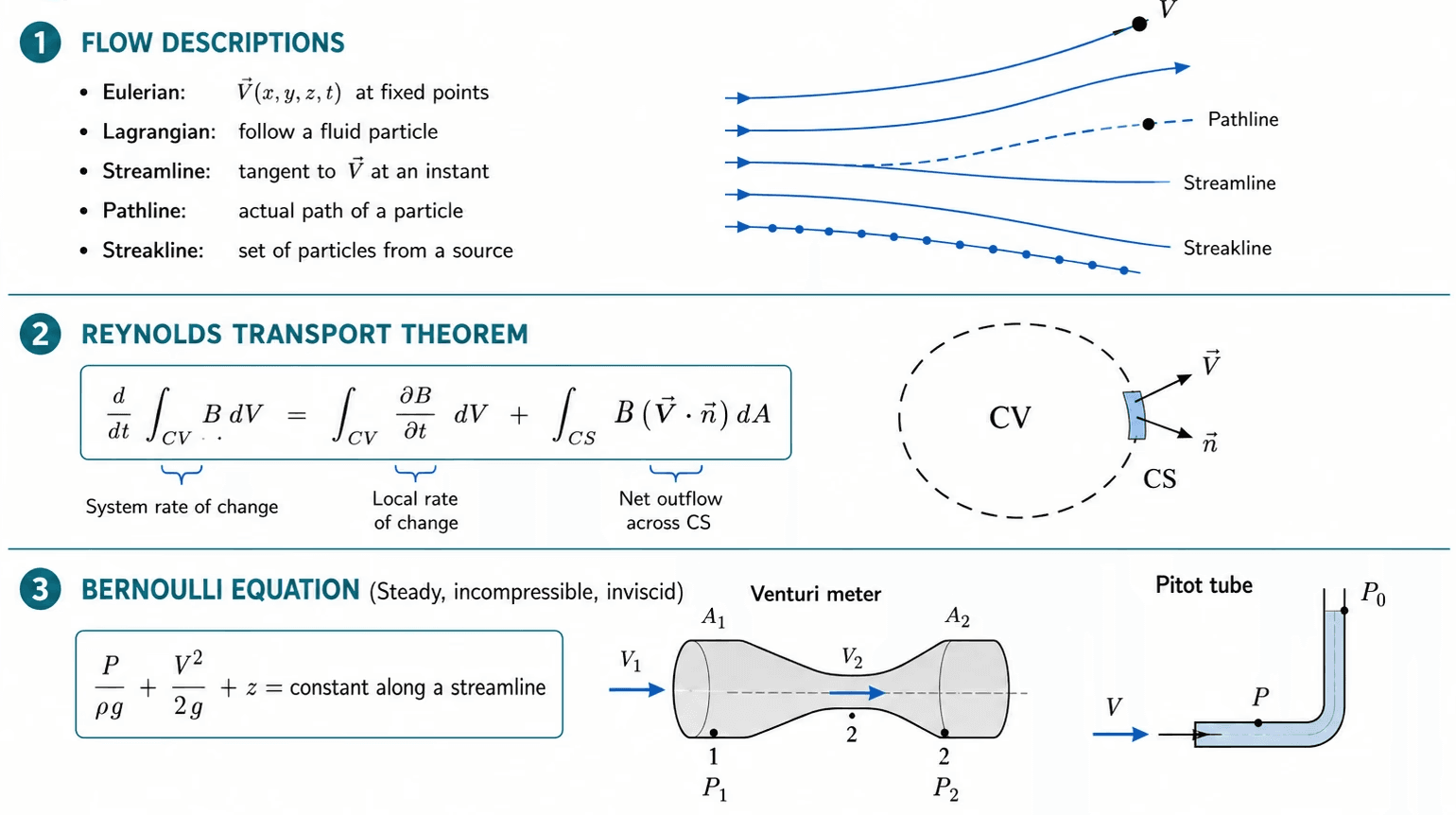
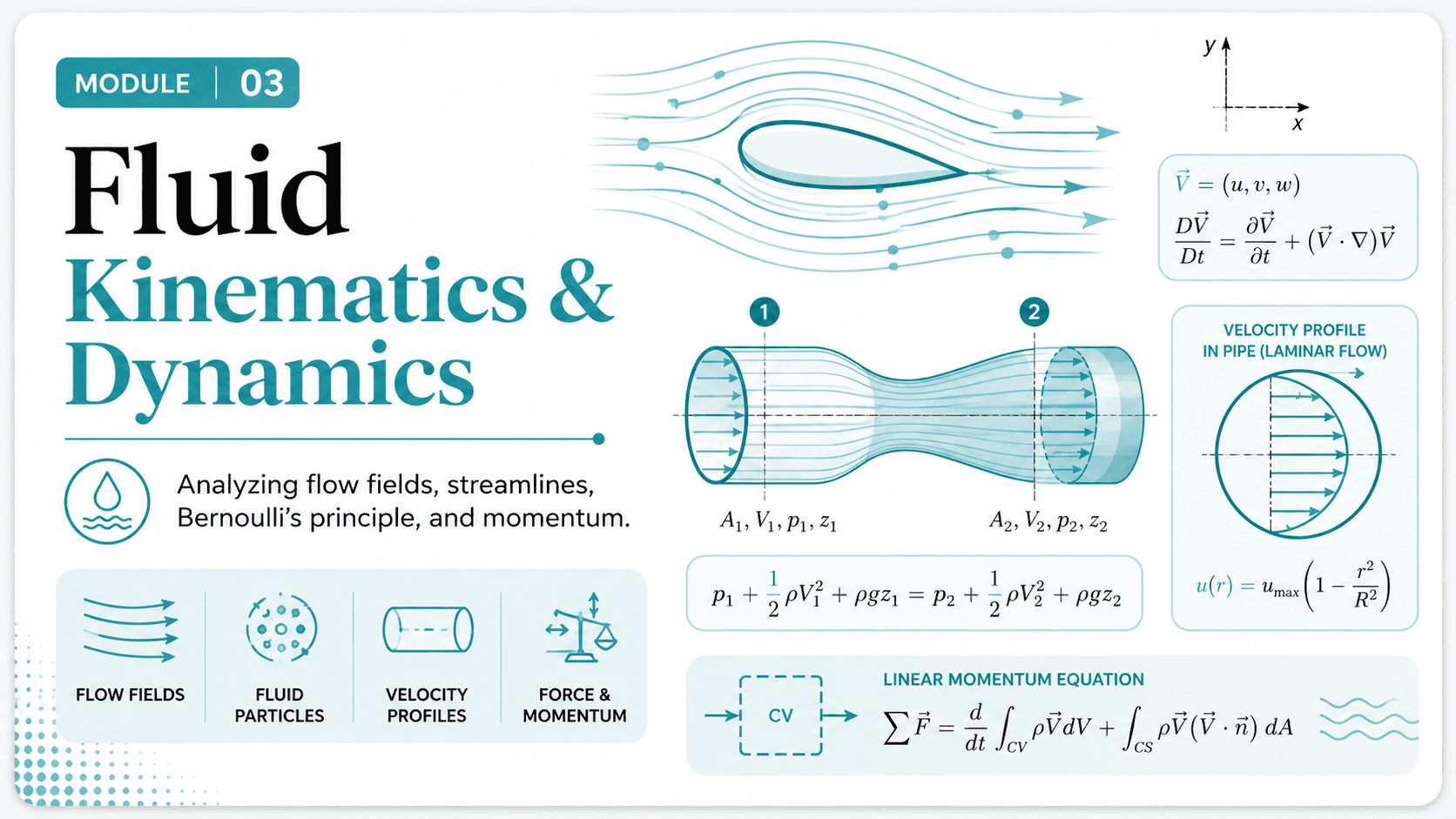
Learn how fluids move and interact with their surroundings by studying the principles of fluid kinematics and dynamics. This guide reviews flow descriptions, Reynolds Transport Theorem, Bernoulli’s Equation, streamline analysis, and energy conservation techniques that are fundamental to engineering fluid flow analysis.ytt
Learn how fluids move and interact with their surroundings by studying the principles of fluid kinematics and dynamics. This guide reviews flow descriptions, Reynolds Transport Theorem, Bernoulli’s Equation, streamline analysis, and energy conservation techniques that are fundamental to engineering fluid flow analysis.ytt
Learn how fluids move and interact with their surroundings by studying the principles of fluid kinematics and dynamics. This guide reviews flow descriptions, Reynolds Transport Theorem, Bernoulli’s Equation, streamline analysis, and energy conservation techniques that are fundamental to engineering fluid flow analysis.ytt
Understanding fluid motion is essential for analyzing pipelines, pumps, turbines, aircraft, and hydraulic systems. Developing confidence with these equations will prepare students for more advanced engineering applications involving real fluid flow and energy transfer.
Understanding fluid motion is essential for analyzing pipelines, pumps, turbines, aircraft, and hydraulic systems. Developing confidence with these equations will prepare students for more advanced engineering applications involving real fluid flow and energy transfer.
UNIT
1
UNIT
1
Fluid Properties & Statics
Fluid Properties & Statics
Fluid Properties & Statics

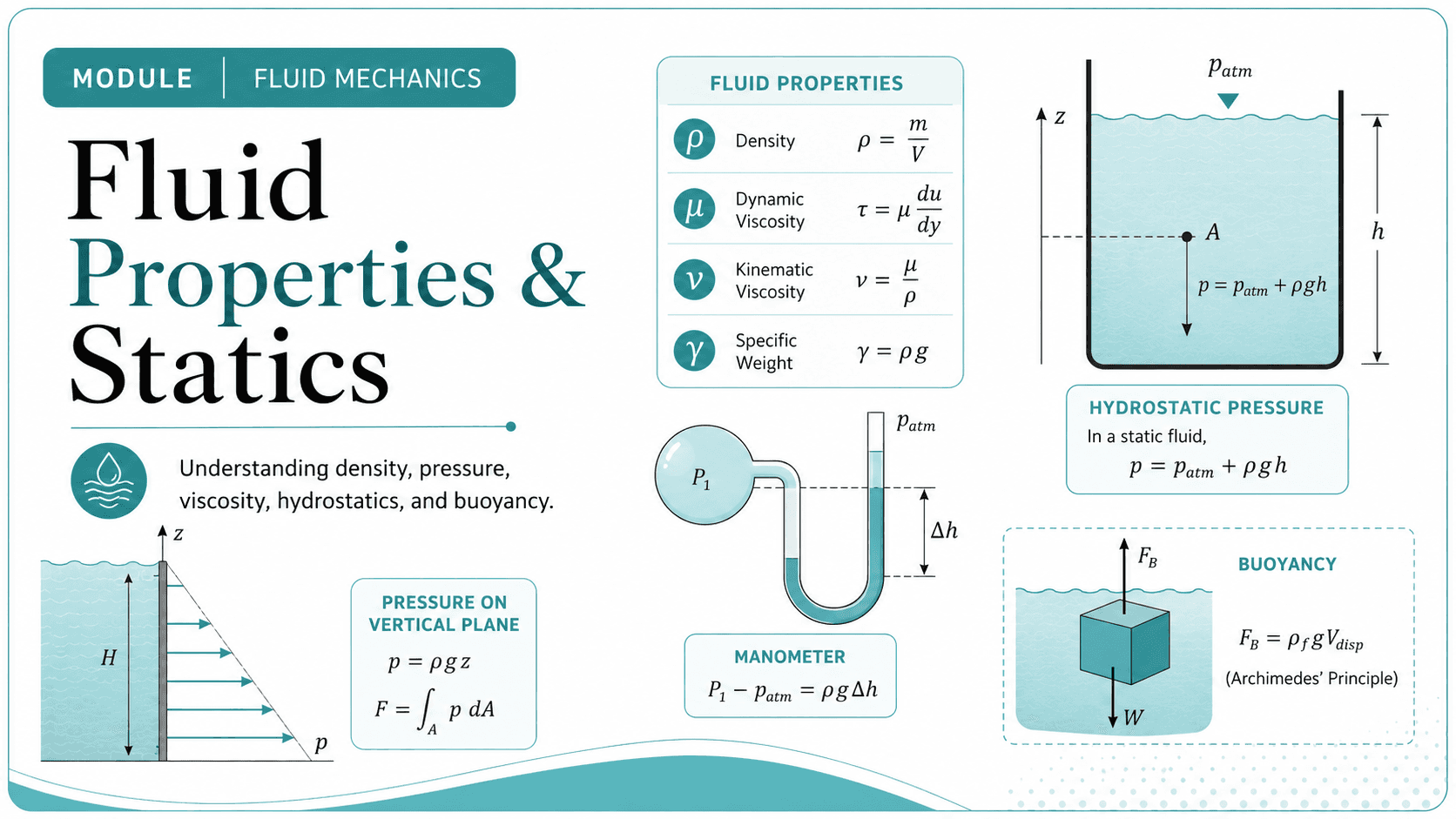
Build a strong foundation in Fluid Mechanics by understanding the physical properties of fluids and how they behave when at rest. You will start with the properties that define every fluid — density, viscosity, and surface tension — before applying them to pressure and buoyancy problems. This summary covers fluid properties, hydrostatic pressure, manometers, submerged surfaces, buoyancy, and the governing principles used throughout civil, mechanical, chemical, and aerospace engineering.
Build a strong foundation in Fluid Mechanics by understanding the physical properties of fluids and how they behave when at rest. You will start with the properties that define every fluid — density, viscosity, and surface tension — before applying them to pressure and buoyancy problems. This summary covers fluid properties, hydrostatic pressure, manometers, submerged surfaces, buoyancy, and the governing principles used throughout civil, mechanical, chemical, and aerospace engineering.
Build a strong foundation in Fluid Mechanics by understanding the physical properties of fluids and how they behave when at rest. You will start with the properties that define every fluid — density, viscosity, and surface tension — before applying them to pressure and buoyancy problems. This summary covers fluid properties, hydrostatic pressure, manometers, submerged surfaces, buoyancy, and the governing principles used throughout civil, mechanical, chemical, and aerospace engineering.
Fluid statics provides the foundation for understanding pressure forces, floating bodies, hydraulic systems, and many engineering structures. Mastering these principles will make it easier to analyze moving fluids and solve more advanced fluid mechanics problems with confidence.
Fluid statics provides the foundation for understanding pressure forces, floating bodies, hydraulic systems, and many engineering structures. Mastering these principles will make it easier to analyze moving fluids and solve more advanced fluid mechanics problems with confidence.
What We Cover:
What We Cover:

University Fluid Mechanics for Engineers
University Fluid Mechanics for Engineers
University Fluid Mechanics for Engineers
Transition from static pressures to dynamic, viscous fluid transformations. These 1-on-1 sessions equip you with the control volume equations, dimensional analysis frameworks, and boundary layer theories required to solve complex internal and external flow systems.
Transition from static pressures to dynamic, viscous fluid transformations. These 1-on-1 sessions equip you with the control volume equations, dimensional analysis frameworks, and boundary layer theories required to solve complex internal and external flow systems.
Transition from static pressures to dynamic, viscous fluid transformations. These 1-on-1 sessions equip you with the control volume equations, dimensional analysis frameworks, and boundary layer theories required to solve complex internal and external flow systems.
100% Money-Back Guarantee on your first session.
100% Money-Back Guarantee on your first session.
100% Money-Back Guarantee on your first session.
UNIT
6
UNIT
6
External Flows & Boundary Layers
External Flows & Boundary Layers
External Flows & Boundary Layers

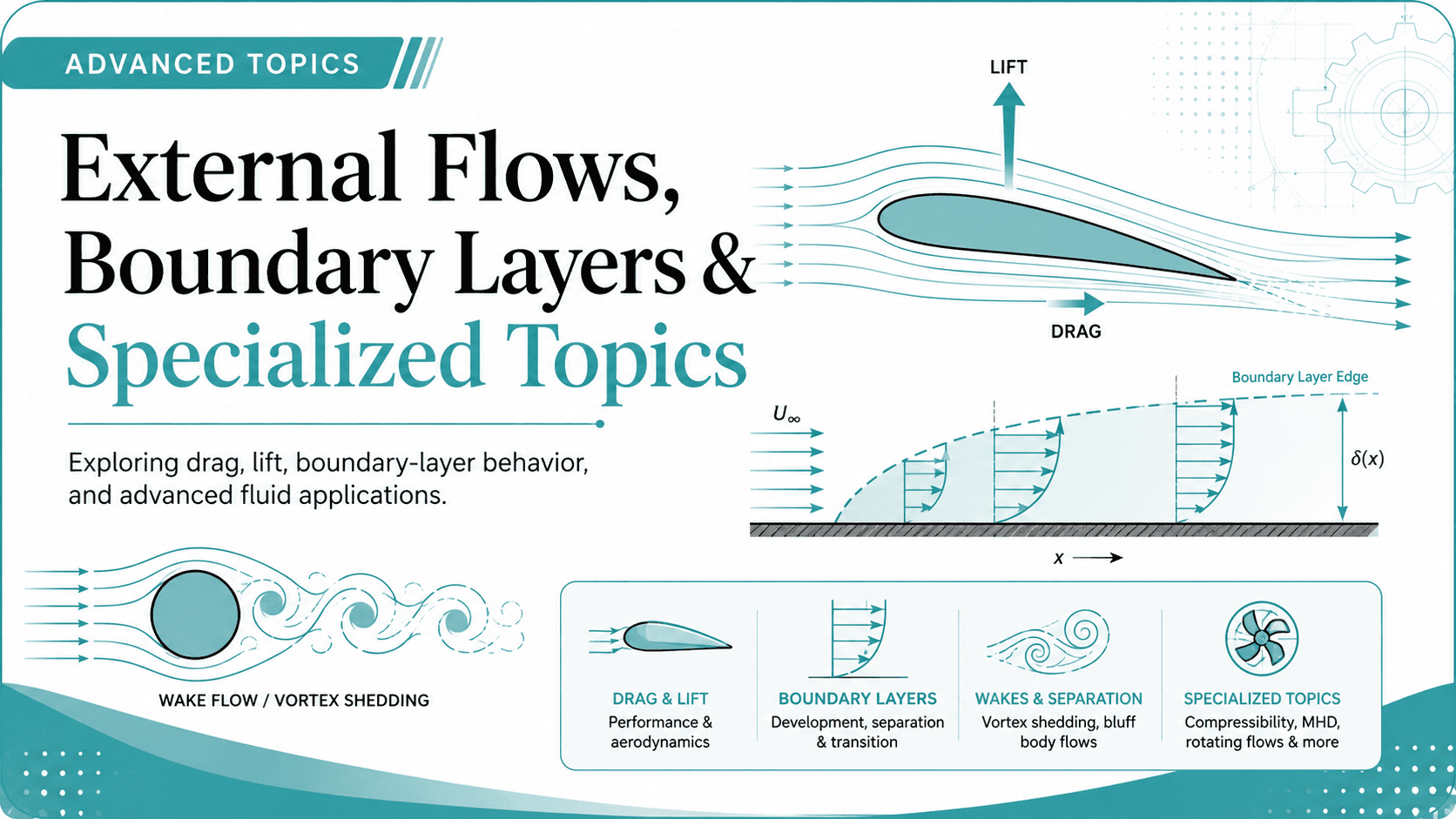
Explore how fluids interact with objects moving through liquids and gases by studying external flow behaviour and boundary layer development. This guide covers drag and lift forces, boundary layers, friction coefficients, flow separation, and drag coefficients used in aerospace, automotive, and mechanical engineering.
Explore how fluids interact with objects moving through liquids and gases by studying external flow behaviour and boundary layer development. This guide covers drag and lift forces, boundary layers, friction coefficients, flow separation, and drag coefficients used in aerospace, automotive, and mechanical engineering.
Explore how fluids interact with objects moving through liquids and gases by studying external flow behaviour and boundary layer development. This guide covers drag and lift forces, boundary layers, friction coefficients, flow separation, and drag coefficients used in aerospace, automotive, and mechanical engineering.
External flow analysis is essential for improving aerodynamic performance, reducing drag, and optimizing engineering designs. These concepts are widely applied to aircraft, automobiles, ships, wind turbines, and many other systems that operate within moving fluids.
External flow analysis is essential for improving aerodynamic performance, reducing drag, and optimizing engineering designs. These concepts are widely applied to aircraft, automobiles, ships, wind turbines, and many other systems that operate within moving fluids.
Fluid Mechanics demands total comfort with field descriptions, vector calculus, and continuous systems. You will learn to predict exactly how liquids and gases interact with structural boundaries, conduits, and aerodynamic profiles.
Fluid Mechanics demands total comfort with field descriptions, vector calculus, and continuous systems. You will learn to predict exactly how liquids and gases interact with structural boundaries, conduits, and aerodynamic profiles.
Fluid Mechanics demands total comfort with field descriptions, vector calculus, and continuous systems. You will learn to predict exactly how liquids and gases interact with structural boundaries, conduits, and aerodynamic profiles.
UNIT
7
UNIT
7
Advanced / Specialized Topics
Advanced / Specialized Topics
Advanced / Specialized Topics

Complete your Fluid Mechanics studies by exploring advanced topics used in high-level engineering analysis and system design. This summary reviews the Navier–Stokes equations, turbomachinery velocity triangles, compressible flow, and isentropic relationships that form the basis of advanced fluid dynamics and propulsion systems.
Complete your Fluid Mechanics studies by exploring advanced topics used in high-level engineering analysis and system design. This summary reviews the Navier–Stokes equations, turbomachinery velocity triangles, compressible flow, and isentropic relationships that form the basis of advanced fluid dynamics and propulsion systems.
Complete your Fluid Mechanics studies by exploring advanced topics used in high-level engineering analysis and system design. This summary reviews the Navier–Stokes equations, turbomachinery velocity triangles, compressible flow, and isentropic relationships that form the basis of advanced fluid dynamics and propulsion systems.
These advanced topics connect the fundamental principles of fluid mechanics with real-world engineering applications involving turbines, compressors, propulsion systems, and high-speed flows. Building a strong understanding of these concepts prepares students for upper-year engineering courses and professional practice.
These advanced topics connect the fundamental principles of fluid mechanics with real-world engineering applications involving turbines, compressors, propulsion systems, and high-speed flows. Building a strong understanding of these concepts prepares students for upper-year engineering courses and professional practice.

Rami Alzaytavi
B.ENG. Software Engineer

Yacoob Kathrada
Bsc. Biomedical

Maya Al Khowjeh
B.Tech. Civil Engineering

Taha Arafat
Msc. Pharmacology

Jawad Qourshah
B.ENG. Mechanical Engineering

Manish Bahat
M.ENG. Mechanical Engineering

Oubada Al Tarabishi
M.ENG. Electrical Engineering

Ahmad Dawood
MSc. Computer Science
Rami Alzaytavi
B.ENG. Software Engineer
Yacoob Kathrada
Bsc. Biomedical
Maya Al Khowjeh
B.Tech. Civil Engineering
Taha Arafat
Msc. Pharmacology
Jawad Qourshah
B.ENG. Mechanical Engineering
Manish Bahat
M.ENG. Mechanical Engineering
Oubada Al Tarabishi
M.ENG. Electrical Engineering
Ahmad Dawood
MSc. Computer Science
Rami Alzaytavi
B.ENG. Software Engineer
Yacoob Kathrada
Bsc. Biomedical
Maya Al Khowjeh
B.Tech. Civil Engineering
Taha Arafat
Msc. Pharmacology
Jawad Qourshah
B.ENG. Mechanical Engineering
Manish Bahat
M.ENG. Mechanical Engineering
Oubada Al Tarabishi
M.ENG. Electrical Engineering
Ahmad Dawood
MSc. Computer Science
Rami Alzaytavi
B.ENG. Software Engineer
Yacoob Kathrada
Bsc. Biomedical
Maya Al Khowjeh
B.Tech. Civil Engineering
Taha Arafat
Msc. Pharmacology
Jawad Qourshah
B.ENG. Mechanical Engineering
Manish Bahat
M.ENG. Mechanical Engineering
Oubada Al Tarabishi
M.ENG. Electrical Engineering
Ahmad Dawood
MSc. Computer Science
Rami Alzaytavi
B.ENG. Software Engineer
Yacoob Kathrada
Bsc. Biomedical
Maya Al Khowjeh
B.Tech. Civil Engineering
Taha Arafat
Msc. Pharmacology
Jawad Qourshah
B.ENG. Mechanical Engineering
Manish Bahat
M.ENG. Mechanical Engineering
Oubada Al Tarabishi
M.ENG. Electrical Engineering
Ahmad Dawood
MSc. Computer Science
Rami Alzaytavi
B.ENG. Software Engineer
Yacoob Kathrada
Bsc. Biomedical
Maya Al Khowjeh
B.Tech. Civil Engineering
Taha Arafat
Msc. Pharmacology
Jawad Qourshah
B.ENG. Mechanical Engineering
Manish Bahat
M.ENG. Mechanical Engineering
Oubada Al Tarabishi
M.ENG. Electrical Engineering
Ahmad Dawood
MSc. Computer Science
Rami Alzaytavi
B.ENG. Software Engineer
Yacoob Kathrada
Bsc. Biomedical
Maya Al Khowjeh
B.Tech. Civil Engineering
Taha Arafat
Msc. Pharmacology
Jawad Qourshah
B.ENG. Mechanical Engineering
Manish Bahat
M.ENG. Mechanical Engineering
Oubada Al Tarabishi
M.ENG. Electrical Engineering
Ahmad Dawood
MSc. Computer Science
Rami Alzaytavi
B.ENG. Software Engineer
Yacoob Kathrada
Bsc. Biomedical
Maya Al Khowjeh
B.Tech. Civil Engineering
Taha Arafat
Msc. Pharmacology
Jawad Qourshah
B.ENG. Mechanical Engineering
Manish Bahat
M.ENG. Mechanical Engineering
Oubada Al Tarabishi
M.ENG. Electrical Engineering
Ahmad Dawood
MSc. Computer Science

Contact us
Get in touch with our experts team

Where Our Students Come From
Where Our Students Come From





Here is a quick recap on all the units covered in Fluid Mechanics
Here is a quick recap on all the units covered in Fluid Mechanics
Here is a quick recap on all the units covered in Fluid Mechanics

Coming Soon!
Fluid Mechanics Course Notes & Exam Review
Review the major concepts taught throughout your course in one organized resource. The course review breaks challenging topics into smaller, understandable sections and provides clear examples showing how important concepts are applied.
✓ Fluid Statics
✓ Fluid Kinematics & Conservation Laws
✓ Internal Viscous Flow (Pipe Flow)
✓ External Flow & Boundary Layer Theory
✓ Dimensional Analysis & Similitude
✓ Compressible Flow & Gas Dynamics
✓ Core course topics and foundational concepts
✓ Clear explanations supported by worked examples
✓ Common mistakes and strategies for avoiding them
✓ Important skills needed for Fluid Mechanics
✓ Practice questions organized by course topic

What the Course
Review Includes
Topics Covered
Coming Soon!
Fluid Mechanics Practice Problems with Solutions
Prepare for tests and final assessments with realistic, course-aligned practice exams. Each exam covers the major topics taught throughout the course, with detailed answer explanations that help students understand concepts, apply their knowledge, and learn from mistakes.
Students can use the practice exams to become familiar with different question formats, review challenging units, improve time management, and determine which concepts require additional preparation.

✓ Full-length practice exams
✓ Course-aligned and exam-style questions
✓ Questions from all major Fluid Mechanics topics
✓ Detailed step-by-step solution guides
✓ Focused review of mistakes and weaker areas
Coming Soon!

Fluid Mechanics Formula Sheet & Cheat Sheet (PDF)
Quickly access the most important formulas, equations, constants, and reference tables for your course in one organized resource. Each formula sheet is designed to simplify exam preparation by bringing together the equations, symbols, and relationships students use most often throughout the semester.
Whether you're reviewing for a quiz, preparing for a midterm, or studying for a final exam, our formula sheets provide a convenient reference for the key equations and concepts covered in your course. They help students review more efficiently while building confidence before assessments.
✓ Essential formulas organized by topic
✓ Common symbols, variables, and units
✓ Quick reference tables and diagrams
✓ Important equations used throughout the course
✓ Perfect for exam review and last-minute revision
Fluid Mechanics Free Resources
Fit Minds Academy provides personalized 1-on-1 tutoring for high school students pursuing engineering programs and university students tackling challenging engineering courses. Our support covers math, physics, chemistry, calculus, statics, dynamics, thermodynamics, fluid mechanics, strength of materials, and other core engineering subjects.
Courses:

High School Courses
Support for Ontario high school students building the math and science foundation needed for future engineering programs.
Courses:

First-Year Engineering Courses
One-on-One private tutoring for core courses taken by every first years engineering student
Courses:

Advanced Engineering Courses
Course-specific tutoring for technical courses that require stronger applied problem-solving.
All Courses We Tutor

Why Choose
Fit Minds Academy
Personalized 1-on-1 Tutoring
Every student has different strengths, learning gaps, and academic goals. Each tutoring session is tailored to the student’s course, current level, pace, and areas requiring additional support. Lessons focus on the exact concepts and problem types the student needs to understand.
Carefully Matched Tutors for Every Student
Students are matched with tutors based on their course, academic level, subject requirements, learning needs, and availability. Many of our tutors are engineers or technical professionals who understand both the course material and its practical applications.
Ontario Curriculum and Engineering-Focused Support
Our high school tutoring follows the Ontario curriculum and supports the math and science prerequisites required for engineering, science, and technology programs. We also tutor first-year and upper-year university courses, including calculus, physics, linear algebra, programming, thermodynamics, fluid mechanics, and strength of materials.
More than Homework Help
Our tutoring goes beyond completing assignments or memorizing formulas. Students receive clear explanations, structured practice, and step-by-step problem-solving support designed to strengthen understanding and prepare them for quizzes, tests, exams, university courses, and future engineering studies.
Flexible Hourly Tutoring
$125
Per Hour
Pay-As-You-Go Plan, Billed Biweekly
✓ Sessions from the comfort of your home
✓ Access to Fit Minds Discord server
✓ Personalised sessions to suit you
✓ We teach your course material
✓ Resources (course notes, practice tests, and videos)
10-hour Prepaid Plan
$1100
Per 10 Hours
$110 per hour - Save $150
✓ Sessions from the comfort of your home
✓ Access to Fit Minds Discord server
✓ Personalised sessions to suit you
✓ We teach your course material
✓ Resources (course notes, practice tests, and videos)
Not Sure Which Option Is Right?
Speak with Fit Minds Academy and find the Fluid Mechanics tutoring plan that best matches the student’s current course needs and academic goals.


Pricing
Fluid Mechanics Course Notes & Exam Review
Review the major concepts taught throughout your course in one organized resource. The course review breaks challenging topics into smaller, understandable sections and provides clear examples showing how important concepts are applied.
✓ Core course topics and foundational concepts
✓ Clear explanations supported by worked examples
✓ Common mistakes and strategies for avoiding them
✓ Important skills needed for Fluid Mechanics
✓ Practice questions organized by course topic
What the Course
Review Includes
Topics Covered
Coming Soon!
✓ Fluid Statics
✓ Fluid Kinematics & Conservation Laws
✓ Internal Viscous Flow (Pipe Flow)
✓ External Flow & Boundary Layer Theory
✓ Dimensional Analysis & Similitude
✓ Compressible Flow & Gas Dynamics
Coming Soon!
Fluid Mechanics Practice Problems with Solutions
Prepare for tests and final assessments with realistic, course-aligned practice exams. Each exam covers the major topics taught throughout the course, with detailed answer explanations that help students understand concepts, apply their knowledge, and learn from mistakes.
Students can use the practice exams to become familiar with different question formats, review challenging units, improve time management, and determine which concepts require additional preparation.
✓ Full-length practice exams
✓ Course-aligned and exam-style questions
✓ Questions from all major Fluid Mechanics topics
✓ Detailed step-by-step solution guides
✓ Focused review of mistakes and weaker areas
Fluid Mechanics Formula Sheet & Cheat Sheet (PDF)
Coming Soon!
Quickly access the most important formulas, equations, constants, and reference tables for your course in one organized resource. Each formula sheet is designed to simplify exam preparation by bringing together the equations, symbols, and relationships students use most often throughout the semester.
Whether you're reviewing for a quiz, preparing for a midterm, or studying for a final exam, our formula sheets provide a convenient reference for the key equations and concepts covered in your course. They help students review more efficiently while building confidence before assessments.
✓ Essential formulas organized by topic
✓ Common symbols, variables, and units
✓ Quick reference tables and diagrams
✓ Important equations used throughout the course
✓ Perfect for exam review and last-minute revision
Courses:
High School Courses
Support for Ontario high school students building the math and science foundation needed for future engineering programs.
Courses:
First-Year Engineering Courses
One-on-One private tutoring for core courses taken by every first years engineering student
Courses:
Advanced Engineering Courses
Course-specific tutoring for technical courses that require stronger applied problem-solving.
Fit Minds Academy provides personalized 1-on-1 tutoring for high school students pursuing engineering programs and university students tackling challenging engineering courses. Our support covers math, physics, chemistry, calculus, statics, dynamics, thermodynamics, fluid mechanics, strength of materials, and other core engineering subjects.
All Courses We Tutor
Fluid Mechanics Free Resources
Why Choose
Fit Minds Academy
Personalized 1-on-1 Tutoring
Every student has different strengths, learning gaps, and academic goals. Each tutoring session is tailored to the student’s course, current level, pace, and areas requiring additional support. Lessons focus on the exact concepts and problem types the student needs to understand.
Carefully Matched Tutors for Every Student
Students are matched with tutors based on their course, academic level, subject requirements, learning needs, and availability. Many of our tutors are engineers or technical professionals who understand both the course material and its practical applications.
Ontario Curriculum and Engineering-Focused Support
Our high school tutoring follows the Ontario curriculum and supports the math and science prerequisites required for engineering, science, and technology programs. We also tutor first-year and upper-year university courses, including calculus, physics, linear algebra, programming, thermodynamics, fluid mechanics, and strength of materials.
More than Homework Help
Our tutoring goes beyond completing assignments or memorizing formulas. Students receive clear explanations, structured practice, and step-by-step problem-solving support designed to strengthen understanding and prepare them for quizzes, tests, exams, university courses, and future engineering studies.
Flexible Hourly Tutoring
$125
Per Hour
Pay-As-You-Go Plan, Billed Biweekly
✓ Sessions from the comfort of your home
✓ Access to Fit Minds Discord server
✓ Personalised sessions to suit you
✓ We teach your course material
✓ Resources (course notes, practice tests, and videos)
10-hour Prepaid Plan
$1100
Per 10 Hours
$110 per hour - Save $150
✓ Sessions from the comfort of your home
✓ Access to Fit Minds Discord server
✓ Personalised sessions to suit you
✓ We teach your course material
✓ Resources (course notes, practice tests, and videos)
Not Sure Which Option Is Right?
Speak with Fit Minds Academy and find the Fluid Mechanics tutoring plan that best matches the student’s current course needs and academic goals.
Pricing
Where Our Students Come From
Fluid Mechanics Course Notes & Exam Review
Review the major concepts taught throughout your course in one organized resource. The course review breaks challenging topics into smaller, understandable sections and provides clear examples showing how important concepts are applied.
✓ Core course topics and foundational concepts
✓ Clear explanations supported by worked examples
✓ Common mistakes and strategies for avoiding them
✓ Important skills needed for Fluid Mechanics
✓ Practice questions organized by course topic
What the Course
Review Includes
Topics Covered
Coming Soon!
✓ Fluid Statics
✓ Fluid Kinematics & Conservation Laws
✓ Internal Viscous Flow (Pipe Flow)
✓ External Flow & Boundary Layer Theory
✓ Dimensional Analysis & Similitude
✓ Compressible Flow & Gas Dynamics
Fluid Mechanics Practice Problems with Solutions
Prepare for tests and final assessments with realistic, course-aligned practice exams. Each exam covers the major topics taught throughout the course, with detailed answer explanations that help students understand concepts, apply their knowledge, and learn from mistakes.
Students can use the practice exams to become familiar with different question formats, review challenging units, improve time management, and determine which concepts require additional preparation.
Coming Soon!
✓ Full-length practice exams
✓ Course-aligned and exam-style questions
✓ Questions from all major Fluid Mechanics topics
✓ Detailed step-by-step solution guides
✓ Focused review of mistakes and weaker areas
Fluid Mechanics Formula Sheet & Cheat Sheet (PDF)
Coming Soon!
Fluid Mechanics Formula Sheet & Cheat Sheet (PDF)
✓ Essential formulas organized by topic
✓ Common symbols, variables, and units
✓ Quick reference tables and diagrams
✓ Important equations used throughout the course
✓ Perfect for exam review and last-minute revision
Quickly access the most important formulas, equations, constants, and reference tables for your course in one organized resource. Each formula sheet is designed to simplify exam preparation by bringing together the equations, symbols, and relationships students use most often throughout the semester.
Whether you're reviewing for a quiz, preparing for a midterm, or studying for a final exam, our formula sheets provide a convenient reference for the key equations and concepts covered in your course. They help students review more efficiently while building confidence before assessments.
All Courses We Tutor
Fluid Mechanics Free Resources
Fit Minds Academy provides personalized 1-on-1 tutoring for high school students pursuing engineering programs and university students tackling challenging engineering courses. Our support covers math, physics, chemistry, calculus, statics, dynamics, thermodynamics, fluid mechanics, strength of materials, and other core engineering subjects.
Courses:
High School Courses
Support for Ontario high school students building the math and science foundation needed for future engineering programs.
Courses:
First-Year Engineering Courses
One-on-One private tutoring for core courses taken by every first years engineering student
Courses:
Advanced Engineering Courses
Course-specific tutoring for technical courses that require stronger applied problem-solving.
Why Choose
Fit Minds Academy
Personalized 1-on-1 Tutoring
Every student has different strengths, learning gaps, and academic goals. Each tutoring session is tailored to the student’s course, current level, pace, and areas requiring additional support. Lessons focus on the exact concepts and problem types the student needs to understand.
Carefully Matched Tutors for Every Student
Students are matched with tutors based on their course, academic level, subject requirements, learning needs, and availability. Many of our tutors are engineers or technical professionals who understand both the course material and its practical applications.
Ontario Curriculum and Engineering-Focused Support
Our high school tutoring follows the Ontario curriculum and supports the math and science prerequisites required for engineering, science, and technology programs. We also tutor first-year and upper-year university courses, including calculus, physics, linear algebra, programming, thermodynamics, fluid mechanics, and strength of materials.
More than Homework Help
Our tutoring goes beyond completing assignments or memorizing formulas. Students receive clear explanations, structured practice, and step-by-step problem-solving support designed to strengthen understanding and prepare them for quizzes, tests, exams, university courses, and future engineering studies.
Flexible Hourly Tutoring
$125
Per Hour
Pay-As-You-Go Plan, Billed Biweekly
✓ Sessions from the comfort of your home
✓ Access to Fit Minds Discord server
✓ Personalised sessions to suit you
✓ We teach your course material
✓ Resources (course notes, practice tests, and videos)
10-hour Prepaid Plan
$1100
Per 10 Hours
$110 per hour - Save $150
✓ Sessions from the comfort of your home
✓ Access to Fit Minds Discord server
✓ Personalised sessions to suit you
✓ We teach your course material
✓ Resources (course notes, practice tests, and videos)
Not Sure Which Option Is Right?
Speak with Fit Minds Academy and find the Fluid Mechanics tutoring plan that best matches the student’s current course needs and academic goals.
Contact us
Get in touch with our experts team
Pricing
FAQ
What Is Fluid Mechanics?

Is Fluid Mechanics Hard?
What Does a Fluid Mechanics Course Cover?
Is Fluid Mechanics Harder Than Thermodynamics?
Do You Need Calculus for Fluid Mechanics?
How Do I Solve Fluid Mechanics Problems?
How Do I Pass Fluid Mechanics?
Do You Offer Fluid Mechanics Tutoring Online?