Here is a quick recap on all the units covered in Grade 11 Chemistry
Here is a quick recap on all the units covered in Grade 11 Chemistry

Matter and Chemical Bonding
Mastering ionic and covalent bonding, compound nomenclature, and predicting molecular shapes.
Matter and Chemical Bonding
Mastering ionic and covalent bonding, compound nomenclature, and predicting molecular shapes.

Quantities in Chemical Reactions
Simplifying the mole concept, molar mass, limiting reagents, and percent yield calculations.
Quantities in Chemical Reactions
Simplifying the mole concept, molar mass, limiting reagents, and percent yield calculations.
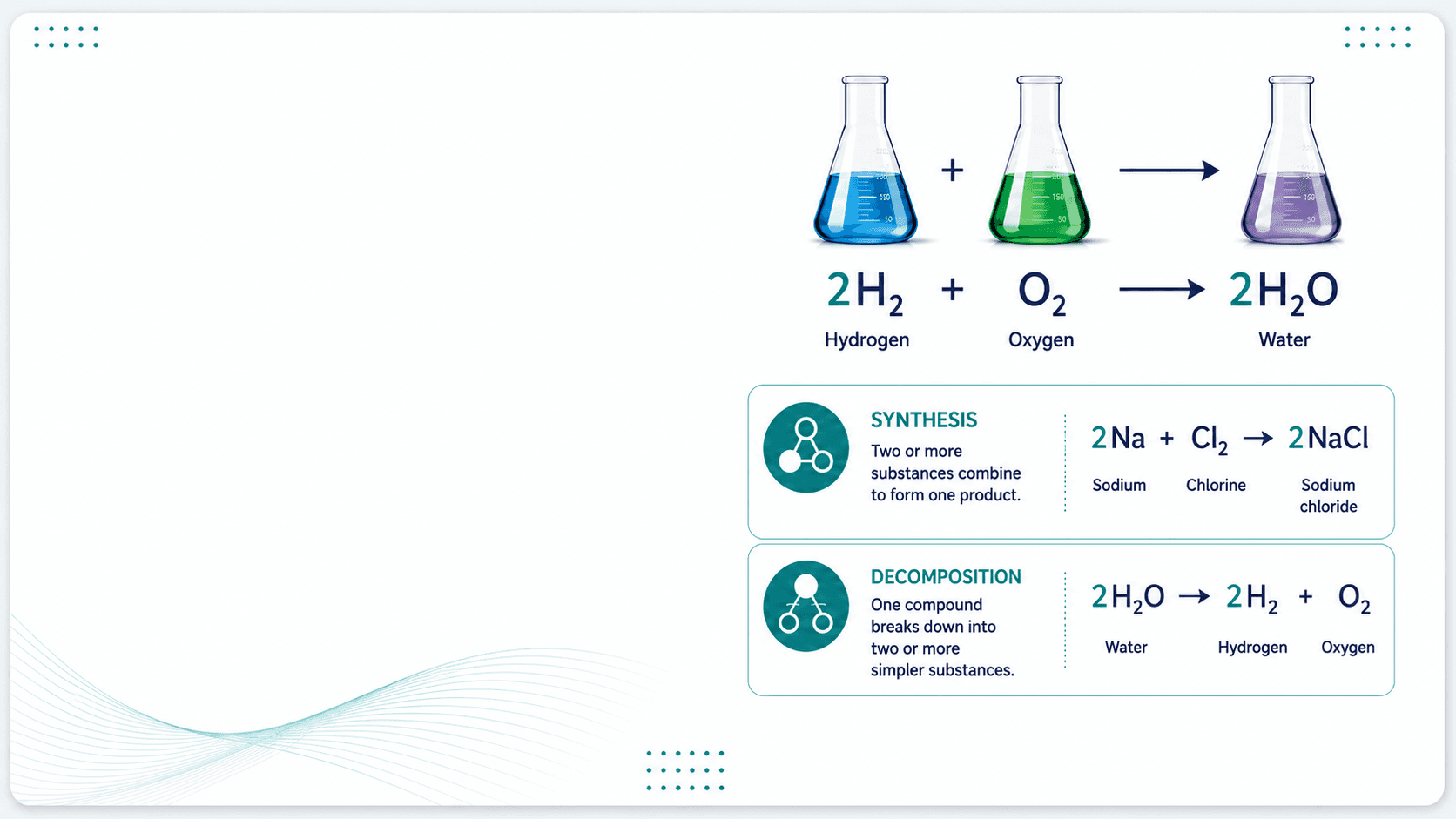
Chemical Reactions
Identifying reaction types, balancing chemical equations, and predicting reaction products.
Chemical Reactions
Identifying reaction types, balancing chemical equations, and predicting reaction products.

Solutions, Solubility, and Gases
Solving concentration and dilution problems, applying solubility rules, writing net ionic equations, and using gas laws.
Solutions, Solubility, and Gases
Solving concentration and dilution problems, applying solubility rules, writing net ionic equations, and using gas laws.
UNIT
1
UNIT
1
Matter & Chemical Bonding
Matter & Chemical Bonding
1) Ionic Bonding
1) Ionic Bonding
2) Ionic bonding formula:
2) Ionic bonding formula:
3) Naming ionic compounds:


magnesium oxide
calcium bromide
iron (II) chloride
iron (III) chloride
sodium chloride
Write the metal first, then the non-metal with an -ide ending.
magnesium oxide
calcium bromide
iron (II) chloride
iron (III) chloride
sodium chloride
Write the metal first, then the non-metal with an -ide ending.
This is where SCH3U starts and where most students either build confidence or start to fall behind. Bonding is the foundation of everything in chemistry. Get this unit right and the rest of the course feels much more manageable.
This is where SCH3U starts and where most students either build confidence or start to fall behind. Bonding is the foundation of everything in chemistry. Get this unit right and the rest of the course feels much more manageable.


tri
tetra
penta
di
1
2
3
4
5
mono (only used for second element)
carbon monoxide
carbon dixide
dinitrogen tetroxide
phosphorus pentachloride
Use prefixes to show how many atoms of each element are present.
Name the first element and omit mono- when only one atom is present.
Name the second element using the correct prefix and an -ide ending.
Drop the last vowel of a prefix when the element name begins with a vowel.
tri
tetra
penta
di
1
2
3
4
5
mono (only used for second element)
carbon monoxide
carbon dixide
dinitrogen tetroxide
phosphorus pentachloride
Use prefixes to show how many atoms of each element are present.
Name the first element and omit mono- when only one atom is present.
Name the second element using the correct prefix and an -ide ending.
Drop the last vowel of a prefix when the element name begins with a vowel.
4) Covalent Bonding
4) Covalent Bonding
5) Covalent Bonding of
CO2
5) Covalent Bonding of
CO2
6) Naming covalent compounds:
6) Naming covalent compounds:
3) Naming ionic compounds:
Meet Our Grade 11 Chemistry (SCH3U) Tutors

Rami Alzaytavi
B.ENG. Software Engineer

Yacoob Kathrada
Bsc. Biomedical

Maya Al Khowjeh
B.Tech. Civil Engineering

Taha Arafat
Msc. Pharmacology

Jawad Qourshah
B.ENG. Mechanical Engineering

Manish Bahat
M.ENG. Mechanical Engineering

Oubada Al Tarabishi
M.ENG. Electrical Engineering

Ahmad Dawood
MSc. Computer Science
Rami Alzaytavi
B.ENG. Software Engineer
Yacoob Kathrada
Bsc. Biomedical
Maya Al Khowjeh
B.Tech. Civil Engineering
Taha Arafat
Msc. Pharmacology
Jawad Qourshah
B.ENG. Mechanical Engineering
Manish Bahat
M.ENG. Mechanical Engineering
Oubada Al Tarabishi
M.ENG. Electrical Engineering
Ahmad Dawood
MSc. Computer Science
Rami Alzaytavi
B.ENG. Software Engineer
Yacoob Kathrada
Bsc. Biomedical
Maya Al Khowjeh
B.Tech. Civil Engineering
Taha Arafat
Msc. Pharmacology
Jawad Qourshah
B.ENG. Mechanical Engineering
Manish Bahat
M.ENG. Mechanical Engineering
Oubada Al Tarabishi
M.ENG. Electrical Engineering
Ahmad Dawood
MSc. Computer Science
Rami Alzaytavi
B.ENG. Software Engineer
Yacoob Kathrada
Bsc. Biomedical
Maya Al Khowjeh
B.Tech. Civil Engineering
Taha Arafat
Msc. Pharmacology
Jawad Qourshah
B.ENG. Mechanical Engineering
Manish Bahat
M.ENG. Mechanical Engineering
Oubada Al Tarabishi
M.ENG. Electrical Engineering
Ahmad Dawood
MSc. Computer Science
Rami Alzaytavi
B.ENG. Software Engineer
Yacoob Kathrada
Bsc. Biomedical
Maya Al Khowjeh
B.Tech. Civil Engineering
Taha Arafat
Msc. Pharmacology
Jawad Qourshah
B.ENG. Mechanical Engineering
Manish Bahat
M.ENG. Mechanical Engineering
Oubada Al Tarabishi
M.ENG. Electrical Engineering
Ahmad Dawood
MSc. Computer Science
Rami Alzaytavi
B.ENG. Software Engineer
Yacoob Kathrada
Bsc. Biomedical
Maya Al Khowjeh
B.Tech. Civil Engineering
Taha Arafat
Msc. Pharmacology
Jawad Qourshah
B.ENG. Mechanical Engineering
Manish Bahat
M.ENG. Mechanical Engineering
Oubada Al Tarabishi
M.ENG. Electrical Engineering
Ahmad Dawood
MSc. Computer Science
Rami Alzaytavi
B.ENG. Software Engineer
Yacoob Kathrada
Bsc. Biomedical
Maya Al Khowjeh
B.Tech. Civil Engineering
Taha Arafat
Msc. Pharmacology
Jawad Qourshah
B.ENG. Mechanical Engineering
Manish Bahat
M.ENG. Mechanical Engineering
Oubada Al Tarabishi
M.ENG. Electrical Engineering
Ahmad Dawood
MSc. Computer Science
Rami Alzaytavi
B.ENG. Software Engineer
Yacoob Kathrada
Bsc. Biomedical
Maya Al Khowjeh
B.Tech. Civil Engineering
Taha Arafat
Msc. Pharmacology
Jawad Qourshah
B.ENG. Mechanical Engineering
Manish Bahat
M.ENG. Mechanical Engineering
Oubada Al Tarabishi
M.ENG. Electrical Engineering
Ahmad Dawood
MSc. Computer Science
FAQ
Is Grade 11 Chemistry Hard?

What is Ionic Bonding?
FAQ
What is the Ionic Bonding Formula?
What is Covalent Bonding?
What is Stoichiometry?
Do you offer SCH3U tutoring online?
Do you offer SCH3U tutoring online?
Do you provide Grade 11 Chemistry homework help?
Do you provide Grade 11 Chemistry homework help?
How do I get Started?
How do I get Started?
Do you offer SCH3U tutoring online?
Do you provide Grade 11 Chemistry homework help?
How do I get Started?
UNIT
5
UNIT
5
Gases Chemistry
Gases Chemistry
Gases Chemistry
The gases unit applies the laws that describe how gases behave under different conditions of pressure, volume, and temperature.
The gases unit applies the laws that describe how gases behave under different conditions of pressure, volume, and temperature.


1) Boyle's Law:
1) Boyle's Law:
1) Boyle's Law:
3) Gay-Lussac's Law
3) Gay-Lussac's Law:
3) Gay-Lussac's Law
2) Charles's Law:
2) Charles's Law:


4) Combined Gas Law:
4) Combined Gas Law:
6) Important Notes:
6) Important Notes:
6) Important Notes:
5) Ideal Gas Law:
5) Ideal Gas Law:
The gases unit applies the laws that describe how gases behave under different conditions of pressure, volume, and temperature.
Contact us
Get in touch with our experts team

UNIT
4
UNIT
4
Solutions & Solubility
Solutions & Solubility
1) Key Formulas:
1) Key Formulas:
3) Dilution:
3) Dilution:
4) Solubility Rules & Precipitate Visual:
4) Solubility Rules & Precipitate Visual:
2) Types of Solutions:
2) Types of Solutions:
This unit covers how substances dissolve in water and how to work with concentrations.
This unit covers how substances dissolve in water and how to work with concentrations.


UNIT
3
UNIT
3
Quantities in Chemical Reactions (Stoichiometry)
Quantities in Chemical Reactions (Stoichiometry)
Quantities in Chemical Reactions (Stoichiometry)
This is the math-heavy unit of SCH3U. Stoichiometry connects the formulas you write in Unit 2 to real quantities: how many grams, how many moles, how much is made.
This is the math-heavy unit of SCH3U. Stoichiometry connects the formulas you write in Unit 2 to real quantities: how many grams, how many moles, how much is made.
This is the math-heavy unit of SCH3U. Stoichiometry connects the formulas you write in Unit 2 to real quantities: how many grams, how many moles, how much is made.


The molar mass of a substance is its mass in grams per mole. You can calculate it by adding the atomic masses of all atoms in its chemical formula.
1) The Mole Concept:
1) The Mole Concept:
2) Molar Mass:
2) Molar Mass:
3) Stoichiometry, the Roadmap:
3) Stoichiometry, the Roadmap:

Stoichiometry connects the formulas you write in chemistry to real quantities—how many grams, how many moles, and how much product is made.
Convert grams of the given substance to moles.
Use the balanced equation to find the mole ratio.
Convert to moles of the desired product.
Convert moles of product back to grams.
Final Reminder
Every stoichiometry problem follows this exact path.
Master this roadmap, and every stoichiometry question becomes the same process with different numbers.
Stoichiometry connects the formulas you write in chemistry to real quantities—how many grams, how many moles, and how much product is made.
Convert grams of the given substance to moles.
Use the balanced equation to find the mole ratio.
Convert to moles of the desired product.
Convert moles of product back to grams.
Final Reminder
Every stoichiometry problem follows this exact path.
Master this roadmap, and every stoichiometry question becomes the same process with different numbers.
Stoichiometry connects the formulas you write in chemistry to real quantities—how many grams, how many moles, and how much product is made.
Convert grams of the given substance to moles.
Use the balanced equation to find the mole ratio.
Convert to moles of the desired product.
Convert moles of product back to grams.
Final Reminder
Every stoichiometry problem follows this exact path.
Master this roadmap, and every stoichiometry question becomes the same process with different numbers.
UNIT
2
UNIT
2
Chemical Reactions
Chemical Reactions
Chemical Reactions
1) Types of chemical reactions in SCH3U:
1) Types of chemical reactions in SCH3U:
1) Types of chemical reactions in SCH3U:

Decomposition
Single
Displacement
Double
Displacement
Combustion
Synthesis
Two substances combine to make one.
One substance breaks into two or more.
One element replaces another in a compound.
Two compounds swap partners.
A fuel reacts with oxygen to produce CO₂ and H₂O.
Decomposition
Single
Displacement
Double
Displacement
Combustion
Synthesis
Two substances combine to make one.
One substance breaks into two or more.
One element replaces another in a compound.
Two compounds swap partners.
A fuel reacts with oxygen to produce CO₂ and H₂O.

Write the unbalanced equation.
Check every element when you think you are done.
Balance one element at a time. Save hydrogen and oxygen for last.
Count the atoms of each element on both sides.
Add coefficients in front of compounds to balance the equation. Never change subscripts.
Write the unbalanced equation.
Check every element when you think you are done.
Balance one element at a time. Save hydrogen and oxygen for last.
Count the atoms of each element on both sides.
Add coefficients in front of compounds to balance the equation. Never change subscripts.
This unit is about what happens when substances combine or break apart. You need to be able to identify reaction types, balance equations, and predict products.
This unit is about what happens when substances combine or break apart. You need to be able to identify reaction types, balance equations, and predict products.
This unit is about what happens when substances combine or break apart. You need to be able to identify reaction types, balance equations, and predict products.
2) Balancing chemical equations,
the simple method:
2) Balancing chemical equations, the simple method:
2) Balancing chemical equations, the simple method:
Write the unbalanced equation.
Check every element when you think you are done.
Balance one element at a time. Save hydrogen and oxygen for last.
Count the atoms of each element on both sides.
Add coefficients in front of compounds to balance the equation. Never change subscripts.
Write the unbalanced equation.
Check every element when you think you are done.
Balance one element at a time. Save hydrogen and oxygen for last.
Count the atoms of each element on both sides.
Add coefficients in front of compounds to balance the equation. Never change subscripts.
What does the SCH3U course outline cover?
What does the SCH3U course outline cover?
What does the SCH3U course outline cover?

Grade 11 Chemistry Tutoring (SCH3U) in Mississauga & Across Canada
Grade 11 Chemistry Tutoring (SCH3U) in Mississauga & Across Canada
Grade 11 Chemistry Tutoring (SCH3U) in Mississauga & Across Canada
Grade 11 Chemistry; prerequisite for
Grade 11 Chemistry; prerequisite for
Grade 11 Chemistry; prerequisite for
Build a strong foundation required for competitive engineering and health science programs. Expert 1-on-1 tutoring for the Ontario Grade 11 Chemistry (SCH3U) curriculum.
Build a strong foundation required for competitive engineering and health science programs. Expert 1-on-1 tutoring for the Ontario Grade 11 Chemistry (SCH3U) curriculum.
Build a strong foundation required for competitive engineering and health science programs. Expert 1-on-1 tutoring for the Ontario Grade 11 Chemistry (SCH3U) curriculum.
100% Money-Back Guarantee on your first session.
100% Money-Back Guarantee on your first session.
Where Our Students Go
Where Our Students Go





Coming Soon!
SCH3U Exam Review & Course Notes — Grade 11 Chemistry
Review the major concepts taught throughout your course in one organized resource. The course review breaks challenging topics into smaller, understandable sections and provides clear examples showing how important concepts are applied.
✓ Matter and Chemical Bonding
✓ Quantities in Chemical Reactions
✓ Chemical Reactions
✓ Solutions, Solubility, and Gases
✓ Core course topics and foundational concepts
✓ Clear explanations supported by worked examples
✓ Common mistakes and strategies for avoiding them
✓ Important skills needed for SCH3U
✓ Practice questions organized by course topic
What the Course
Review Includes
Topics Covered

Coming Soon!
SCH3U Practice Exam with Answers — Grade 11 Chemistry Final Exam
Prepare for tests and final assessments with realistic, course-aligned practice exams. Each exam covers the major topics taught throughout the course, with detailed answer explanations that help students understand concepts, apply their knowledge, and learn from mistakes.
Students can use the practice exams to become familiar with different question formats, review challenging units, improve time management, and determine which concepts require additional preparation.

✓ Full-length practice exams
✓ Course-aligned and exam-style questions
✓ Questions from all major SCH3U topics
✓ Detailed step-by-step solution guides
✓ Focused review of mistakes and weaker areas
Coming Soon!
Identify a student’s current strengths, foundational learning gaps, and course-specific areas of difficulty. The diagnostic assessment evaluates understanding across major course topics and provides students with a clearer starting point for future review or tutoring.

The results can help Fit Minds Academy create a more personalized learning plan focused on the concepts and problem types requiring the most attention.
Diagnostic Assessment
✓ Identify current course strengths
✓ Detect gaps in foundational science knowledge
✓ Recognize challenging topics and question types
✓ Determine which skills require further practice
✓ Receive recommended next steps for improvement
SCH3U Grade 11 Chemistry Free Resources
Fit Minds Academy provides personalized 1-on-1 tutoring for high school students pursuing engineering programs and university students tackling challenging engineering courses. Our support covers math, physics, chemistry, calculus, statics, dynamics, thermodynamics, fluid mechanics, strength of materials, and other core engineering subjects.
Courses:

High School Courses
Support for Ontario high school students building the math and science foundation needed for future engineering programs.
Courses:

First-Year Engineering Courses
One-on-One private tutoring for core courses taken by every first years engineering student
Courses:

Advanced Engineering Courses
Course-specific tutoring for technical courses that require stronger applied problem-solving.
All Courses We Tutor

Why Choose
Fit Minds Academy
Personalized 1-on-1 Tutoring
Every student has different strengths, learning gaps, and academic goals. Each tutoring session is tailored to the student’s course, current level, pace, and areas requiring additional support. Lessons focus on the exact concepts and problem types the student needs to understand.
Carefully Matched Tutors for Every Student
Students are matched with tutors based on their course, academic level, subject requirements, learning needs, and availability. Many of our tutors are engineers or technical professionals who understand both the course material and its practical applications.
Ontario Curriculum and Engineering-Focused Support
Our high school tutoring follows the Ontario curriculum and supports the math and science prerequisites required for engineering, science, and technology programs. We also tutor first-year and upper-year university courses, including calculus, physics, linear algebra, programming, thermodynamics, fluid mechanics, and strength of materials.
More than Homework Help
Our tutoring goes beyond completing assignments or memorizing formulas. Students receive clear explanations, structured practice, and step-by-step problem-solving support designed to strengthen understanding and prepare them for quizzes, tests, exams, university courses, and future engineering studies.
Reviews
Flexible Hourly Tutoring
$75
Per Hour
Pay-As-You-Go Plan, Billed Biweekly
✓ Sessions from the comfort of your home
✓ Access to Fit Minds Discord server
✓ Personalised sessions to suit you
✓ We teach your course material
✓ Resources (course notes, practice tests, and videos)
10-hour Prepaid Plan
$700
Per 10 Hours
$70 per hour - Save $50
✓ Sessions from the comfort of your home
✓ Access to Fit Minds Discord server
✓ Personalised sessions to suit you
✓ We teach your course material
✓ Resources (course notes, practice tests, and videos)
Not Sure Which Option Is Right?
Speak with Fit Minds Academy and find the Grade 9 Math tutoring plan that best matches the student’s current course needs and academic goals.


Pricing
SCH3U Exam Review & Course Notes — Grade 11 Chemistry
Review the major concepts taught throughout your course in one organized resource. The course review breaks challenging topics into smaller, understandable sections and provides clear examples showing how important concepts are applied.
✓ Core course topics and foundational concepts
✓ Clear explanations supported by worked examples
✓ Common mistakes and strategies for avoiding them
✓ Important skills needed for SCH3U
✓ Practice questions organized by course topic
What the Course
Review Includes
Topics Covered
Coming Soon!
✓ Matter and Chemical Bonding
✓ Quantities in Chemical Reactions
✓ Chemical Reactions
✓ Solutions, Solubility, and Gases
Coming Soon!
SCH3U Practice Exam with Answers — Grade 11 Chemistry Final Exam
Prepare for tests and final assessments with realistic, course-aligned practice exams. Each exam covers the major topics taught throughout the course, with detailed answer explanations that help students understand concepts, apply their knowledge, and learn from mistakes.
Students can use the practice exams to become familiar with different question formats, review challenging units, improve time management, and determine which concepts require additional preparation.
✓ Full-length practice exams
✓ Course-aligned and exam-style questions
✓ Questions from all major SCH3U topics
✓ Detailed step-by-step solution guides
✓ Focused review of mistakes and weaker areas
Identify a student’s current strengths, foundational learning gaps, and course-specific areas of difficulty. The diagnostic assessment evaluates understanding across major course topics and provides students with a clearer starting point for future review or tutoring.
The results can help Fit Minds Academy create a more personalized learning plan focused on the concepts and problem types requiring the most attention.
Diagnostic Assessment
✓ Identify current course strengths
✓ Detect gaps in foundational science knowledge
✓ Recognize challenging topics and question types
✓ Determine which skills require further practice
✓ Receive recommended next steps for improvement
Coming Soon!
Free Resources
SCH3U Grade 11 Chemistry Free Resources
All Courses We Tutor
Fit Minds Academy provides personalized 1-on-1 tutoring for high school students pursuing engineering programs and university students tackling challenging engineering courses. Our support covers math, physics, chemistry, calculus, statics, dynamics, thermodynamics, fluid mechanics, strength of materials, and other core engineering subjects.
Courses:
High School Courses
Support for Ontario high school students building the math and science foundation needed for future engineering programs.
Courses:
First-Year Engineering Courses
One-on-One private tutoring for core courses taken by every first years engineering student
Courses:
Advanced Engineering Courses
Course-specific tutoring for technical courses that require stronger applied problem-solving.
Why Choose
Fit Minds Academy
Personalized 1-on-1 Tutoring
Every student has different strengths, learning gaps, and academic goals. Each tutoring session is tailored to the student’s course, current level, pace, and areas requiring additional support. Lessons focus on the exact concepts and problem types the student needs to understand.
Carefully Matched Tutors for Every Student
Students are matched with tutors based on their course, academic level, subject requirements, learning needs, and availability. Many of our tutors are engineers or technical professionals who understand both the course material and its practical applications.
Ontario Curriculum and Engineering-Focused Support
Our high school tutoring follows the Ontario curriculum and supports the math and science prerequisites required for engineering, science, and technology programs. We also tutor first-year and upper-year university courses, including calculus, physics, linear algebra, programming, thermodynamics, fluid mechanics, and strength of materials.
More than Homework Help
Our tutoring goes beyond completing assignments or memorizing formulas. Students receive clear explanations, structured practice, and step-by-step problem-solving support designed to strengthen understanding and prepare them for quizzes, tests, exams, university courses, and future engineering studies.
Reviews
Meet Our Grade 11 Chemistry (SCH3U) Tutors
Flexible Hourly Tutoring
$75
Per Hour
Pay-As-You-Go Plan, Billed Biweekly
✓ Sessions from the comfort of your home
✓ Access to Fit Minds Discord server
✓ Personalised sessions to suit you
✓ We teach your course material
✓ Resources (course notes, practice tests, and videos)
10-hour Prepaid Plan
$700
Per 10 Hours
$70 per hour - Save $50
✓ Sessions from the comfort of your home
✓ Access to Fit Minds Discord server
✓ Personalised sessions to suit you
✓ We teach your course material
✓ Resources (course notes, practice tests, and videos)
Not Sure Which Option Is Right?
Speak with Fit Minds Academy and find the Grade 9 Math tutoring plan that best matches the student’s current course needs and academic goals.
Pricing
Contact us
Get in touch with our experts team
Flexible Hourly Tutoring
$75
Per Hour
Pay-As-You-Go Plan, Billed Biweekly
✓ Sessions from the comfort of your home
✓ Access to Fit Minds Discord server
✓ Personalised sessions to suit you
✓ We teach your course material
✓ Resources (course notes, practice tests, and videos)
10-hour Prepaid Plan
$700
Per 10 Hours
$70 per hour - Save $50
✓ Sessions from the comfort of your home
✓ Access to Fit Minds Discord server
✓ Personalised sessions to suit you
✓ We teach your course material
✓ Resources (course notes, practice tests, and videos)
Not Sure Which Option Is Right?
Speak with Fit Minds Academy and find the Grade 9 Math tutoring plan that best matches the student’s current course needs and academic goals.
Pricing
Reviews
Why Choose
Fit Minds Academy
Personalized 1-on-1 Tutoring
Every student has different strengths, learning gaps, and academic goals. Each tutoring session is tailored to the student’s course, current level, pace, and areas requiring additional support. Lessons focus on the exact concepts and problem types the student needs to understand.
Carefully Matched Tutors for Every Student
Students are matched with tutors based on their course, academic level, subject requirements, learning needs, and availability. Many of our tutors are engineers or technical professionals who understand both the course material and its practical applications.
Ontario Curriculum and Engineering-Focused Support
Our high school tutoring follows the Ontario curriculum and supports the math and science prerequisites required for engineering, science, and technology programs. We also tutor first-year and upper-year university courses, including calculus, physics, linear algebra, programming, thermodynamics, fluid mechanics, and strength of materials.
More than Homework Help
Our tutoring goes beyond completing assignments or memorizing formulas. Students receive clear explanations, structured practice, and step-by-step problem-solving support designed to strengthen understanding and prepare them for quizzes, tests, exams, university courses, and future engineering studies.
SCH3U Exam Review & Course Notes — Grade 11 Chemistry
Review the major concepts taught throughout your course in one organized resource. The course review breaks challenging topics into smaller, understandable sections and provides clear examples showing how important concepts are applied.
✓ Core course topics and foundational concepts
✓ Clear explanations supported by worked examples
✓ Common mistakes and strategies for avoiding them
✓ Important skills needed for SCH3U
✓ Practice questions organized by course topic
What the Course
Review Includes
Topics Covered
Coming Soon!
✓ Matter and Chemical Bonding
✓ Quantities in Chemical Reactions
✓ Chemical Reactions
✓ Solutions, Solubility, and Gases
SCH3U Practice Exam with Answers — Grade 11 Chemistry Final Exam
Prepare for tests and final assessments with realistic, course-aligned practice exams. Each exam covers the major topics taught throughout the course, with detailed answer explanations that help students understand concepts, apply their knowledge, and learn from mistakes.
Students can use the practice exams to become familiar with different question formats, review challenging units, improve time management, and determine which concepts require additional preparation.
✓ Full-length practice exams
✓ Course-aligned and exam-style questions
✓ Questions from all major SCH3U topics
✓ Detailed step-by-step solution guides
✓ Focused review of mistakes and weaker areas
Coming Soon!
Identify a student’s current strengths, foundational learning gaps, and course-specific areas of difficulty. The diagnostic assessment evaluates understanding across major course topics and provides students with a clearer starting point for future review or tutoring.
The results can help Fit Minds Academy create a more personalized learning plan focused on the concepts and problem types requiring the most attention.
Diagnostic Assessment
✓ Identify current course strengths
✓ Detect gaps in foundational science knowledge
✓ Recognize challenging topics and question types
✓ Determine which skills require further practice
✓ Receive recommended next steps for improvement
Coming Soon!
All Courses We Tutor
Fit Minds Academy provides personalized 1-on-1 tutoring for high school students pursuing engineering programs and university students tackling challenging engineering courses. Our support covers math, physics, chemistry, calculus, statics, dynamics, thermodynamics, fluid mechanics, strength of materials, and other core engineering subjects.
Courses:
High School Courses
Support for Ontario high school students building the math and science foundation needed for future engineering programs.
Courses:
First-Year Engineering Courses
One-on-One private tutoring for core courses taken by every first years engineering student
Courses:
Advanced Engineering Courses
Course-specific tutoring for technical courses that require stronger applied problem-solving.
UNIT
4
Solutions & Solubility
1) Key Formulas:
3) Dilution:
4) Solubility Rules & Precipitate Visual:
2) Types of Solutions:
This unit covers how substances dissolve in water and how to work with concentrations.
Where Our Students Go
Here is a quick recap on all the units covered in Grade 11 Chemistry
UNIT
1
Matter & Chemical Bonding
1) Ionic Bonding
2) Ionic bonding formula:
magnesium oxide
calcium bromide
iron (II) chloride
iron (III) chloride
sodium chloride
Write the metal first, then the non-metal with an -ide ending.
magnesium oxide
calcium bromide
iron (II) chloride
iron (III) chloride
sodium chloride
Write the metal first, then the non-metal with an -ide ending.

tri
tetra
penta
di
1
2
3
4
5
mono (only used for second element)
carbon monoxide
carbon dixide
dinitrogen tetroxide
phosphorus pentachloride
Use prefixes to show how many atoms of each element are present.
Name the first element and omit mono- when only one atom is present.
Name the second element using the correct prefix and an -ide ending.
Drop the last vowel of a prefix when the element name begins with a vowel.
tri
tetra
penta
di
1
2
3
4
5
mono (only used for second element)
carbon monoxide
carbon dixide
dinitrogen tetroxide
phosphorus pentachloride
Use prefixes to show how many atoms of each element are present.
Name the first element and omit mono- when only one atom is present.
Name the second element using the correct prefix and an -ide ending.
Drop the last vowel of a prefix when the element name begins with a vowel.
4) Covalent Bonding
5) Covalent Bonding of
CO2
6) Naming covalent compounds:
3) Naming ionic compounds:
This is where SCH3U starts and where most students either build confidence or start to fall behind. Bonding is the foundation of everything in chemistry. Get this unit right and the rest of the course feels much more manageable.
Meet Our Grade 11 Chemistry (SCH3U) Tutors
SCH3U Grade 11 Chemistry Free Resources