Whether you strictly need an accredited four-year degree depends on the field. For regulated work, like designing bridges, power plants, or aircraft parts, an accredited degree is required by law to become a licensed Professional Engineer, or P.Eng. There is no way around that one.
For fields like software or tech product work, the knowledge is open to everyone. You can learn full computer science topics through self-study, tutorials, and practice. If your goal is software, a five-year university program is just one valid path, not the only one.
Why the big gap? Engineering needs expensive labs, machine shops, robotics gear, and special software. Schools also run whole co-op departments to set up job placements. And every program must meet strict national safety and quality rules to count toward a professional license.
You dislike math and physics and feel zero curiosity
You dislike math and physics and feel zero curiosity
Red flag: a core mismatch. Forcing four-plus years can lead to burnout and dropping out.
Red flag: a core mismatch. Forcing four-plus years can lead to burnout and dropping out.
Rethink engineering before you spend the money.
Rethink engineering before you spend the money.
You struggle with math or physics but want to learn
You struggle with math or physics but want to learn
Fixable: this is a skill gap, not a reason to give up.
Fixable: this is a skill gap, not a reason to give up.
Get tutoring and a study plan, then keep going.
Get tutoring and a study plan, then keep going.
By Oubada Al Tarabishi, M.Eng. Electrical Engineering · Tutor at Fit Minds Academy
By Oubada Al Tarabishi, M.Eng. Electrical Engineering · Tutor at Fit Minds Academy
Quick answer: Yes, engineering is worth it for most students. An engineering degree gives you strong job demand, pay that grows over time, and many career paths beyond one job title. It is not worth it if you dislike math and physics, because the high cost ($60,000 to $100,000+ in Ontario) and heavy workload need real interest to pay off. Being weak at math today is a fixable skill gap, not a reason to quit.
Quick answer: Yes, engineering is worth it for most students. An engineering degree gives you strong job demand, pay that grows over time, and many career paths beyond one job title. It is not worth it if you dislike math and physics, because the high cost ($60,000 to $100,000+ in Ontario) and heavy workload need real interest to pay off. Being weak at math today is a fixable skill gap, not a reason to quit.
I remember sitting at my desk in Grade 12. I had every university application site open, and one question kept looping in my head: is it worth getting an engineering degree? I was scared. I did not want to give four or five years of my life, and thousands of dollars, to a path I might hate or fail. I knew I liked solving problems. I just did not know if becoming an engineer was worth it, or if I was only chasing the hype.
I remember sitting at my desk in Grade 12. I had every university application site open, and one question kept looping in my head: is it worth getting an engineering degree? I was scared. I did not want to give four or five years of my life, and thousands of dollars, to a path I might hate or fail. I knew I liked solving problems. I just did not know if becoming an engineer was worth it, or if I was only chasing the hype.
Is an engineering degree worth it? Start with what "worth" means
Is an engineering degree worth it? Start with what "worth" means
I spent months looking into different fields, talking to real engineers, and checking my own interests. Then I took the leap. Looking back now, here is the honest breakdown I wish I had. This guide is for every high school student, and every stressed first-year, asking the same thing I did.
I spent months looking into different fields, talking to real engineers, and checking my own interests. Then I took the leap. Looking back now, here is the honest breakdown I wish I had. This guide is for every high school student, and every stressed first-year, asking the same thing I did.
People say medicine is the safest career because the world always needs doctors. The same is true for engineers. Without engineers, modern life stops. They build our roads, our power grids, our phones, our medical machines, and the software we use every day.
People say medicine is the safest career because the world always needs doctors. The same is true for engineers. Without engineers, modern life stops. They build our roads, our power grids, our phones, our medical machines, and the software we use every day.
So the world will always need engineers. That part is easy. The harder question is whether studying engineering is the right choice for you. That comes down to how much time, energy, and money you are ready to put in. If you match your interests to the right field, the degree gives you four real benefits.
Good companies and fast-growing startups are always hunting for real talent. Thousands of people apply to each job, but few have real skill. When you build true ability during your studies, you stand out from the crowd without much effort.
Strong job demand, even in crowded markets
Many different career paths
Networking that can change your career
An engineering degree does not lock you into one job for life. Grads end up all over the place:
Core design work like software, structural, or hardware engineering
Consulting, strategy, and project management
Research and grad school (a Master's or PhD)
Starting their own companies
Starting pay for new grads is solid. The real payoff comes later. As you gain deep skill and lead teams, senior engineering and management pay can get very high.
One warning here. Do not pick a major just because it looks like it pays the most on paper.
The four real benefits of getting an engineering degree
The four real benefits of getting an engineering degree
Every engineering major pays well if you reach the top ten percent of your field. The only way to get there is to enjoy the work. When you love what you do, long hours of problem solving feel like a fun challenge, not painful work.
Every engineering major pays well if you reach the top ten percent of your field. The only way to get there is to enjoy the work. When you love what you do, long hours of problem solving feel like a fun challenge, not painful work.
The people you meet may matter more than your grades. Go to industry events, design team shows, and campus meetups. You get direct access to mentors, founders, and hiring managers. Many great jobs come from a simple hello and a real connection, long before you ever fill out an online form.
A guide that only says "yes, engineering is amazing" is lying to you. To choose well, you need the honest counter-case too.
Engineering is one of the hardest undergrad programs there is. You will spend many late nights on advanced calculus, fluid mechanics, or circuit analysis, sometimes just to pass one brutal exam.
Here is the part that matters most. There is a big difference between disliking these subjects and being weak at them right now.
Why engineering is not worth it for some students
If you are only struggling with Grade 12 physics or calculus, that is a problem you can solve, not a reason to quit your goal.
Cost is a huge part of deciding if engineering is worth it. Engineering is one of the priciest degrees you can take.
That engineering number does not even include co-op fees, textbooks (often $1,500 or more), or living costs ($13,000 to $19,000 or more per year).
Add tuition and living costs across four or five years, and an engineering degree can cost $60,000 to $100,000 or more. If you are not truly interested in the field, taking on that much money and stress makes little sense.
How to make your engineering degree actually pay off
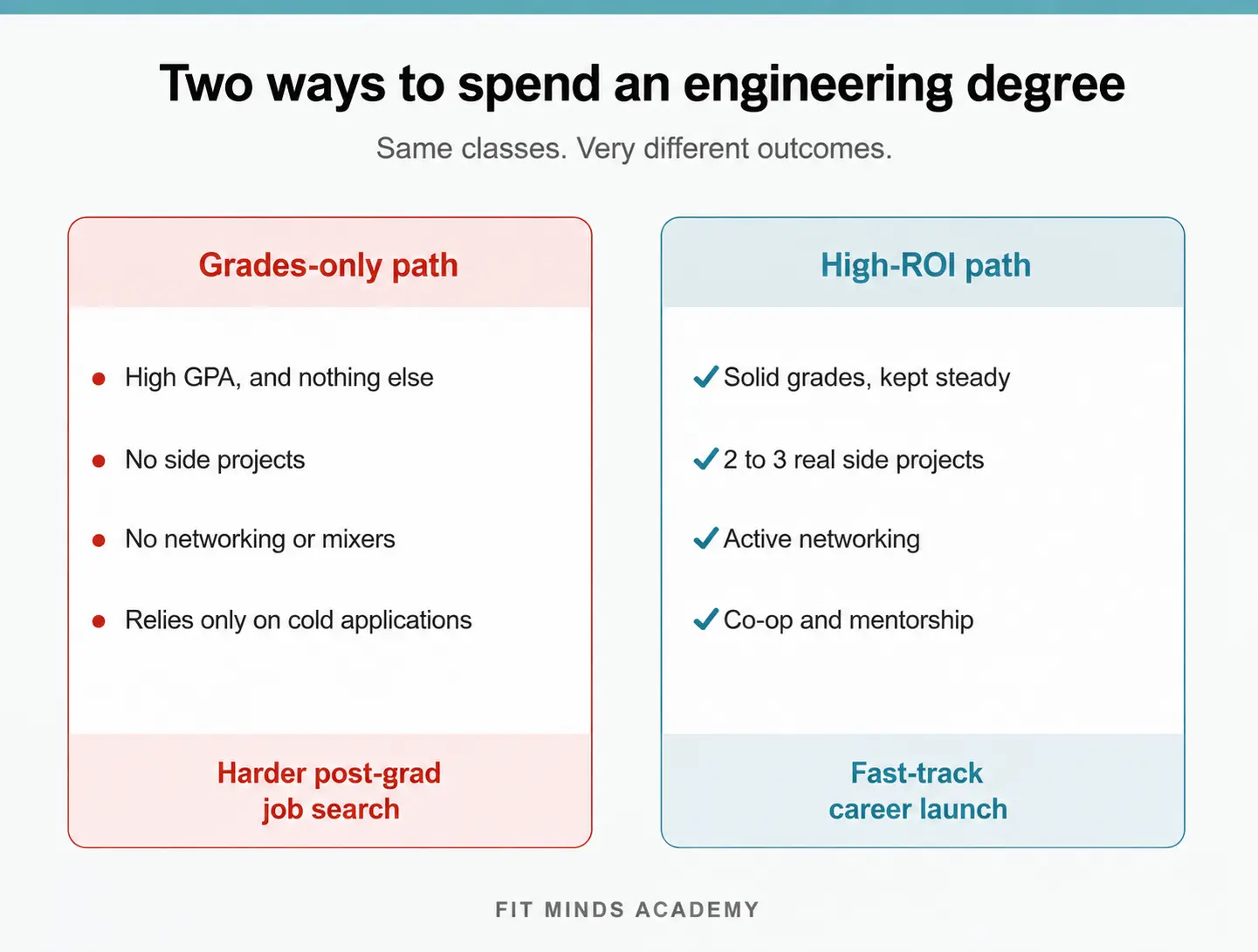
The job market is changing fast, and school is slow to catch up. Going to class, handing in labs, and memorizing formulas for an A+ is no longer a promised ticket to a job. Every year, many grads leave with great marks but no real experience, then search for work for months.
Do you need an engineering degree to be an engineer?
Why is engineering tuition so expensive?
How to make your engineering degree actually pay off
How to make your engineering degree actually pay off
So use your years well:
Get to know your professors. Many have years of industry contacts and real projects.
Build real things. Join design teams like Formula SAE, robotics, or concrete canoe, or ship your own app.
Show up in person. Go to mixers and conferences and talk to hiring managers.
Learn the tools the job uses. Python, CAD, MATLAB, and Git go further than lecture notes alone.
Courses end, but the people you meet stay with you.
When you plan your schooling, remember you are not just planning four years. You are setting up the next forty years of your career.
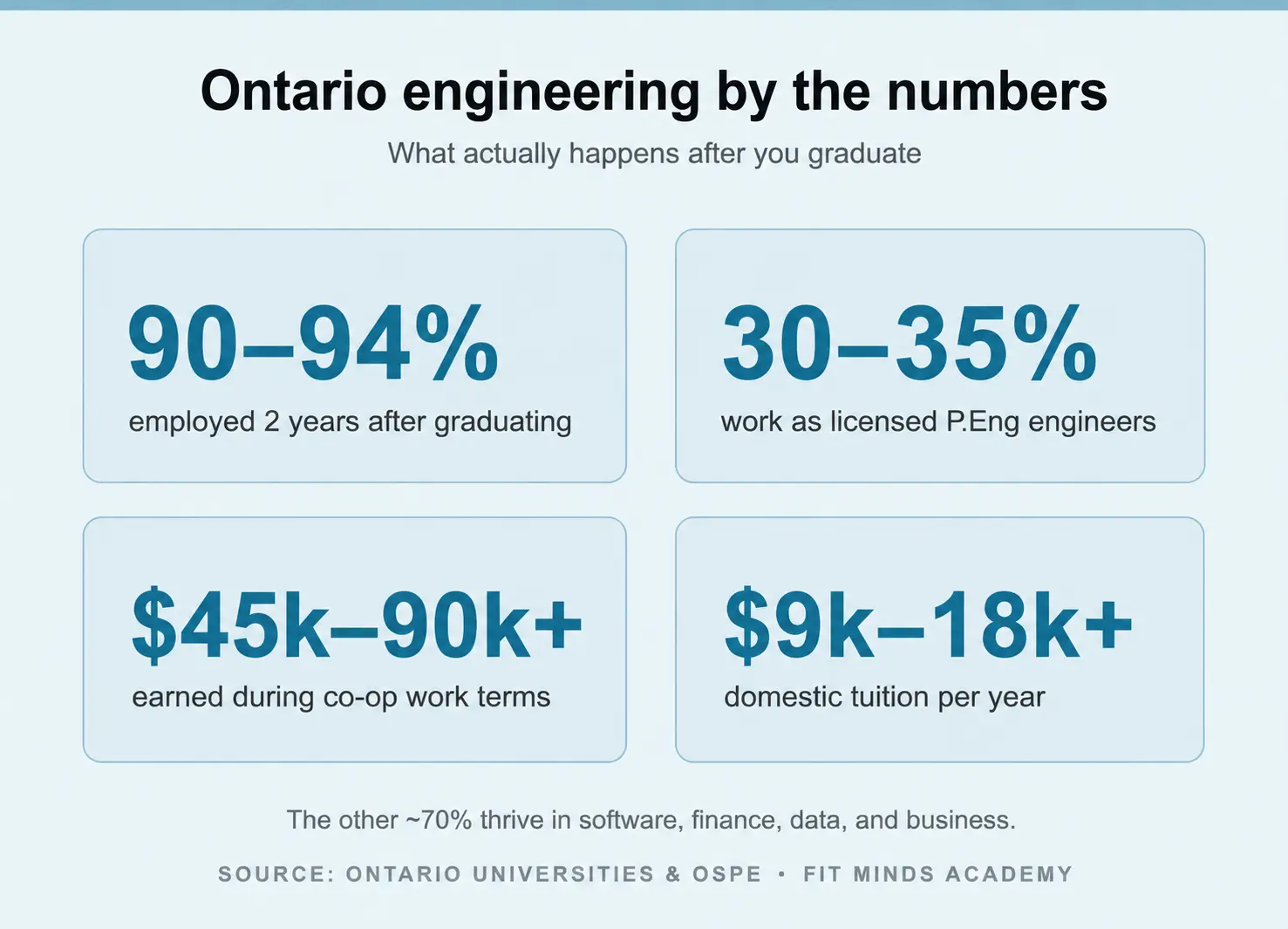
Now the stat that scares people. Only about 30 to 35 percent of engineering grads in Ontario work in licensed, traditional engineering jobs. That sounds bad until you read it right. It does not mean the other 70 percent are jobless. It means the degree is flexible. Most grads use their problem-solving skills to do well in software, finance, consulting, data science, and startups.
Frequently asked questions
Final verdict: is engineering worth it?
Final verdict: is engineering worth it?
Ontario engineering by the numbers
Engineering is worth it for most students, but only if you actually enjoy math and physics.
The real risk is disliking the subjects, not being weak at them today. Skill gaps are fixable.
In Ontario, plan for $60,000 to $100,000+ across the full degree.
Grades alone no longer guarantee a job. Co-op, projects, and networking matter as much.
Only ~30% of grads become licensed engineers, yet the degree opens doors in tech, finance, and business.
So, is engineering worth it? If you want strong thinking skills, high-paying doors, and real problems to solve, then yes. It is worth every bit of effort.
It is not worth it if you are only doing it for the title, or because your parents want it, while you dislike the subjects. The high cost, heavy workload, and burnout risk need real interest to carry you through.
Take time to check your own interests. Look into different career paths. Build your math and physics base early. And treat university as a launch pad, not just a finish line.
What is your biggest worry about studying engineering? Whether you are fighting through Grade 12 physics or trying to pick a field, drop a comment or reach out to our team at Fit Minds Academy for one-on-one help.
A pre-engineering program is worth it if you need to build your math and physics base before a full degree. It gives you time to close skill gaps and confirm you enjoy the work before you commit the money.
Oubada Al Tarabishi holds a Master of Engineering (M.Eng.) in Electrical Engineering and tutors first-year and upper-year engineering students at Fit Minds Academy. He works with students across Mississauga and online, helping them get through the exact courses — calculus, physics, and core engineering — that decide whether the degree feels worth it.
An honest guide for Ontario students:
the real costs, the salaries, and the counter-case
Struggling with a specific course? If you are stuck on Grade 12 SPH4U physics or MCV4U calculus, that is a fixable skill gap, not a dead end. Our tutors at Fit Minds Academy fix exactly this, one on one, so a weak spot does not cost you the whole degree.
Program (Ontario, domestic)
Ontario engineering outcome
Employed 2 years after graduation
Employed at 6 months (Western, Ontario Tech)
Working in licensed P.Eng roles
Co-op earnings across all work terms
Domestic tuition per year
Is a pre-engineering program worth it?
Yes. Being weak at math today is a skill gap, not a wall. Good tutoring and steady practice can fix it. Only a true dislike of math and physics is a real reason to rethink engineering.
Is becoming an engineer worth it if I am bad at math right now?
Yes. Only about 30 to 35 percent of Ontario grads work in licensed P.Eng roles, yet most of the rest do well in software, finance, data, and business. The degree stays useful even off the traditional path.
Is it worth studying engineering if I might not become a licensed engineer?
Domestic engineering tuition runs about $9,000 to over $18,000 per year. With textbooks and living costs, a full degree often reaches $60,000 to $100,000 or more across four or five years.
How much does an engineering degree cost in Ontario?
Ontario engineering by the numbers
Frequently asked questions
Why is engineering tuition so expensive?
Program (Ontario, domestic)
Why the big gap? Engineering needs expensive labs, machine shops, robotics gear, and special software. Schools also run whole co-op departments to set up job placements. And every program must meet strict national safety and quality rules to count toward a professional license.
Add tuition and living costs across four or five years, and an engineering degree can cost $60,000 to $100,000 or more. If you are not truly interested in the field, taking on that much money and stress makes little sense.
How to make your engineering degree actually pay off
How to make your engineering degree actually pay off
The job market is changing fast, and school is slow to catch up. Going to class, handing in labs, and memorizing formulas for an A+ is no longer a promised ticket to a job. Every year, many grads leave with great marks but no real experience, then search for work for months.
So use your years well:
Get to know your professors. Many have years of industry contacts and real projects.
Build real things. Join design teams like Formula SAE, robotics, or concrete canoe, or ship your own app.
Show up in person. Go to mixers and conferences and talk to hiring managers.
Learn the tools the job uses. Python, CAD, MATLAB, and Git go further than lecture notes alone.
Courses end, but the people you meet stay with you.
Do you need an engineering degree to be an engineer?
Whether you strictly need an accredited four-year degree depends on the field. For regulated work, like designing bridges, power plants, or aircraft parts, an accredited degree is required by law to become a licensed Professional Engineer, or P.Eng. There is no way around that one.
For fields like software or tech product work, the knowledge is open to everyone. You can learn full computer science topics through self-study, tutorials, and practice. If your goal is software, a five-year university program is just one valid path, not the only one.
Engineering is worth it for most students, but only if you actually enjoy math and physics.
The real risk is disliking the subjects, not being weak at them today. Skill gaps are fixable.
In Ontario, plan for $60,000 to $100,000+ across the full degree.
Grades alone no longer guarantee a job. Co-op, projects, and networking matter as much.
Only ~30% of grads become licensed engineers, yet the degree opens doors in tech, finance, and business.
Ontario engineering by the numbers
Ontario engineering outcome
Employed 2 years after graduation
Employed at 6 months (Western, Ontario Tech)
Working in licensed P.Eng roles
Co-op earnings across all work terms
Domestic tuition per year
Now the stat that scares people. Only about 30 to 35 percent of engineering grads in Ontario work in licensed, traditional engineering jobs. That sounds bad until you read it right. It does not mean the other 70 percent are jobless. It means the degree is flexible. Most grads use their problem-solving skills to do well in software, finance, consulting, data science, and startups.
So, is engineering worth it? If you want strong thinking skills, high-paying doors, and real problems to solve, then yes. It is worth every bit of effort.
It is not worth it if you are only doing it for the title, or because your parents want it, while you dislike the subjects. The high cost, heavy workload, and burnout risk need real interest to carry you through.
Take time to check your own interests. Look into different career paths. Build your math and physics base early. And treat university as a launch pad, not just a finish line.
What is your biggest worry about studying engineering? Whether you are fighting through Grade 12 physics or trying to pick a field, drop a comment or reach out to our team at Fit Minds Academy for one-on-one help.
Final verdict: is engineering worth it?
Is a pre-engineering program worth it?
Is becoming an engineer worth it if I am bad at math right now?
Is it worth studying engineering if I might not become a licensed engineer?
How much does an engineering degree cost in Ontario?
Frequently asked questions
Domestic engineering tuition runs about $9,000 to over $18,000 per year. With textbooks and living costs, a full degree often reaches $60,000 to $100,000 or more across four or five years.
A pre-engineering program is worth it if you need to build your math and physics base before a full degree. It gives you time to close skill gaps and confirm you enjoy the work before you commit the money.
Yes. Being weak at math today is a skill gap, not a wall. Good tutoring and steady practice can fix it. Only a true dislike of math and physics is a real reason to rethink engineering.
Yes. Only about 30 to 35 percent of Ontario grads work in licensed P.Eng roles, yet most of the rest do well in software, finance, data, and business. The degree stays useful even off the traditional path.