Contact us
Get in touch with our experts team

Contact us
Get in touch with our experts team
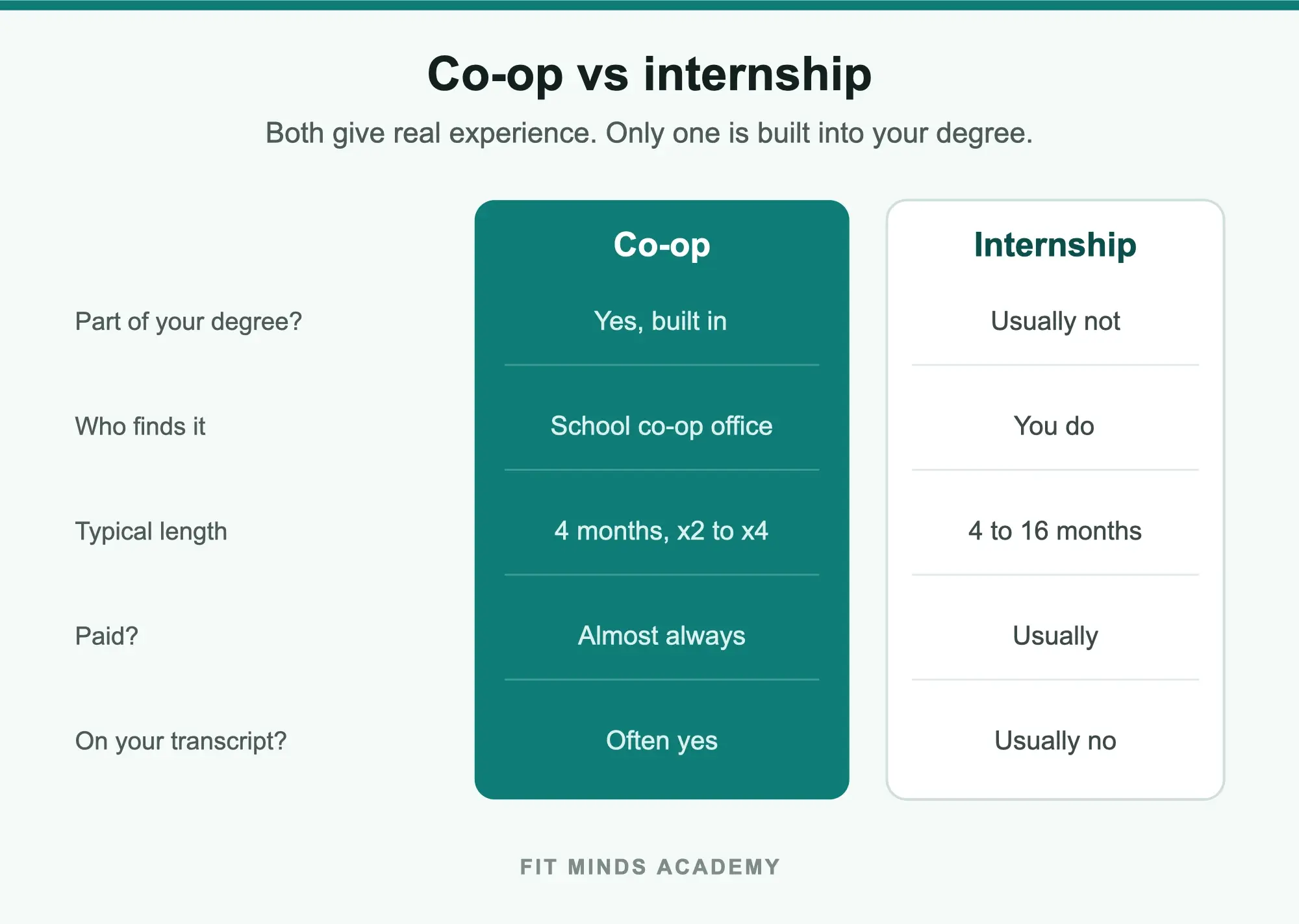
Co-op
Co-op
Internship
Internship
Part of your degree?
Part of your degree?
Yes, it is built into your program
Yes, it is built into your program
Usually not, you find it on your own
Usually not, you find it on your own
Who helps you find it
Who helps you find it
Your school's co-op office and job portal
Your school's co-op office and job portal
You, through applications and networking
You, through applications and networking
Typical length
Typical length
4 months, repeated 2 to 4 times
4 months, repeated 2 to 4 times
4 to 16 months, often one term
4 to 16 months, often one term
Paid?
Paid?
Almost always
Almost always
Usually, but not always
Usually, but not always
Shows on your transcript?
Shows on your transcript?
Often Yes
Often Yes
Usually No
Usually No

By Rami Alzaytavi, B.Eng. Software Engineering · Tutor at Fit Minds Academy
By Rami Alzaytavi, B.Eng. Software Engineering · Tutor at Fit Minds Academy
Quick answer: To get your first engineering co-op, keep your GPA above your program's cutoff, build two or three small projects you can talk about, join a design team or club, get to know your professors and TAs, and have your resume and LinkedIn ready before postings open. Most students become eligible after second or third year, but the ones who land the best placements start preparing in first year.
Quick answer: To get your first engineering co-op, keep your GPA above your program's cutoff, build two or three small projects you can talk about, join a design team or club, get to know your professors and TAs, and have your resume and LinkedIn ready before postings open. Most students become eligible after second or third year, but the ones who land the best placements start preparing in first year.
Getting your first engineering co-op can feel scary.
You see other students posting "I got the offer!" on LinkedIn while you are still trying to survive midterms. Meanwhile you are wondering what employers actually want, when you are supposed to start preparing, and what you are supposed to say when you have no real experience yet.
Here is the thing most students miss. Your program probably only lets you apply after second or third year. But the students who get the best placements did not start in third year. They started in first and second year without even realizing it.
This guide shows you what to do before co-op season, so that when applications open you are ready instead of starting from zero.
Getting your first engineering co-op can feel scary.
You see other students posting "I got the offer!" on LinkedIn while you are still trying to survive midterms. Meanwhile you are wondering what employers actually want, when you are supposed to start preparing, and what you are supposed to say when you have no real experience yet.
Here is the thing most students miss. Your program probably only lets you apply after second or third year. But the students who get the best placements did not start in third year. They started in first and second year without even realizing it.
This guide shows you what to do before co-op season, so that when applications open you are ready instead of starting from zero.
What is an engineering co-op?
What is an engineering
co-op?
How to get your first engineering co-op: a simple guide for students
How to get your first engineering co-op: a simple guide for students
An engineering co-op is a paid work term where you work full time at a real company as part of your degree. You alternate between school terms and work terms, and the work counts toward your program. Most Canadian engineering co-op terms run four months, and many students complete between two and four of them before they graduate.
An engineering co-op is a paid work term where you work full time at a real company as part of your degree. You alternate between school terms and work terms, and the work counts toward your program. Most Canadian engineering co-op terms run four months, and many students complete between two and four of them before they graduate.
The word co-op is short for cooperative education. Your school, the employer, and you all work together: the school connects you to jobs and tracks your progress, the company pays you and gives you real work, and you get experience that no lecture can teach.
People use these words like they mean the same thing. They do not, and the difference matters when you are searching for postings.
It is fair to ask why you should care this much. Why not just look for a job after you graduate?
You can. Co-op simply makes that job hunt much easier. During a work term you see what real engineering work looks like, you learn tools that never show up in lectures, and you start building a network of people who know your name and your work.
Plenty of students finish school with zero real experience. Co-op students graduate with eight to sixteen months of work on their resume, and sometimes a return offer from a company that already knows them.
Both give you real experience. Co-op just gives you more structure and a school portal full of employers who are specifically looking for students.
Co-op vs internship: what is the difference?
Co-op vs internship: what is the difference?
Why this matters: Students reach third year all the time and only then discover their GPA is under the cutoff, or that they missed a required workshop. Knowing the target early turns co-op from "maybe" into something you can actually plan for.
The first step is simple. Know the rules at your school.
Every university is different. Some let you do a first work term after second year, some only after third year, and some run one long internship instead. They also each have their own minimum GPA, required prep courses, and deadlines.
Spend ten minutes on your program's co-op page. Write down when you first become eligible, what the minimum GPA is, and which workshops or prep courses you have to finish first. That is it. Now you are not guessing.
If you want to see how a big co-op program is structured, look at Waterloo's co-operative education program or U of T Engineering's professional experience options. Even if you go somewhere else, seeing how these programs lay out eligibility and work terms makes your own school's rules easier to understand.
Co-op programs and companies often use GPA as a simple filter. You do not need to be perfect. You do need to stay above the cutoff.
At the start of each term, open every course outline and put all your tests, labs, quizzes, and assignments into one calendar. Look at the whole term at once. When you spot a week where five things are due, start early so that week does not flatten you.
Treat homework and labs as easy marks, not annoying extras. They are usually the part of your grade you control most. You have time, you can ask questions, and you can work with classmates when the rules allow it. Skipping them throws away marks you already owned.
When can you actually apply for co-op?
When can you actually apply for
co-op?
Most students only talk to professors and TAs when they are desperate the week before an exam. That is fine, but you are leaving a lot on the table.
Your professors and TAs know which companies hire from your program, which skills employers keep asking for, and which students actually show up and do the work.
Office hours do not have to be awkward. Start small:
After a few visits they know your name. Later, when you ask about co-op, they already see you as a hardworking student instead of a stranger asking for a favour.
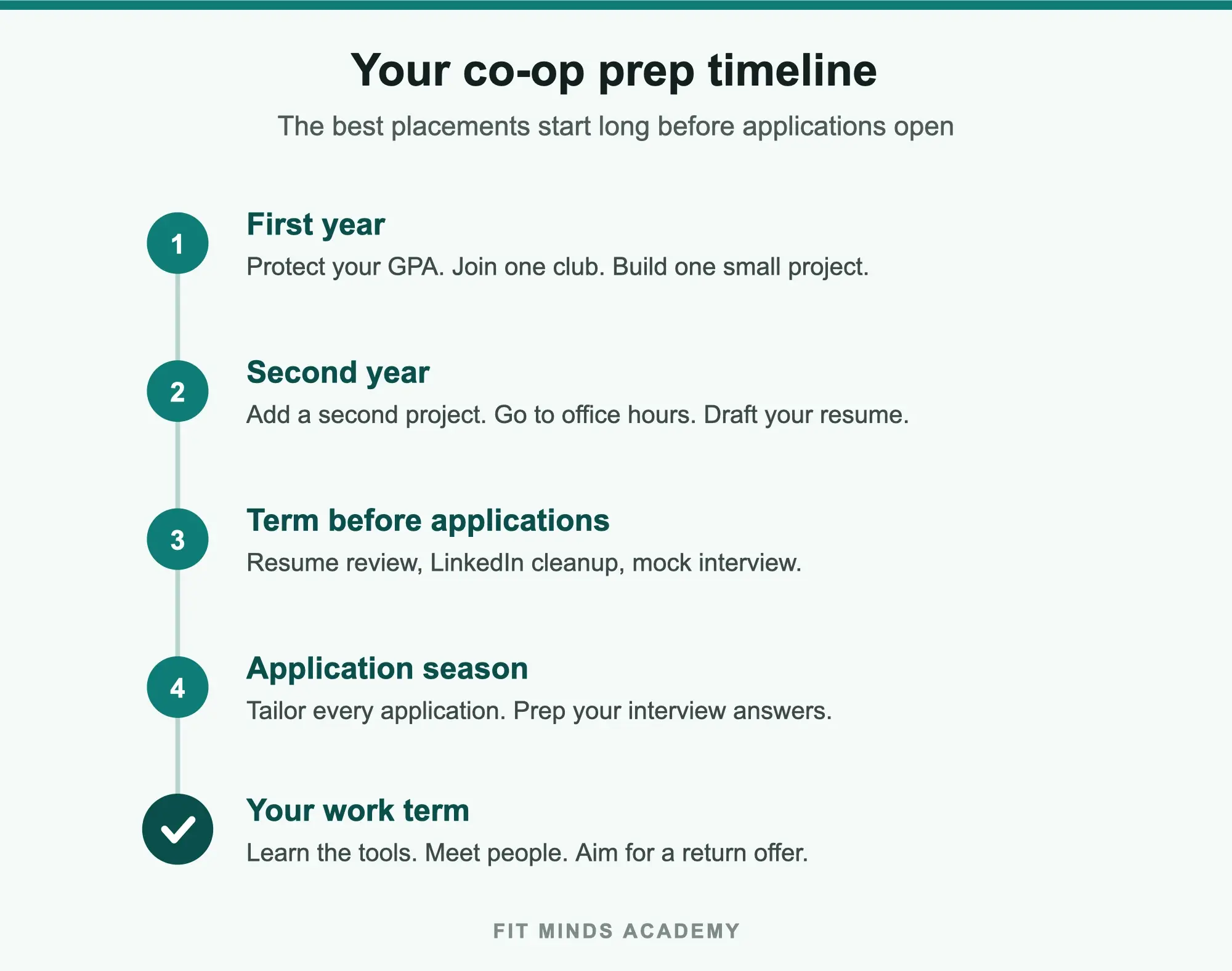
You do not need to do all of this at once. Here is roughly when each piece matters.
Step 2: build real skills before you apply
Is engineering co-op worth it?
Step 1: keep your GPA co-op ready
Step 1: keep your GPA co-op ready
A few things you can start using this week:
Your school's co-op or internship page, to learn the actual rules and deadlines
Your university's career portal, to browse real postings and see what employers ask for
A LinkedIn headline generator, to get a first draft of your profile text
An AI headshot tool, to upgrade your profile photo from random selfie to hireable
CEWIL Canada, the national body for co-op and work-integrated learning, if you want to understand how co-op works across the country
From our side at Fit Minds Academy, you can use our university course tutoring if your GPA is slipping, and our guide on whether an engineering degree is worth it if you are still deciding on the path itself.
Getting your first engineering co-op is not about luck. It is about what you do in the years before you apply.
If you want to keep your GPA strong, actually understand the hard courses, and feel confident putting yourself in front of employers, you do not have to figure it out alone.
At Fit Minds Academy we help engineering students build better study systems, stay on top of their courses, and connect what they are learning to real careers. If that sounds like the support you want, book a free consultation and see if we are a good fit.
Your future co-op offer starts with the choices you make this term.
Key takeaways
Your co-op prep toolbox
Frequently asked questions
Need help staying co-op read
Your co-op prep timeline
Your co-op prep timeline
Step 3: use professors, TAs and clubs to open doors
Step 4: get your resume, LinkedIn and portfolio ready early
Co-op is a paid work term built into your degree, and most students do two to four of them.
The students with the best placements start preparing in first and second year, not third.
GPA is a filter. Stay above your program's cutoff or you never get to apply.
Small personal projects and design teams count as real experience. Paid jobs are not the only proof.
Professors and TAs fill roles that never get posted publicly. Let them know who you are.
Twenty tailored applications beat eighty generic ones.
An engineering co-op is a paid, full-time work term that counts toward your engineering degree. You alternate between study terms and work terms. Most Canadian co-op terms last four months, and students usually complete two to four of them before graduating.
Author's Bio
Rami graduated from Ankara Science University with a degree in Software Engineering and has extensive experience in software development and education. He Specializes in programming fundamentals, data structures, algorithms, and web development. Rami's practical industry experience and teaching skills make him excellent at preparing students for both academic success and co-op positions.
In This Article
In This Article
In This Article
In This Article
In This Article
In This Article

How to get your first engineering co-op: a simple guide for students
How to get your first engineering co-op: a simple guide for students
By Rami Alzaytavi
|
September 3, 2026
|
13 min read
Why this matters: Employers love low-risk choices. A student who has already worked inside an engineering team is much safer to hire than someone who has only passed exams. Co-op is the proof.
When
What to Focus on
First Year
Protect your GPA, join one club, build one small project
Second Year
Add a second project, go to office hours, draft your resume
Term before applications
Resume review, LinkedIn cleanup, mock interview, browse postings
Application Season
Tailor each application, prep interview answers, track everything
During your work term
Learn the tools, meet people, aim for a return offer
What is an engineering co-op?
A co-op is built into your degree and supported by your school's co-op office and job portal. An internship is usually something you find on your own and does not formally count toward your program. Both give real experience, but co-op comes with more structure and a portal full of employers looking specifically for students.
What is the difference between a co-op and an internship?
Most Canadian engineering programs let you apply after second or third year, though the exact rules differ by school. Check your program's co-op page for the eligibility year, the minimum GPA, and any required prep workshops.
When can I apply for my first engineering co-op?
You need to stay above your program's minimum, which is often the real filter. You do not need a perfect average. Once you clear the cutoff, projects, clubs, and how you interview usually matter more than the difference between a B and an A.
Yes, for most students. Co-op graduates leave school with eight to sixteen months of paid experience, a professional network, and sometimes a return offer. That makes the post-graduation job hunt far easier than starting with no experience at all.
Do I need a high GPA to get an engineering co-op?
Is an engineering co-op worth it?
Frequently asked questions
Key takeaways
Why this matters: A solid GPA keeps doors open. If your average slips under the co-op requirement, it will not matter how good your resume or your personality is. You may never get to apply at all.
A lot of students get stuck in the same loop. You cannot get experience because nobody hires you without experience. The way out is to stop believing that only paid jobs count.
Start with small projects. Write a Python script that solves a real problem you actually have. Build a small circuit or an Arduino project. Model a part in CAD and print it in the school lab. The project does not need to be impressive. It needs to be real enough that you can explain what you tried, what tools you used, and what broke along the way.
Joining an engineering club or design team is the other shortcut. You end up surrounded by upper-year students who already survived the courses you are taking now. You see real tools, real deadlines, and real mistakes, with far less pressure than a job.
Why this matters: When an interviewer says "tell me about a project you worked on," you want a real answer instead of "uh, my lab last week." Projects and clubs turn you from another first-time applicant into someone who has already started doing the work.
"Hi, I'm in your class and I'm stuck on this idea. Can I show you what I tried?"
Why this matters: Many research jobs, lab jobs, and even co-op roles are never posted publicly. They get filled when someone asks "do you know a good student for this?" If nobody knows you, your name never comes up.
When a great posting appears, you should not be writing your resume from scratch at 2 a.m.
Build a simple one-page resume now. Include your program, school, graduation year, a short list of relevant courses, a few projects from class or clubs or your own time, any jobs or volunteer work, and a short skills section. Honest, clear bullet points beat long paragraphs stuffed with buzzwords.
Then clean up your LinkedIn. Write a headline that says what you actually do, like "First-year mechanical engineering student interested in design and manufacturing." In your About section, explain what you are studying, what interests you, and what kind of co-op you want. If the writing feels hard, use a LinkedIn headline generator for a rough first draft, then rewrite it in your own words so it sounds like a person.
Pick a clear, friendly profile photo too. If your current picture is a blurry group shot, swap it for a simple head-and-shoulders photo. An AI headshot tool can turn a normal selfie into something more polished if you do not have a good photo.
Finally, keep your best projects in one place: a Google Drive folder, a Notion page, or a GitHub account. For each project write a few lines about what you built and what you used.
Why this matters: When an employer searches your name, they see the whole picture at once. A clean resume, a clear LinkedIn, and real projects beat an empty profile with no photo every single time.
Your university almost certainly has a co-op office or career centre. They run info sessions, resume checks, and mock interviews. Most students ignore all of it until the week everything is due.
Go before you are in panic mode. Attend one co-op info session. Log into the job portal and scroll real postings even if you cannot apply yet, just to see what companies ask for. Book a resume review once you have a draft. Do at least one practice interview
Step 5: use your school's co-op and career office
Why this matters: You get feedback while it is still cheap. When everyone else is lined up outside the career office two days before the deadline, you already know how the system works and what to fix.
When applications finally open, the temptation is to panic and hit apply on everything with the same generic resume.
Slow down slightly. Read each job description and ask what problem the team is trying to solve and which skills keep repeating. Then move your most relevant project and skills near the top of your resume. You do not need to rewrite the whole thing. You just need to make it obvious why you fit that specific role.
Prepare for the questions too. Most first co-op interviews ask the same handful of things: tell me about yourself, walk me through a project, describe a time something went wrong, and why this company. Write out rough answers once and you will sound calm instead of surprised.
You will get rejected. Everyone does. Track where you applied, learn something from each interview, and keep going.
Step 6: apply smart when co-op postings go live
Why this matters: Twenty thoughtful applications almost always beat eighty random ones. Employers can tell instantly who read the posting and who did not.
Quick answer: To get your first engineering co-op, keep your GPA above your program's cutoff, build two or three small projects you can talk about, join a design team or club, get to know your professors and TAs, and have your resume and LinkedIn ready before postings open. Most students become eligible after second or third year, but the ones who land the best placements start preparing in first year.
Why this matters: Students reach third year all the time and only then discover their GPA is under the cutoff, or that they missed a required workshop. Knowing the target early turns co-op from "maybe" into something you can actually plan for.
Why this matters: Employers love low-risk choices. A student who has already worked inside an engineering team is much safer to hire than someone who has only passed exams. Co-op is the proof.
Step 3: use professors, TAs and clubs to open doors
Step 4: get your resume, LinkedIn and portfolio ready early
Need help staying co-op read
In This Article
Why this matters: Students reach third year all the time and only then discover their GPA is under the cutoff, or that they missed a required workshop. Knowing the target early turns co-op from "maybe" into something you can actually plan for.
Is engineering co-op worth it?
It is fair to ask why you should care this much. Why not just look for a job after you graduate?
You can. Co-op simply makes that job hunt much easier. During a work term you see what real engineering work looks like, you learn tools that never show up in lectures, and you start building a network of people who know your name and your work.
Plenty of students finish school with zero real experience. Co-op students graduate with eight to sixteen months of work on their resume, and sometimes a return offer from a company that already knows them.
Why this matters: Employers love low-risk choices. A student who has already worked inside an engineering team is much safer to hire than someone who has only passed exams. Co-op is the proof.
Step 1: keep your GPA co-op ready
Co-op programs and companies often use GPA as a simple filter. You do not need to be perfect. You do need to stay above the cutoff.
At the start of each term, open every course outline and put all your tests, labs, quizzes, and assignments into one calendar. Look at the whole term at once. When you spot a week where five things are due, start early so that week does not flatten you.
Treat homework and labs as easy marks, not annoying extras. They are usually the part of your grade you control most. You have time, you can ask questions, and you can work with classmates when the rules allow it. Skipping them throws away marks you already owned.
Why this matters: A solid GPA keeps doors open. If your average slips under the co-op requirement, it will not matter how good your resume or your personality is. You may never get to apply at all.
Step 2: build real skills before you apply
A lot of students get stuck in the same loop. You cannot get experience because nobody hires you without experience. The way out is to stop believing that only paid jobs count.
Start with small projects. Write a Python script that solves a real problem you actually have. Build a small circuit or an Arduino project. Model a part in CAD and print it in the school lab. The project does not need to be impressive. It needs to be real enough that you can explain what you tried, what tools you used, and what broke along the way.
Joining an engineering club or design team is the other shortcut. You end up surrounded by upper-year students who already survived the courses you are taking now. You see real tools, real deadlines, and real mistakes, with far less pressure than a job.
Why this matters: When an interviewer says "tell me about a project you worked on," you want a real answer instead of "uh, my lab last week." Projects and clubs turn you from another first-time applicant into someone who has already started doing the work.
Step 3: use professors, TAs and clubs to open doors
Most students only talk to professors and TAs when they are desperate the week before an exam. That is fine, but you are leaving a lot on the table.
Your professors and TAs know which companies hire from your program, which skills employers keep asking for, and which students actually show up and do the work.
Office hours do not have to be awkward. Start small:
"Hi, I'm in your class and I'm stuck on this idea. Can I show you what I tried?"
After a few visits they know your name. Later, when you ask about co-op, they already see you as a hardworking student instead of a stranger asking for a favour.
Why this matters: Many research jobs, lab jobs, and even co-op roles are never posted publicly. They get filled when someone asks "do you know a good student for this?" If nobody knows you, your name never comes up.
Step 4: get your resume, LinkedIn and portfolio ready early
When a great posting appears, you should not be writing your resume from scratch at 2 a.m.
Build a simple one-page resume now. Include your program, school, graduation year, a short list of relevant courses, a few projects from class or clubs or your own time, any jobs or volunteer work, and a short skills section. Honest, clear bullet points beat long paragraphs stuffed with buzzwords.
Then clean up your LinkedIn. Write a headline that says what you actually do, like "First-year mechanical engineering student interested in design and manufacturing." In your About section, explain what you are studying, what interests you, and what kind of co-op you want. If the writing feels hard, use a LinkedIn headline generator for a rough first draft, then rewrite it in your own words so it sounds like a person.
Pick a clear, friendly profile photo too. If your current picture is a blurry group shot, swap it for a simple head-and-shoulders photo. An AI headshot tool can turn a normal selfie into something more polished if you do not have a good photo.
Finally, keep your best projects in one place: a Google Drive folder, a Notion page, or a GitHub account. For each project write a few lines about what you built and what you used.
Why this matters: When an employer searches your name, they see the whole picture at once. A clean resume, a clear LinkedIn, and real projects beat an empty profile with no photo every single time.
Your university almost certainly has a co-op office or career centre. They run info sessions, resume checks, and mock interviews. Most students ignore all of it until the week everything is due.
Go before you are in panic mode. Attend one co-op info session. Log into the job portal and scroll real postings even if you cannot apply yet, just to see what companies ask for. Book a resume review once you have a draft. Do at least one practice interview
Step 5: use your school's co-op and career office
Why this matters: You get feedback while it is still cheap. When everyone else is lined up outside the career office two days before the deadline, you already know how the system works and what to fix.
Step 6: apply smart when co-op postings go live
When applications finally open, the temptation is to panic and hit apply on everything with the same generic resume.
Slow down slightly. Read each job description and ask what problem the team is trying to solve and which skills keep repeating. Then move your most relevant project and skills near the top of your resume. You do not need to rewrite the whole thing. You just need to make it obvious why you fit that specific role.
Prepare for the questions too. Most first co-op interviews ask the same handful of things: tell me about yourself, walk me through a project, describe a time something went wrong, and why this company. Write out rough answers once and you will sound calm instead of surprised.
You will get rejected. Everyone does. Track where you applied, learn something from each interview, and keep going.
Why this matters: Twenty thoughtful applications almost always beat eighty random ones. Employers can tell instantly who read the posting and who did not.
When
What to Focus on
First Year
Protect your GPA, join one club, build one small project
Second Year
Add a second project, go to office hours, draft your resume
Term before applications
Resume review, LinkedIn cleanup, mock interview, browse postings
Application Season
Tailor each application, prep interview answers, track everything
During your work term
Learn the tools, meet people, aim for a return offer
Co-op is a paid work term built into your degree, and most students do two to four of them.
The students with the best placements start preparing in first and second year, not third.
GPA is a filter. Stay above your program's cutoff or you never get to apply.
Small personal projects and design teams count as real experience. Paid jobs are not the only proof.
Professors and TAs fill roles that never get posted publicly. Let them know who you are.
Twenty tailored applications beat eighty generic ones.
Frequently asked questions
Getting your first engineering co-op is not about luck. It is about what you do in the years before you apply.
If you want to keep your GPA strong, actually understand the hard courses, and feel confident putting yourself in front of employers, you do not have to figure it out alone.
At Fit Minds Academy we help engineering students build better study systems, stay on top of their courses, and connect what they are learning to real careers. If that sounds like the support you want, book a free consultation and see if we are a good fit.
Your future co-op offer starts with the choices you make this term.
Need help staying
co-op read
An engineering co-op is a paid, full-time work term that counts toward your engineering degree. You alternate between study terms and work terms. Most Canadian co-op terms last four months, and students usually complete two to four of them before graduating.
What is an engineering co-op?
A co-op is built into your degree and supported by your school's co-op office and job portal. An internship is usually something you find on your own and does not formally count toward your program. Both give real experience, but co-op comes with more structure and a portal full of employers looking specifically for students.
What is the difference between a co-op and an internship?
Most Canadian engineering programs let you apply after second or third year, though the exact rules differ by school. Check your program's co-op page for the eligibility year, the minimum GPA, and any required prep workshops.
When can I apply for my first engineering co-op?
You need to stay above your program's minimum, which is often the real filter. You do not need a perfect average. Once you clear the cutoff, projects, clubs, and how you interview usually matter more than the difference between a B and an A.
Do I need a high GPA to get an engineering co-op?
Yes, for most students. Co-op graduates leave school with eight to sixteen months of paid experience, a professional network, and sometimes a return offer. That makes the post-graduation job hunt far easier than starting with no experience at all.
Is an engineering co-op worth it?
Your co-op prep timeline
A few things you can start using this week:
Your school's co-op or internship page, to learn the actual rules and deadlines
Your university's career portal, to browse real postings and see what employers ask for
A LinkedIn headline generator, to get a first draft of your profile text
An AI headshot tool, to upgrade your profile photo from random selfie to hireable
CEWIL Canada, the national body for co-op and work-integrated learning, if you want to understand how co-op works across the country
From our side at Fit Minds Academy, you can use our university course tutoring if your GPA is slipping, and our guide on whether an engineering degree is worth it if you are still deciding on the path itself.