Contact us
Get in touch with our experts team

Contact us
Get in touch with our experts team
Do grades matter in university? The honest answer
By Ahmad Dawood, M.Sc. Computer Science · Tutor at Fit Minds Academy
Quick answer: Grades matter a lot at a few specific gates, and much less everywhere else. They decide whether you get into co-op, grad school, scholarships, and a handful of competitive employers that screen by GPA. Once you are past those gates, what you can actually do matters more than your average. So the real question is not "do grades matter," it is "which gates am I trying to get through, and what number do they need?"
You are probably reading this at 1 a.m. after a rough midterm, half hoping someone tells you grades do not matter.
I am not going to tell you that. But I am also not going to tell you that every percentage point decides your future, because that is not true either, and you have probably heard it enough already.
Here is the honest version. Grades work like gates. There are a small number of moments in your degree where a number on a transcript decides whether a door opens or stays shut. Outside of those moments, grades matter far less than most students think.
The trick is knowing which gates apply to you.
The short answer: grades are a gate, not a scoreboard
Most students treat GPA like a score in a game, where higher is always better and every mark is worth stressing over.
It works more like a bouncer at a door. The bouncer checks one number. If you are above the line, you walk in and nobody mentions your average again. If you are below it, nothing else about you gets looked at.
That changes what you should do. You do not need to chase a perfect average. You need to know where your gates are, what number each one needs, and stay above it.
Where your grades matter a lot

These are the gates. Each one uses your GPA as a filter before a human ever looks at you.
Gate
Why grades decide it
Co-op and internship applications
Programs set a minimum GPA to stay eligible, and some rank students by average
Grad school (master's and PhD)
Admissions usually look at your final two years and set a firm minimum
Scholarships and awards
Almost all are decided on GPA alone
Staying on OSAP
Government aid requires you to keep making academic progress
Transferring programs
Competitive transfers pick from the top of the applicant pile
A few big employers
Some consulting, finance and new-grad engineering programs still screen by GPA
Co-op is the gate that catches most students
This is the one students discover too late. Your co-op program sets a minimum GPA, and if you fall below it you may not be allowed to apply at all. Some programs also rank applicants, which means your average affects which employers see you first.
The painful part is the timing. You usually apply in second or third year, but the average being checked includes the courses you took in first year, when you were still figuring out how university works. Check your program's requirement now, not the term you plan to apply. Here is how a large program lays out its structure, using Waterloo's co-op program as an example.
Grad school looks at your last two years
If you are thinking about a master's or a PhD, your later years carry the most weight. Ontario graduate programs typically want somewhere around a B+ average in your final two years, though the exact number varies by program and by school. You can check the real requirement for any program through your university's graduate studies office, like the University of Toronto's School of Graduate Studies.
The useful part of this: a rough first year does far less damage than students assume, as long as your last two years are strong.
OSAP quietly checks too
If you receive OSAP, you have to keep making academic progress to stay eligible. Failing or dropping too many courses can put your funding at risk. Most students never think about this until a letter shows up.
Why this matters: The pattern worth noticing: every gate on this list is checked automatically, before a person reads your resume or meets you. That is exactly why grades matter more than "grades do not matter" people admit, and less than anxious students fear.
Where grades matter much less than you think

Now the other side, and this part is just as true.
Most employers, after your very first job, care about what you have built and what you can do. Nobody asks a third-year engineer for their transcript. Startups and small companies rarely ask at all, even for a first role. Your ability to solve a real problem, work with a team, and explain your thinking is what gets judged in an interview.
And the biggest one: your GPA has almost nothing to do with whether you are good at the subject. It measures how well you performed under one set of conditions, on a specific schedule, in a specific format. Plenty of excellent engineers had a rough second year.
So the honest summary is that grades open doors, but they do not do the work once you are through them.
Do grades matter when getting a job?
For your first job, sometimes. For everything after, rarely.
A small number of employers use GPA as an early filter, usually large firms with more applicants than they can read: some consulting firms, some finance roles, and some big new-grad engineering programs. If those are your targets, the number matters and you should know their cutoff.
Everyone else is looking at your experience, your projects, and how you interview. This is why a student with co-op experience and two real projects often beats a student with a higher average and neither. If you want to build that side, our guide on how to get your first engineering co-op walks through it.
Once you have one or two years of work behind you, your transcript effectively disappears. Nobody asks again.
Do grades matter for a master's or PhD?
Yes, more than anywhere else on this list.
Graduate admissions are competitive and heavily weighted toward your academic record, especially your final two years. A PhD application adds research experience and reference letters, but a weak average still makes it hard, because your references and your marks are usually the two things a committee has to go on.
If grad school is even a maybe for you, that is a reason to protect your average in third and fourth year specifically. That is the window that counts.
Do grades matter in life?
Honestly, no. Not the way school makes it feel.
Nobody has ever asked me my GPA at a dinner table, in a meeting, or on a project. What follows you is what you can do, how you treat people, and whether you finish things you start.
But that is not the same as saying school does not matter. What university actually gives you is the habit of working through something hard when you do not feel like it. That habit shows up everywhere later. The grade is just the receipt.
What to do with all this
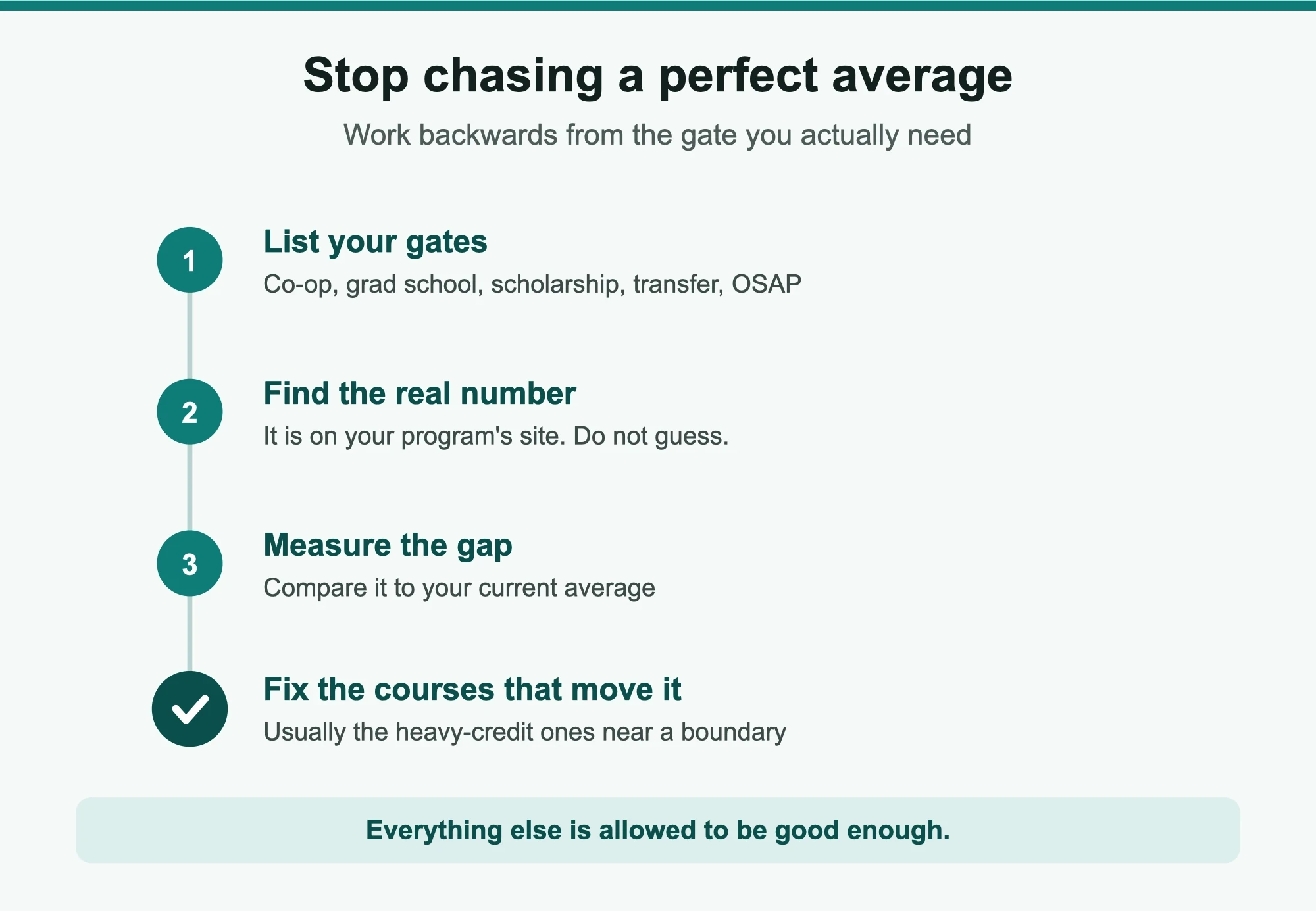
Stop asking whether grades matter in general. Ask a smaller, more useful question: which gates am I trying to get through?
Then work backwards.
Write down the gates that apply to you: co-op, grad school, a scholarship, a transfer, OSAP.
Find the actual number each one needs. Do not guess. It is on your program's website.
Compare it to your current average, and note the gap.
Focus on the courses that move that gap most, usually the heavy-credit ones you are closest to failing or closest to a boundary in.
Everything else is allowed to be good enough.
That is a much smaller job than "get high marks in everything," and it protects the doors you actually care about.
Key takeaways
Grades work like gates, not a scoreboard. A few moments check the number, and the rest do not.
Co-op is the gate that surprises the most students, and it counts your first-year marks.
Grad school cares most about your final two years, so an early rough patch is survivable.
Scholarships, OSAP, and competitive transfers are decided largely on GPA.
After your first job, almost nobody asks about your average again.
Find the specific number your gate requires instead of chasing a perfect average.
When grades are slipping and you do not know why
There is a version of this problem that is not about effort. Some students study constantly and still watch a specific course drag their average down, usually a math-heavy one that everything else builds on.
That is worth taking seriously early, because of the timing problem above. A weak first-year calculus or physics mark sits in your co-op average for years.
At Fit Minds Academy we work with high school and university students one on one in the courses that do the most damage to an average: first-year calculus, physics, linear algebra, and the Grade 11 and 12 courses that feed into them. If your average is drifting toward a cutoff you care about, book a free consultation and we will look at where the marks are actually going.
Frequently asked questions
Do grades matter in university?
Grades matter at specific gates: co-op eligibility, graduate school admission, scholarships, competitive program transfers, keeping OSAP funding, and a small number of employers who filter by GPA. Outside those gates, experience and skills matter more. The goal is to stay above the cutoffs that apply to you, not to chase a perfect average.
How much do grades actually matter for getting a job?
For a first job, some large employers in consulting, finance, and new-grad engineering programs screen by GPA. Most other employers focus on your projects, co-op experience, and interview. After one or two years of work, employers almost never ask about your transcript again.
Do grades matter for a master's degree?
Yes. Graduate admissions weigh your academic record heavily, especially your final two years. Ontario programs commonly look for around a B+ average in those years, though the exact requirement varies by program. Check the specific number with your university's graduate studies office.
Do grades matter in life?
Not directly. No employer, client, or colleague will ask your GPA years later. What lasts is the working habit university builds: doing difficult work consistently even when you do not feel like it.
Can I recover from a bad first year?
Usually yes. Grad school focuses on your final two years, and most employers never see your transcript. Co-op is the main exception, since it often uses your cumulative average, so recovering early matters most if co-op is your goal.
Author's Bio
Ahmed is a passionate educator with extensive experience in electrical and computer engineering. With a Master's degree in Computer Science from Concordia University, he specializes in helping students master complex programming concepts and circuit design. Ahmed has worked on numerous research projects involving embedded systems and has a knack for breaking down difficult concepts into digestible lessons.
In This Article
In This Article
In This Article
In This Article
In This Article
In This Article

Do grades matter in university? The honest answer
By Ahmad Dawood, M.Sc. Computer Science · Tutor at Fit Minds Academy
Quick answer: Grades matter a lot at a few specific gates, and much less everywhere else. They decide whether you get into co-op, grad school, scholarships, and a handful of competitive employers that screen by GPA. Once you are past those gates, what you can actually do matters more than your average. So the real question is not "do grades matter," it is "which gates am I trying to get through, and what number do they need?"
You are probably reading this at 1 a.m. after a rough midterm, half hoping someone tells you grades do not matter.
I am not going to tell you that. But I am also not going to tell you that every percentage point decides your future, because that is not true either, and you have probably heard it enough already.
Here is the honest version. Grades work like gates. There are a small number of moments in your degree where a number on a transcript decides whether a door opens or stays shut. Outside of those moments, grades matter far less than most students think.
The trick is knowing which gates apply to you.
The short answer: grades are a gate, not a scoreboard
Most students treat GPA like a score in a game, where higher is always better and every mark is worth stressing over.
It works more like a bouncer at a door. The bouncer checks one number. If you are above the line, you walk in and nobody mentions your average again. If you are below it, nothing else about you gets looked at.
That changes what you should do. You do not need to chase a perfect average. You need to know where your gates are, what number each one needs, and stay above it.
Co-op vs internship: what is the difference?
These are the gates. Each one uses your GPA as a filter before a human ever looks at you.
Gate
Why grades decide it
Co-op and internship applications
Programs set a minimum GPA to stay eligible, and some rank students by average
Grad school (master's and PhD)
Admissions usually look at your final two years and set a firm minimum
Scholarships and awards
Almost all are decided on GPA alone
Staying on OSAP
Government aid requires you to keep making academic progress
Transferring programs
Competitive transfers pick from the top of the applicant pile
A few big employers
Some consulting, finance and new-grad engineering programs still screen by GPA
Co-op is the gate that catches most students
This is the one students discover too late. Your co-op program sets a minimum GPA, and if you fall below it you may not be allowed to apply at all. Some programs also rank applicants, which means your average affects which employers see you first.
The painful part is the timing. You usually apply in second or third year, but the average being checked includes the courses you took in first year, when you were still figuring out how university works. Check your program's requirement now, not the term you plan to apply. Here is how a large program lays out its structure, using Waterloo's co-op program as an example.
Grad school looks at your last two years
If you are thinking about a master's or a PhD, your later years carry the most weight. Ontario graduate programs typically want somewhere around a B+ average in your final two years, though the exact number varies by program and by school. You can check the real requirement for any program through your university's graduate studies office, like the University of Toronto's School of Graduate Studies.
The useful part of this: a rough first year does far less damage than students assume, as long as your last two years are strong.
OSAP quietly checks too
If you receive OSAP, you have to keep making academic progress to stay eligible. Failing or dropping too many courses can put your funding at risk. Most students never think about this until a letter shows up.
Why this matters: The pattern worth noticing: every gate on this list is checked automatically, before a person reads your resume or meets you. That is exactly why grades matter more than "grades do not matter" people admit, and less than anxious students fear.
Where grades matter much less than you think
Now the other side, and this part is just as true.
Most employers, after your very first job, care about what you have built and what you can do. Nobody asks a third-year engineer for their transcript. Startups and small companies rarely ask at all, even for a first role. Your ability to solve a real problem, work with a team, and explain your thinking is what gets judged in an interview.
And the biggest one: your GPA has almost nothing to do with whether you are good at the subject. It measures how well you performed under one set of conditions, on a specific schedule, in a specific format. Plenty of excellent engineers had a rough second year.
So the honest summary is that grades open doors, but they do not do the work once you are through them.
Do grades matter when getting a job?
For your first job, sometimes. For everything after, rarely.
A small number of employers use GPA as an early filter, usually large firms with more applicants than they can read: some consulting firms, some finance roles, and some big new-grad engineering programs. If those are your targets, the number matters and you should know their cutoff.
Everyone else is looking at your experience, your projects, and how you interview. This is why a student with co-op experience and two real projects often beats a student with a higher average and neither. If you want to build that side, our guide on how to get your first engineering co-op walks through it.
Once you have one or two years of work behind you, your transcript effectively disappears. Nobody asks again.
Do grades matter for a master's or PhD?
Yes, more than anywhere else on this list.
Graduate admissions are competitive and heavily weighted toward your academic record, especially your final two years. A PhD application adds research experience and reference letters, but a weak average still makes it hard, because your references and your marks are usually the two things a committee has to go on.
If grad school is even a maybe for you, that is a reason to protect your average in third and fourth year specifically. That is the window that counts.
Do grades matter in life?
Honestly, no. Not the way school makes it feel.
Nobody has ever asked me my GPA at a dinner table, in a meeting, or on a project. What follows you is what you can do, how you treat people, and whether you finish things you start.
But that is not the same as saying school does not matter. What university actually gives you is the habit of working through something hard when you do not feel like it. That habit shows up everywhere later. The grade is just the receipt.
What to do with all this
Stop asking whether grades matter in general. Ask a smaller, more useful question: which gates am I trying to get through?
Then work backwards.
Write down the gates that apply to you: co-op, grad school, a scholarship, a transfer, OSAP.
Find the actual number each one needs. Do not guess. It is on your program's website.
Compare it to your current average, and note the gap.
Focus on the courses that move that gap most, usually the heavy-credit ones you are closest to failing or closest to a boundary in.
Everything else is allowed to be good enough.
That is a much smaller job than "get high marks in everything," and it protects the doors you actually care about.
Key takeaways
Grades work like gates, not a scoreboard. A few moments check the number, and the rest do not.
Co-op is the gate that surprises the most students, and it counts your first-year marks.
Grad school cares most about your final two years, so an early rough patch is survivable.
Scholarships, OSAP, and competitive transfers are decided largely on GPA.
After your first job, almost nobody asks about your average again.
Find the specific number your gate requires instead of chasing a perfect average.
When grades are slipping and you do not know why
There is a version of this problem that is not about effort. Some students study constantly and still watch a specific course drag their average down, usually a math-heavy one that everything else builds on.
That is worth taking seriously early, because of the timing problem above. A weak first-year calculus or physics mark sits in your co-op average for years.
At Fit Minds Academy we work with high school and university students one on one in the courses that do the most damage to an average: first-year calculus, physics, linear algebra, and the Grade 11 and 12 courses that feed into them. If your average is drifting toward a cutoff you care about, book a free consultation and we will look at where the marks are actually going.
Frequently asked questions
Do grades matter in university?
Grades matter at specific gates: co-op eligibility, graduate school admission, scholarships, competitive program transfers, keeping OSAP funding, and a small number of employers who filter by GPA. Outside those gates, experience and skills matter more. The goal is to stay above the cutoffs that apply to you, not to chase a perfect average.
How much do grades actually matter for getting a job?
For a first job, some large employers in consulting, finance, and new-grad engineering programs screen by GPA. Most other employers focus on your projects, co-op experience, and interview. After one or two years of work, employers almost never ask about your transcript again.
Do grades matter for a master's degree?
Yes. Graduate admissions weigh your academic record heavily, especially your final two years. Ontario programs commonly look for around a B+ average in those years, though the exact requirement varies by program. Check the specific number with your university's graduate studies office.
Do grades matter in life?
Not directly. No employer, client, or colleague will ask your GPA years later. What lasts is the working habit university builds: doing difficult work consistently even when you do not feel like it.
Can I recover from a bad first year?
Usually yes. Grad school focuses on your final two years, and most employers never see your transcript. Co-op is the main exception, since it often uses your cumulative average, so recovering early matters most if co-op is your goal.
Author's Bio
Ahmed is a passionate educator with extensive experience in electrical and computer engineering. With a Master's degree in Computer Science from Concordia University, he specializes in helping students master complex programming concepts and circuit design. Ahmed has worked on numerous research projects involving embedded systems and has a knack for breaking down difficult concepts into digestible lessons.
Do grades matter in university? The honest answer
By Ahmad Dawood, M.Sc. Computer Science · Tutor at Fit Minds Academy
Quick answer: Grades matter a lot at a few specific gates, and much less everywhere else. They decide whether you get into co-op, grad school, scholarships, and a handful of competitive employers that screen by GPA. Once you are past those gates, what you can actually do matters more than your average. So the real question is not "do grades matter," it is "which gates am I trying to get through, and what number do they need?"
You are probably reading this at 1 a.m. after a rough midterm, half hoping someone tells you grades do not matter.
I am not going to tell you that. But I am also not going to tell you that every percentage point decides your future, because that is not true either, and you have probably heard it enough already.
Here is the honest version. Grades work like gates. There are a small number of moments in your degree where a number on a transcript decides whether a door opens or stays shut. Outside of those moments, grades matter far less than most students think.
The trick is knowing which gates apply to you.
The short answer: grades are a gate, not a scoreboard
Most students treat GPA like a score in a game, where higher is always better and every mark is worth stressing over.
It works more like a bouncer at a door. The bouncer checks one number. If you are above the line, you walk in and nobody mentions your average again. If you are below it, nothing else about you gets looked at.
That changes what you should do. You do not need to chase a perfect average. You need to know where your gates are, what number each one needs, and stay above it.
Co-op vs internship: what is the difference?
These are the gates. Each one uses your GPA as a filter before a human ever looks at you.
Gate
Why grades decide it
Co-op and internship applications
Programs set a minimum GPA to stay eligible, and some rank students by average
Grad school (master's and PhD)
Admissions usually look at your final two years and set a firm minimum
Scholarships and awards
Almost all are decided on GPA alone
Staying on OSAP
Government aid requires you to keep making academic progress
Transferring programs
Competitive transfers pick from the top of the applicant pile
A few big employers
Some consulting, finance and new-grad engineering programs still screen by GPA
Co-op is the gate that catches most students
This is the one students discover too late. Your co-op program sets a minimum GPA, and if you fall below it you may not be allowed to apply at all. Some programs also rank applicants, which means your average affects which employers see you first.
The painful part is the timing. You usually apply in second or third year, but the average being checked includes the courses you took in first year, when you were still figuring out how university works. Check your program's requirement now, not the term you plan to apply. Here is how a large program lays out its structure, using Waterloo's co-op program as an example.
Grad school looks at your last two years
If you are thinking about a master's or a PhD, your later years carry the most weight. Ontario graduate programs typically want somewhere around a B+ average in your final two years, though the exact number varies by program and by school. You can check the real requirement for any program through your university's graduate studies office, like the University of Toronto's School of Graduate Studies.
The useful part of this: a rough first year does far less damage than students assume, as long as your last two years are strong.
If you receive OSAP, you have to keep making academic progress to stay eligible. Failing or dropping too many courses can put your funding at risk. Most students never think about this until a letter shows up.
OSAP quietly checks too
Why this matters: The pattern worth noticing: every gate on this list is checked automatically, before a person reads your resume or meets you. That is exactly why grades matter more than "grades do not matter" people admit, and less than anxious students fear.
Where grades matter much less than you think
Do grades matter when getting a job?
Now the other side, and this part is just as true.
Most employers, after your very first job, care about what you have built and what you can do. Nobody asks a third-year engineer for their transcript. Startups and small companies rarely ask at all, even for a first role. Your ability to solve a real problem, work with a team, and explain your thinking is what gets judged in an interview.
And the biggest one: your GPA has almost nothing to do with whether you are good at the subject. It measures how well you performed under one set of conditions, on a specific schedule, in a specific format. Plenty of excellent engineers had a rough second year.
So the honest summary is that grades open doors, but they do not do the work once you are through them.
For your first job, sometimes. For everything after, rarely.
A small number of employers use GPA as an early filter, usually large firms with more applicants than they can read: some consulting firms, some finance roles, and some big new-grad engineering programs. If those are your targets, the number matters and you should know their cutoff.
Everyone else is looking at your experience, your projects, and how you interview. This is why a student with co-op experience and two real projects often beats a student with a higher average and neither. If you want to build that side, our guide on how to get your first engineering co-op walks through it.
Once you have one or two years of work behind you, your transcript effectively disappears. Nobody asks again.
Do grades matter for a master's or PhD?
Yes, more than anywhere else on this list.
Graduate admissions are competitive and heavily weighted toward your academic record, especially your final two years. A PhD application adds research experience and reference letters, but a weak average still makes it hard, because your references and your marks are usually the two things a committee has to go on.
If grad school is even a maybe for you, that is a reason to protect your average in third and fourth year specifically. That is the window that counts.
Stop asking whether grades matter in general. Ask a smaller, more useful question: which gates am I trying to get through?
Then work backwards.
Write down the gates that apply to you: co-op, grad school, a scholarship, a transfer, OSAP.
Find the actual number each one needs. Do not guess. It is on your program's website.
Compare it to your current average, and note the gap.
Focus on the courses that move that gap most, usually the heavy-credit ones you are closest to failing or closest to a boundary in.
Everything else is allowed to be good enough.
That is a much smaller job than "get high marks in everything," and it protects the doors you actually care about.
Honestly, no. Not the way school makes it feel.
Nobody has ever asked me my GPA at a dinner table, in a meeting, or on a project. What follows you is what you can do, how you treat people, and whether you finish things you start.
But that is not the same as saying school does not matter. What university actually gives you is the habit of working through something hard when you do not feel like it. That habit shows up everywhere later. The grade is just the receipt.
Do grades matter in life?
What to do with all this
There is a version of this problem that is not about effort. Some students study constantly and still watch a specific course drag their average down, usually a math-heavy one that everything else builds on.
That is worth taking seriously early, because of the timing problem above. A weak first-year calculus or physics mark sits in your co-op average for years.
At Fit Minds Academy we work with high school and university students one on one in the courses that do the most damage to an average: first-year calculus, physics, linear algebra, and the Grade 11 and 12 courses that feed into them. If your average is drifting toward a cutoff you care about, book a free consultation and we will look at where the marks are actually going.
Grades work like gates, not a scoreboard. A few moments check the number, and the rest do not.
Co-op is the gate that surprises the most students, and it counts your first-year marks.
Grad school cares most about your final two years, so an early rough patch is survivable.
Scholarships, OSAP, and competitive transfers are decided largely on GPA.
After your first job, almost nobody asks about your average again.
Find the specific number your gate requires instead of chasing a perfect average.
Key takeaways
When grades are slipping and you do not know why
Do grades matter in university?
Grades matter at specific gates: co-op eligibility, graduate school admission, scholarships, competitive program transfers, keeping OSAP funding, and a small number of employers who filter by GPA. Outside those gates, experience and skills matter more. The goal is to stay above the cutoffs that apply to you, not to chase a perfect average.
How much do grades actually matter for getting a job?
For a first job, some large employers in consulting, finance, and new-grad engineering programs screen by GPA. Most other employers focus on your projects, co-op experience, and interview. After one or two years of work, employers almost never ask about your transcript again.
Do grades matter for a master's degree?
Yes. Graduate admissions weigh your academic record heavily, especially your final two years. Ontario programs commonly look for around a B+ average in those years, though the exact requirement varies by program. Check the specific number with your university's graduate studies office.
Do grades matter in life?
Not directly. No employer, client, or colleague will ask your GPA years later. What lasts is the working habit university builds: doing difficult work consistently even when you do not feel like it.
Can I recover from a bad first year?
Usually yes. Grad school focuses on your final two years, and most employers never see your transcript. Co-op is the main exception, since it often uses your cumulative average, so recovering early matters most if co-op is your goal.
Frequently asked questions
Author's Bio
Ahmed is a passionate educator with extensive experience in electrical and computer engineering. With a Master's degree in Computer Science from Concordia University, he specializes in helping students master complex programming concepts and circuit design. Ahmed has worked on numerous research projects involving embedded systems and has a knack for breaking down difficult concepts into digestible lessons.
In This Article