You’re sitting at your desk, staring at the same equation for the third time, asking yourself, "why is math so hard?" You’ve reviewed your notes, rewatched the lesson, and searched for explanations online, but when math isn't mathing, the equation looks unsolvable. The more you try, the more frustrated you become.
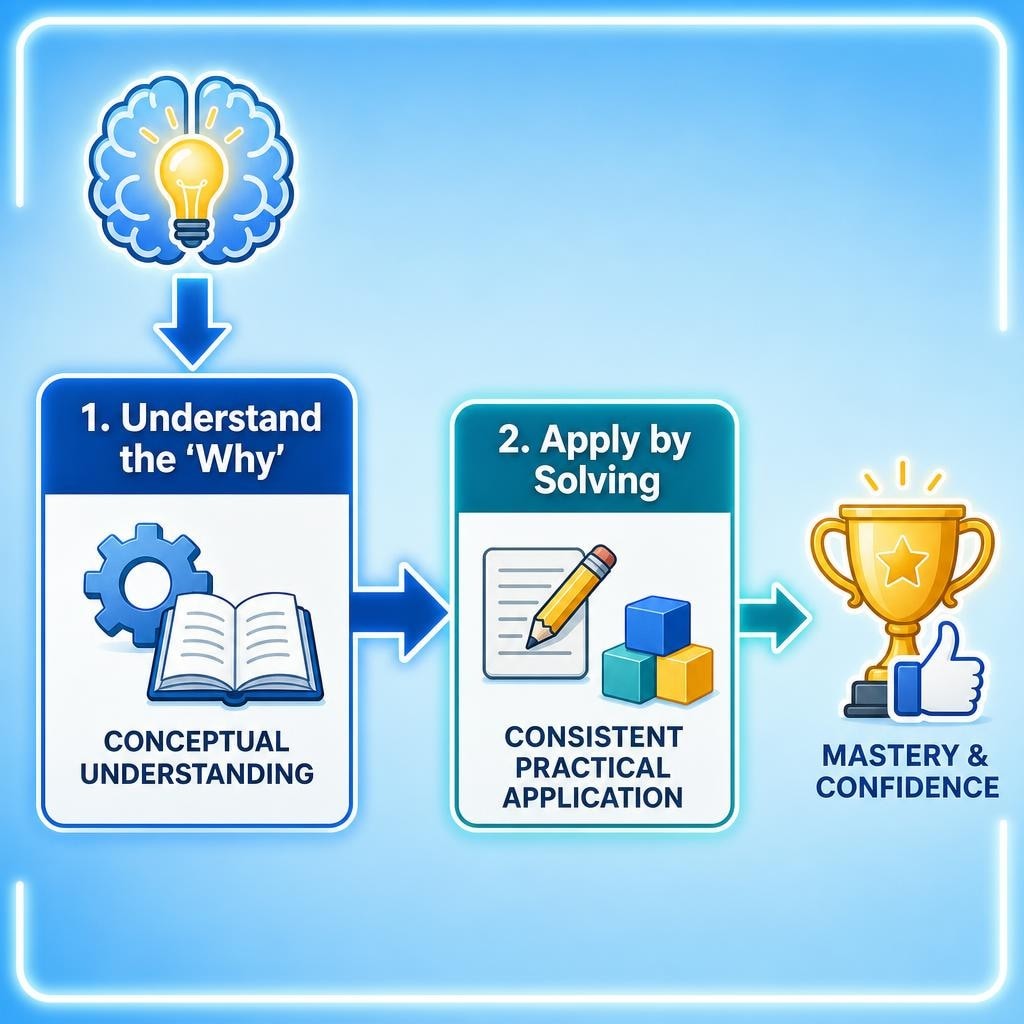
If you've ever wondered, "why is math hard for me specifically?", you are definitely not alone. The truth is that math is a technical skill that begins with a solid conceptual understanding, followed by consistent and intentional practice. Many students find it difficult because they skip the first step, understanding the why, and jump straight into solving problems.
So, here we’ll explore exactly why math is difficult for so many and show you what to do when math is hard using clear, effective strategies that actually work.
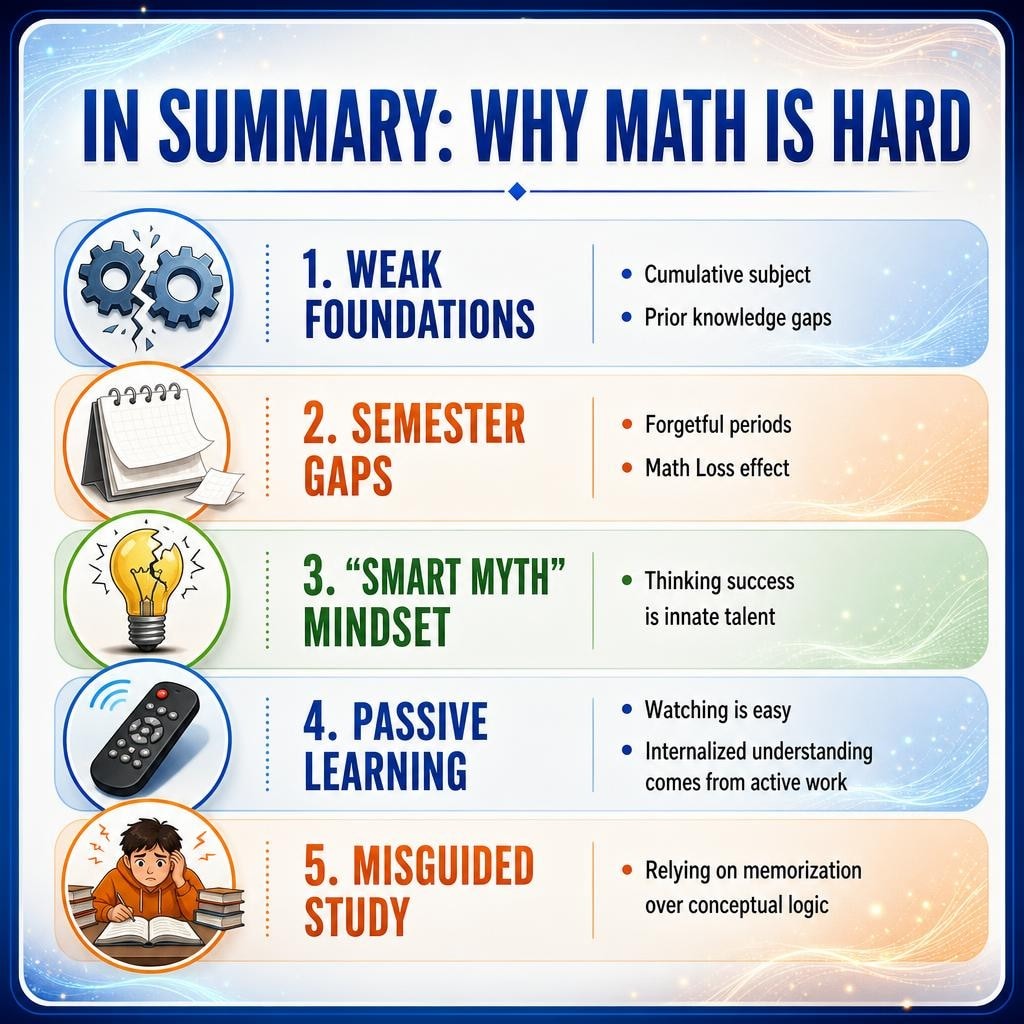
Reason 1: Weak Foundations Build Bigger Problems in the Future
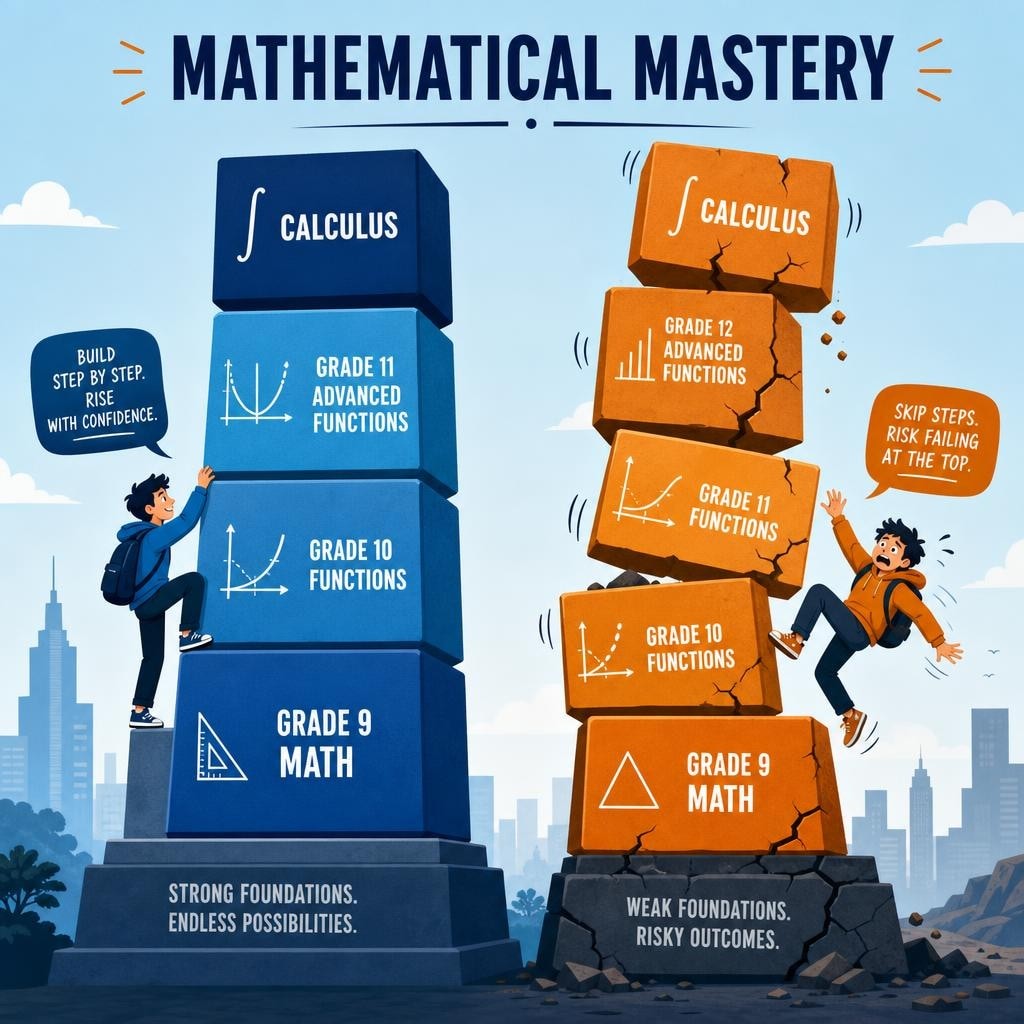
People often ask why math is hard to understand, and the number one culprit is weak foundations. Many high school and university students who struggle are carrying knowledge gaps from earlier courses. Math is a cumulative subject, where every new concept builds directly on what was learned before.
If you did not fully grasp topics like Mathematics in Grade 10 or Functions in Grade 11, subjects like advanced functions or calculus in Grade 12 and beyond will naturally feel much harder. These advanced topics are not stand-alone; they rely on a solid understanding of earlier material.
Without that foundation, each new lesson feels more confusing, frustration builds, and over time, many students start to lose confidence. This is a major reason why students eventually drop math-heavy programs or avoid math-based career paths, even if they were once interested.
Math is not just about memorizing formulas or steps. True learning happens when you slow down, examine each part of an equation, and understand what each number, variable, or symbol actually means.
You need to ask yourself: What does this part of the equation do? How will changing this value affect the outcome? This kind of conceptual thinking takes time, but like mastering any real skill, it requires patience, consistent effort, and the willingness to work through challenges step by step.
Reason 2: Gaps Between Math Courses Lead to Forgetting
In high school, math is taught in a single semester, meaning students may go months without practicing what was learned in class. This long gap leads to Math Loss, especially if the last course was already challenging. When students return to math after a long break, they feel lost.
This isn't a lack of ability, it's simply a lack of continuity and basic memory loss. Like any skill, math fades away without regular practice. Students can always counteract the Math Loss effect by consistently practicing math at home, especially the concepts learned in pervious courses and needed for any upcoming courses.
Imagine learning how to factor quadratic equations in Grade 10 during the fall semester. If you don’t actively review or practice those skills, you’ll likely forget most of what you learned by the time Grade 11 begins. Review sessions for important topics like factoring or trigonometry can be only 10 minutes up to 30 minutes if done frequently.
Reason 3: The Myth of the “Smart Math Student”
A lot of people think math is hard just because they weren't born with a natural "math brain." They assume that top-performing students or tutors have a secret shortcut.
This belief is not only false but also harmful to your progress. In reality, students who succeed in math are not relying on talent. They have simply put in more time doing what works: building a strong conceptual understanding and then following it up with consistent, focused practice.
They follow the right order, first understand the “why,” then apply it through problem-solving. What often happens is that students skip the first step entirely. They jump into solving questions without truly understanding what the equation or method means.
As a result, they get stuck, lose confidence, and start wondering, "is math hard for everyone, or just me?" Believing in the myth of the "smart math student" creates a fixed mindset.
Tim Notke, a famous high school coach, once said, “Hard work beats talent when talent doesn’t work hard.” In math, success is not about shortcuts or special ability. It is about showing up, doing the work in the right order, and staying consistent.
Understanding must come first. Practice must follow. Skipping either step leads to frustration. But when done properly, math becomes a skill anyone can improve, and even enjoy.
Reason 4: Watching Math is Easy, Doing it is Harder
Many students believe they understand math simply because it looks easy when someone else is doing it. They follow along as a teacher solves a problem on the board or as a tutor explains a solution, and it all seems to make sense in the moment.
But when they sit down to try a similar question on their own, they get stuck. The steps they just watched suddenly feel unfamiliar, and confusion sets in. This happens because watching someone else solve a problem is a passive activity, and passive learning does not build real mastery (Dancsi, 2025). Just because something looks clear doesn’t mean you’ve internalized it or know how to reproduce it.
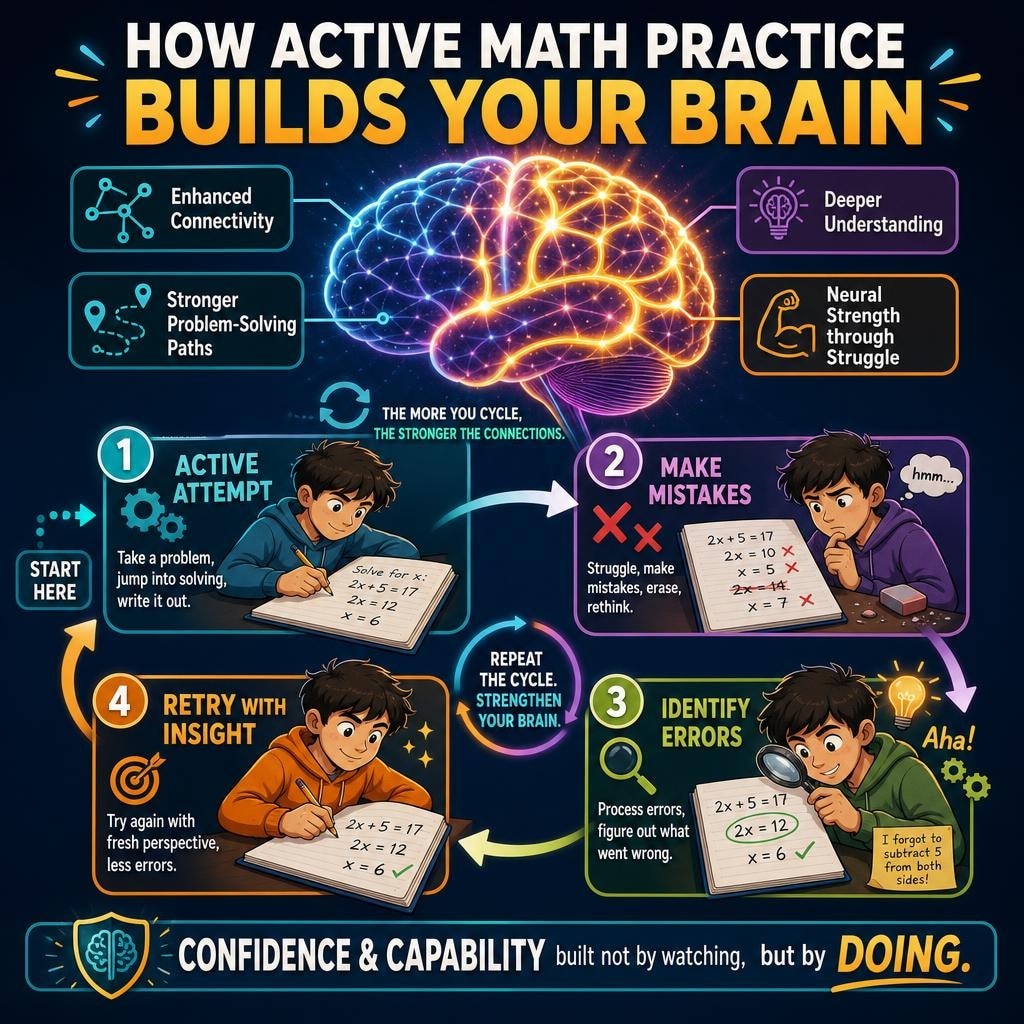
If you're only watching others do the work and not testing your own ability to redo similar questions, you're only engaging with the surface level of the material. To actually get better at math, you have to take an active role in your learning. That means solving problems by hand, checking your thinking, and pushing through confusion until it makes sense. In math, confidence is built not by watching, but by doing.
Reason 5: Math Feels Harder Because It’s Different
Math is not a subject you can cram for the night before a test. Unlike subjects that rely mainly on memorization, such as history or biology, math demands logical thinking, step-by-step problem-solving, and the ability to apply concepts in new situations.
You cannot simply memorize formulas and expect to succeed. You need to understand how and why those formulas work. But to really grasp it, you have to look at how math is used in everyday life. Whether it's calculating exactly what score you need on tomorrow's final to not fail the class, figuring out how to split a massive Uber Eats bill between four friends without getting ripped off, or realizing that the "Buy One Get One 50% Off" sale at the mall is actually a scam, understanding where math is used in everyday life bridges the gap between abstract numbers and reality. That's exactly why math is important and why math matters way beyond the classroom.
You cannot simply memorize formulas and expect to succeed. You need to understand how and why those formulas work. But to really grasp it, you have to look at how math is used in everyday life. Whether it's calculating conversion rates on a Shopify store, negotiating the numbers on a vendor contract, or just crunching the VIN data and depreciation to see if a 2016 model car is actually a good deal, understanding where math is used in everyday life bridges the gap between abstract numbers and reality. That's exactly why math is important and why math matters way beyond the classroom.
It is similar to learning to code, mastering a musical instrument, or training in a sport. Improvement comes not from passive exposure or rushed last-minute study sessions but from steady, repeated practice over time. Just like a muscle, your math skills grow stronger the more you actively challenge and use them.
Math rewards deliberate and focused practice. Each time you wrestle with a tough question, even if you struggle or fail at first, you are building the mental strength and enhancing the neural connectivity in your brain that will help you tackle future challenges with more ease. Over time, these consistent efforts turn frustration into understanding and confusion into confidence.
Four Practical Steps to Improve in Math
Step 1: Try the 30-Minute/day Rule
Set a timer for 30-minutes a day, five days a week, to understand and practice math. This habit builds skill and confidence more effectively than long, inconsistent study sessions.
Step 2: Ask Questions Immediately
If you’re confused by something in class, write it down and get help as soon as possible. Whether from a teacher, friend, tutor, or an online resource, don’t wait. Small problems grow quickly when left unaddressed.
Step 3: Watch a Preview Video Before Class
Look up the topic you’re about to learn in class on YouTube. Knowing about the concepts you will be studying in your classroom beforehand gives you context and improves in-class comprehension. It doesn’t need to be perfect, just familiar.
For example: let’s imagine you upcoming lesson will be about completing the square:
1- Go on YouTube
2- Type solving quadratic equations by completing the square in the search bar
3- Watch a couple of videos/shorts explaining it and solving questions
4- BONUS: write down some notes about what you think is happening in the video
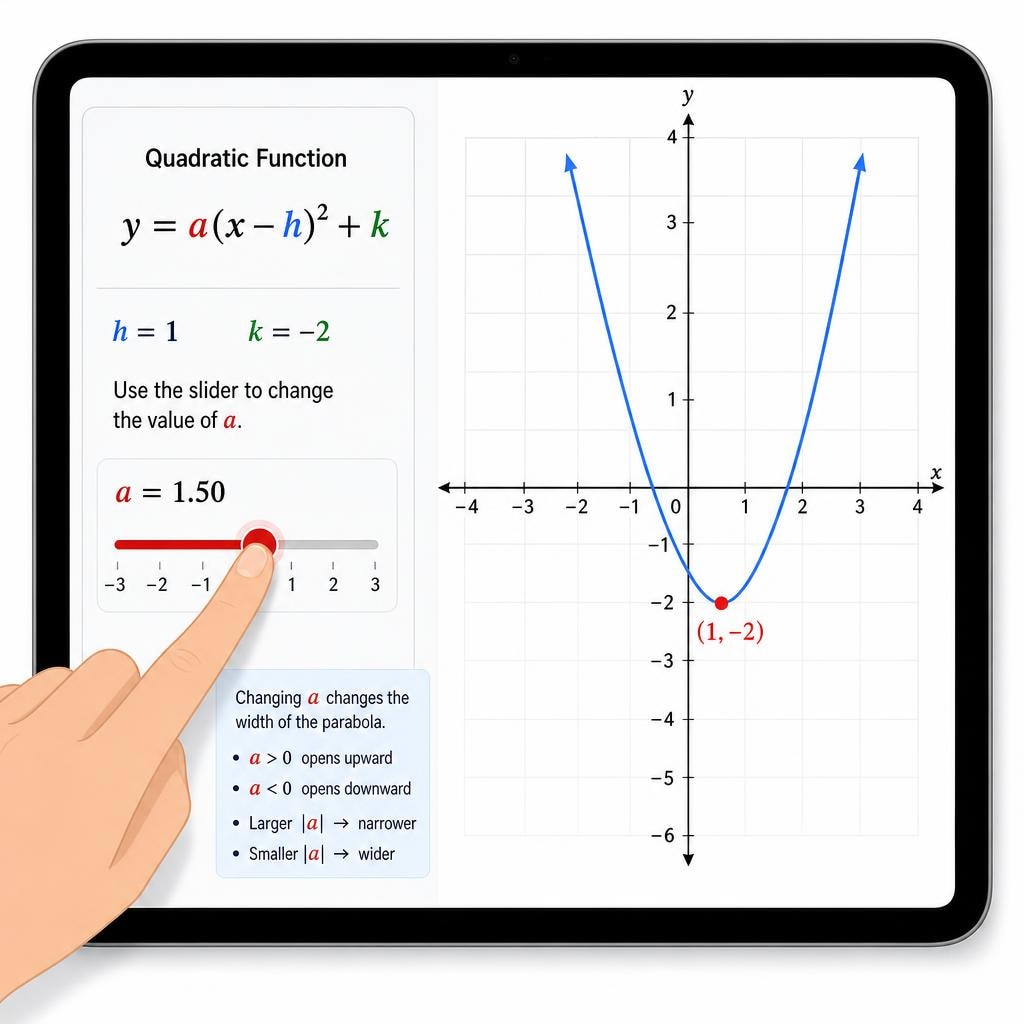
Step 4: Use Visual Tools Like Desmos
Students are constantly searching for which math app is best to save their grades. While there's no app that does the thinking for you, visual tools like Desmos are top-tier. For visual learners, abstract concepts can be hard to grasp. Use Desmos to graph your work andvisualize how equations behave. It's especially useful for functions, transformations, and trigonometry. Desmos allows you to learn what each number and variable in your equation do and what happens when you change it.
Conclusion & Recap of Why Math is Hard and Recap of Steps Mentioned to Improve
Hopefully, these insights will help you feel a little more confident and less overwhelmed as you tackle math this year. Remember, these strategies are meant to guide you, not to serve as a strict checklist. Everyone learns at their own pace. If you stick with it, you'll eventually experience that glorious moment when math is mathing, and everything just clicks.
Now that you have a clearer understanding of why math can feel challenging and what practical steps you can take to strengthen your skills, what’s next? Well, it’s a great time to explore some extra resources and start applying what you learned.
True understanding comes from doing the work yourself. It involves taking a problem, trying to solve it, making mistakes, identifying where you went wrong, and trying again. That struggle, the effort you put into processing and correcting errors, is what actually strengthens your understanding and builds the problem-solving pathways in your brain.